Frontier hostilities after the Owl’s Head massacre of 1755 became much more limited to personal attacks rather than actual warfare. Wabanaki numbers had declined to the point that their raids “were small and infrequent enough to prompt the desire for revenge but not sufficient to raise fears of counter-revenge” (Ghere, 2001).
In the third quarter of the 1700s, most of the violence in the frontier consisted of English attacks on largely peaceful Wabanaki.
Over time, frontier raids by the Wabanaki became very sporadic and mostly ineffective.The only major confrontation occurred in August 1758, when approximately 50 Canadian militia members and more than 250 Maliseet and Canadian mission Penobscot warriors attacked Fort St. George. After several days of an ineffective siege, the warriors dispersed into small bands and harassed settlers in the surrounding region. These would be the last major Wabanaki engagements on the Maine frontier.
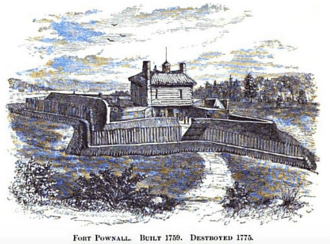
In May 1759, Governor Thomas Pownall led a 400-strong militia force up the St. George River to quell any remaining resistance and claim the land east of Fort Charles. They visited the now-abandoned Penobscot village of Penawabskik, returned to the mouth of the Penobscot, and constructed Fort Pownall, at today’s Stockton. They then returned to Boston, proclaiming a glorious victory, even though they had not encountered a single hostile Wabanaki.
Later that year, the English defeated the French at Quebec, marking the end of the long, bitter struggle for control of North America. Finally free from war, many Wabanaki family bands returned to their traditional tribal grounds on the Penobscot and Kennebec Rivers. Penawabskik and Narantsouak were reoccupied, but with far fewer people than before the last war.
The peace brought a torrent of English settlers to the region, which the Wabanaki were now powerless to stem. To give the Wabanaki some breathing room, the new Massachusetts Governor Bernard sent surveyor Joseph Chadwick to mark a boundary line for English settlement, which fell at the falls above the Kenduskeag (Bangor). However, the English continued to flood into the area, forcing the Wabanaki deeper into the woodland fringes andmaking their traditional ways of life impossible.
A last gasp
In 1760, several Penobscot groups in the vicinity of Fort Pownall approached the commander, General Preble, to sue for peace. “They said they wished to dwell with their families, at some place near the garrison, receive its protection, and enjoy the neighborhood and friendship of the English living with them, as many tribes had lived with the French in Canada” (Willimson, 1889).
Four of their sagamores, Kehovvret, Joseph Marie, Sockaiteon, and Sockebasin, went to Boston, and, on the 29th of April, signed articles of treaty with the Governor in the Council chamber. The terms were the same as all the treaties signed in the last half-century. They acknowledged that they were good subjects of King George, would forfeit their lands, relinquish all allegiance to the French government, and deliver up future offenders for trial. At this point, their Nation was no longer able to wage war, as the once mighty Penobscot were reduced to five Sagamores, seventy-three warriors, and 500 total souls. All they requested was the privilege of hunting and fishing on such tracts as the English might allow them. So few in number were the rest of the Wabanaki people, that no other tribes or bands took part in the signing of this general truce.
The end of a long, devastating struggle
After the French and Indian War in 1763, the English conquest of New England was complete. The English had finally vanquished the Wabanaki, a little over 150 years after the first Europeans had touched Maine’s shore. The Wabanaki had fought hard for the last century to defend their homeland with French help. However, disease, starvation, and battle deaths had whittled them down to the point that they could no longer effectively fight. At the conclusion of the French and Indian War, after more than a century and a half of struggle, a diverse, proud Wabanaki nation of successful hunters, gatherers, and agriculturalists had been steadily pushed from the lifeblood of the coastal bays, estuaries, and river basins to the forests of the north.
At the beginning of the Euro-Algonquian encounters, the Wabanaki had welcomed the English and aided them in their explorations. As Europeans’ lust for fur became apparent, the Wabanaki had abandoned their traditional, self-sufficient hunting and gathering way of life for one dependent on European guns and trade goods for their sustenance. When the ever-growing encroachment of English settlements threatened their very existence, they chose to resist. In response, the English tried to take their guns and ammunition away and began to hunt them for their scalps.
The Wabanaki valiantly slowed the European rate of conquest, defending their homeland. Long after the English of Massachusetts had defeated Metacomet and his allies, the Wabanaki held fast in Maine. Englishmen were forced to flee all but the far western corner of Maine in at least three instances: at the end of Metacomet’s War in 1678, King William’s War in 1697, and Queen Anne’s War in 1713. However, after all these wars, the resilient Englishmen kept coming back, slowly but surely exhausting the Wabanaki’s ability to fight.
Illustration: Fort Pownall
Literature cited:
Ghere, D. L. & Morrison, A. H. (2001) Searching for Justice on the Maine Frontier: Legal Concepts, Treaties, and the 1749 Wiscasset Incident. American Indian Quarterly, 25 (3): 378-399.
Williamson, W. D. (1889) The history of the state of Maine: From its first discovery in A.D. 1602 to the separation, A.D. 1820, exclusive. Vol. 2. Glazers, Masters, and Smith, p. 345

