While Massachusetts’s economy grew dramatically during the 18th century, that of its Maine Province remained stagnant due to the French and Indian Wars. However, after each confrontation, many refugees would stagger back, accompanied by a new cadre of settlers. Maine’s great forests and fisheries would keep drawing them back. There was great profit to be made in the virgin forests of Maine, filled with huge mast trees no longer available in Europe, and the cod fisheries, which were still teeming with fish.
Maine, as part of Massachusetts, would now become a full partner in the economic boom in New England before the Revolution. The traditional industries of lumbering, fishing, and shipbuilding entered a new vigorous period. Water-powered factories, which generated textiles and paper, were built alongside the sawmills already operating along Maine’s mighty rivers. The merchants of Maine would soon become part of the infamous “Triangular Trade,” where rum went to Africa to buy slaves, which were then sold in the Caribbean and Southern colonies. The Caribbean would become Maine’s primary trading partner.
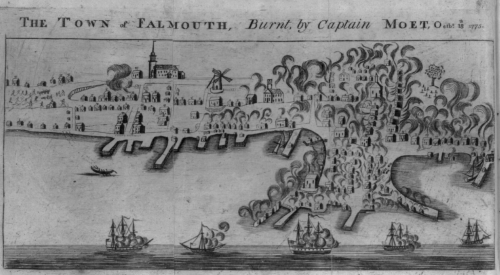
When New England became embroiled in the Revolutionary War, Maine was an active participant. In 1765, a mob seized a large quantity of tax stamps in Falmouth, and in 1773, Maine had its own tea party when a group of men burned a shipment of tea in York. Sixty men from York also fought in the battle of Concord and Lexington. Falmouth was burned to the ground by Capt. Henry Mowatt in 1775 to punish it for its opposition to the Crown. The first naval battle of the Revolution was fought in Maine in the same year, when townspeople captured the British cutter “Margaretta” off Machias. Many Mainers served with Col. Benedict Arnold on his long, ill-fated march through the north woods to capture Quebec. In the largest American naval expedition of the war, a flotilla of 19 warships and 25 support vessels failed to retake the British-held fortification at Castine in 1779.
Many Passamaquoddy, Penobscot, and Maliseet were drawn into the Revolutionary War. With the support of the Wabanaki Confederacy, they “assisted the Patriots through a variety of means, including Continental enlistment, serving as guides, providing supplies for war-weary soldiers and in some cases, leading Battalions.”
Maine would suffer greatly during the Revolution, as it had during the French and Indian Wars. Perhaps as many as 1,000 Mainers lost their lives during the war, its sea trade was crippled, and Falmouth was destroyed. However, Maine’s economy again boomed after the war, and the people of European descent clamored for statehood. The Wabanaki, however, were not consulted. At the end of the Revolution, they were left with an international border that cut through the center of their traditional homeland.
Statehood
After the Revolution, the non-Indigenous people of Maine began a 35-year campaign for statehood. Although Maine began as a separate colony of Sir Ferdinando Gorges in the 1620s, it became part of Massachusetts in the 1640s, in part due to the deceit of George Cleeve. It was administered as a district of Massachusetts starting in 1647.
Before the Revolution, Maine had an English population of only about 10,000 people, who lived primarily around the southern coastal ports, and their livelihoods were mainly tied to the shipping and trade interests of Massachusetts. These demographics began to change dramatically in the early 1800s, when Massachusetts decided to pay off its war debts by selling off public land in Maine. Thousands of farm families took this opportunity to leave crowded Massachusetts, and the English population of Maine grew by leaps and bounds from about 90,000 in 1791 to nearly 300,000 in 1820. The Wabanaki population continued to decline as its family bands struggled to subsist in a world increasingly populated by non-natives. The ancient Wabanaki Confederacy would steadily wane in importance.
As Maine’s non-native population grew, many of its inhabitants became desirous of self-rule, particularly the inland farmers who had little contact with Massachusetts merchants. A common complaint was how far Mainers had to travel to reach the General Court in Boston. Maine towns were also under-represented in the Massachusetts legislature, allowing laws to be passed that enriched Massachusetts at Maine’s expense. During the War of 1812, the Massachusetts General Court ignored Maine’s fate and took no action to protect it.
The first campaign for statehood began in 1815. Several referendums were passed in Maine supporting statehood over the next four years, but it was not until late 1819 that the Massachusetts General Court was finally persuaded and passed a statehood bill for Maine. The only stipulation was that statehood required approval from Congress and the president. This opportunity arose during the debate on the Missouri Compromise, when Maine was admitted to the Union as a free state to balance the addition of Missouri as a slave state. Throughout this process of statehood, the Wabanaki, who had called Dawnland home for many thousands of years, were left out of the discussion.
Illustration: A 1782 engraving depicting the burning of Falmouth. John Norman. Library of Congress. Photographs and Prints Collection.
Bibliography
Leamon, J. S. (1995). Revolution Downeast: The War for American Independence in Maine. University of Massachusetts Press.
Massmoments (2005) March 15, 1820. Massachusetts loses Maine. Mass Humanities. https://www.massmoments.org/moment-details/massachusetts-loses-maine.html
Post, K. (2022) Native Allies “cannot be too highly appreciated:” Wabanaki Confederacy Contributions during the American Revolutionary War. Washington College Review. Vol. XXXII. https://washcollreview.com/wp-content/uploads/2022/12/sce-kitri-post.pdf

