In 1754, the Seven Years’ War in Europe spilled over into the North American colonies of the British and French Empires, with support from various Indigenous tribes. The war, known as the French and Indian War in the colonies, was primarily fought in the Ohio Valley, but there were also some notable outbursts in Frontier Maine.
The war began in Maine when the Kennebec Proprietors, in cahoots with Massachusetts Governor Shirley, used concerns about French activity in Maine to further their commercial interests. Acting on unfounded reports of French forts being built along the Kennebec and Penobscot Rivers. Shirley convinced the General Council of Massachusetts to establish a fort above the Wabanaki Village of Norridgewock near the head of the Kennebec River. Expansionist Shirley wanted to roll back the frontier, not content with the current area settled by the English in the Kennebec Valley.
On July 4, 1754, Major General John Winslow was sent from Falmouth with 800 soldiers to Kennebec to expel the French from the Proprietors’ land and construct a fort. After a brief stay at Fort Richmond, they headed 37 miles upriver to Taconic Falls, where they found no evidence of the French, but they built Fort Halifax anyway.
The placement of this fort posed a direct threat to the Wabanaki of the region, who could no longer move freely into Canada or to their ancient winter hunting grounds. The Kennebec found themselves “in an untenable situation, which resulted in the gradual disintegration of the Tribe. The more antagonistic family bands migrated separately to the Canadian missions, while those seeking to remain neutral joined the Penobscots. The remaining Norridgewock community dwindled to nothing” (Ghere, 2015, p. 138).
The Penobscot would break into three factions: One group moved to the Canadian Missions and fought with the French around Lake Champlain and on the Maine frontier. Another moved out of harm’s way to the St. John’s Valley, and a third moved farther up the Penobscot River in search of peace.
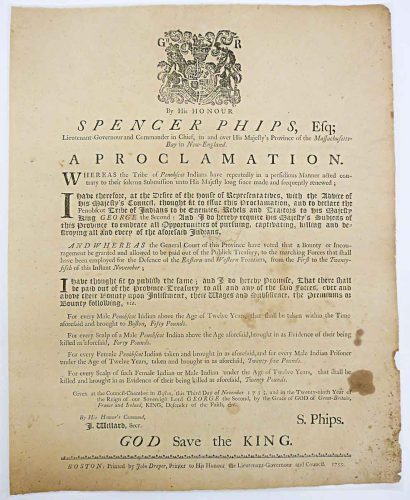
On October 30, 1754, a group of Canadian Penobscot attacked Fort Halifax unsuccessfully, but returned the next spring and continued raids in the St. George’s area. In response, Phips proclaimed a round of bounties in 1755, which was supposed to be directed to the remaining combatant bands of the Penobscot. He promised to pay £ 50 for any Penobscot male captured above the age of 12 and brought to Boston, £ 40 for any scalp of males above the age of 12, £ 25 for any female or male child captured, and £ 20 for the scalps of females and male children. Massachusetts authorities were again using abduction and scalp bounties as tools of war.
Owl’s Head Massacre
In July 1755, James Cargill led a group of volunteers from New Castle to St. George, hunting for Wabanaki to scalp for Phips’s bounty. Near present-day South Tomlinson, they came upon a family band of Penobscot and killed and scalped Margaret Moxa, along with her child and husband. The family had been traveling home from the truck house fort at St. George’s. Moxa, a conciliatory Penobscot, had just alerted the post commander, Capt. Jabez Bradbury, about an impending raid against the English.
Later that day, Cargill’s group attacked a Penobscot encampment on the shores of Owl’s Head (near Rockland) whose occupants were returning from a peace conference at St. George’s Fort. The volunteers mercilessly killed and scalped nine of them, bringing “the total to twelve risk-free scalps in a single day’s patrol” (Ghere and Morrison, 1996, p.110).
Cargill and his posse then went to St. George’s Fort to seek supplies. Here, they received a very cold reception, as Margaret Moxa had been an invaluable source of military information and a cultural mediator. She had readily shared her extensive knowledge of the natural environment and had taught the women of the fort how to live more comfortably in the Maine woods. She personified the “very best of frontier interaction just as surely as James Cargill did its very worst” (Ghere and Morrison, 1996, p. 111).
The commander of the fort, Captain Bradbury, refused to resupply Cargill, forcing the posse to return home. Bradbury also notified Boston that the scalps were taken from innocent Penobscot and then prepared for the inevitable hostility that was sure to come his way from the rest of the Penobscot.
Despite having ordered the scalp bounty, Governor Phips profusely apologized to the Penobscot Nation, sent gifts, and promised justice, offering to cover the expenses of any Penobscot who wished to testify in court. Cargill was arrested and jailed. He was eventually released without being charged, although his Owl Neck scalp bounties were never paid. The governor and Legislature ruled that the scalps did not come from combatants. Despite his atrocious misdeeds, Cargill was made a militia captain and, by August 1756, was leading a bounty posse again. He would scalp several more Wabanaki on that mission and eventually would be promoted to a militia colonel.
Illustration: The scalp bounty of Governor Phips
Bibliography:
Baxter, J. P. (ed) (1916). Documentary History of the State of Maine. Vol. XXIII containing the Baxter Manuscripts. Maine Historical Society. Fred L. Tower Company, Portland.
Ghere, D. L. (2015) Diplomacy & War on the Maine frontier, 1678-1759. In: Judd, R.W., Churchill, E. A., and Eastman, J. W. (eds.). Maine: The Pinetree State from Prehistory to the present. University of Maine Press, Bangor. pp. 120-142, 138.
Ghere, D. L. & Morrison, A. H. (2001) Searching for Justice on the Maine Frontier: Legal Concepts, Treaties, and the 1749 Wiscasset Incident. American Indian Quarterly, 25 (3): 378-399.

