When Father Rale’s War broke out in 1721, the Lincolnshire Proprietors were just about to begin settling two colonies along the St. George River. Under Col. Westbrook’s supervision, a fort and mill had been built, and frames for houses constructed. The ensuing war stopped all settlement activity for five years.
When the hostilities dissipated to the point where settlement was a possibility again, another roadblock was thrown in front of the Lincolnshire Proprietors; the Surveyor-General of the King’s Woods, David Dunbar, decided to dispute the Muscongus Grant. He hoped to get the gorgeous white pines that ringed Muscongus Bay for the British Royal Navy.
To fight Dunbar’s claim, the Thirty Proprietors sent one of their members, Samuel Waldo, to England. He successfully overturned Dunbar’s claim, and the thirty awarded him a 50% share of the claim for his services. Over time, he would continue to build on his share until he had almost total control of what became known as the Waldo Patent.
Waldo’s settlement
Samuel Waldo had a grand goal in mind. He would build settlements on his vast holdings between the Kennebec and Penobscot Rivers, presumably deeded under the old Muscongus Patent and the controversial 1694 land grant from Madockawando. Waldo would need to find colonists willing to settle in a frontier region still in dispute with the French and subject to attack by the Penobscot, who believed firmly that the land was theirs.
Waldo had no intention of honoring Wabanaki sovereignty, believing the Mid-Coast region was an excellent location for development. White pine was abundant, and there was ample water for travel and power. A few hardy Scotch-Irish and Germans had settled in the region by 1739. However, he needed a much larger, more organized colony to generate real profit. Waldo’s plan of expansion highlights the almost unlimited power that land speculators from Massachusetts would exert over the next few decades.
Samuel Waldo’s actions would upset Belcher’s efforts at Indian diplomacy. Dummer’s treaty of 1727 guaranteed Massachusetts the right to reoccupy all towns and forts held before the war began in 1722, but forbade any new incursions onto Wabanaki’s lands. Waldo had not been a participant in negotiating Dummer’s Treaty and would justify his settlement based on Madokawando’s1694 sale of land. This deed’s validity would be hotly disputed by the Penobscots, particularly by Sagouarrab, their most powerful spokesman.
Waldo’s scheme
In 1734, Waldo focused his efforts on settling two towns of forty families each on the west side of the St. Georges River. To find willing colonists, he advertised widely in Massachusetts and brought over a group of Ulster Protestants. He promised each family one hundred acres, which were rented to them for a small fee. He also promised the colonists that the Penobscot had consented to the settlement, a concession he had not obtained.
Along Muscongus Bay, a mighty debate raged between the confrontational and non-confrontational Penobscot over whether to accept Waldo’s new incursions. In a meeting with Waldo, the Penobscots led by Sagouarrab strongly repudiated the Madockawando deed, insisting that he had no right to sell the land to anyone. Waldo brushed the protest aside, and, “presenting a copy of his deed (or a copy thereof) to the Indians, he announced that he would go forward with his plans” (Saxine, 2014, p. 392). To keep the peace, in what must have been a heated exchange, the Penobscot agreed to permit continued occupation, provided it remained limited to the west side of the St. Georges River.
Over the winter, the Penobscot continued to agitate over this decision. Even the non-confrontational leaders, like Espequent, who had received commissions from Belcher, were troubled by the settlers’ close proximity. Eventually, those opposing Waldo’s settlement won the argument, and in April 1736, they sent a letter to Governor Belcher through John Gyles, commander of Fort St. George, in which they renounced the Madockawando deed and asked the governor to prevent the settlement.
In response to the letter, Belcher and his Council invited the Penobscot to send a delegation to Boston. At the meeting, Belcher and the entire Council listened as Espequent and others made their case and expressed their hope to avoid bloodshed. Belcher then appointed a seven-member joint committee of his Council and the House of Representatives to consider the evidence and make a recommendation.
On 2 July 1736, the committee gave its report, a full endorsement of the Penobscots’ rights. The committee recognized that the Penobscots had never accredited the Madockawando purchase and even questioned whether the 1629 Plymouth Grant met the standards of the 1727 treaty. The committee advised Belcher “to assure the Penobscott Tribe that this Government will not Encourage, nor Countenance Mr. Waldo or any others in Settling or Improving any Lands on George’s River above the Falls or flowing of the Water, until the Government shall be satisfy’d that those Lands have been fairly purchased of such Indians, as were the rightful owners thereof. (Saxine, 2014, p. 396).
Waldo was allowed to make a verbal rebuttal, but the whole house voted to support the committee’s findings. With the Massachusetts government’s backing, the Penobscot delegation returned to St. Georges and lost no time in ordering the colonists to leave, threatening to burn down any home or structure that remained by the time the month was up. Remarkably, without bloodshed, the colonists were evicted. “Although hardliners tried to make life as unpleasant as they could for Waldo’s colonists, they did not harm anyone, and they left Gyles and his garrison alone.” (Saxine, 2014, p. 400).
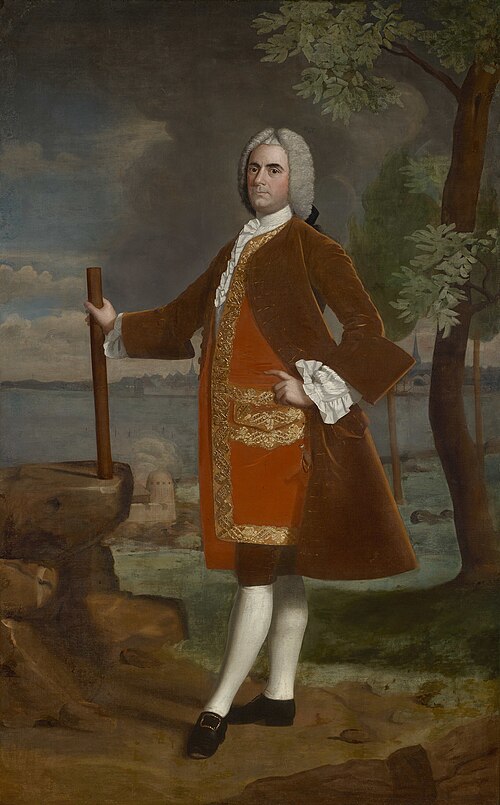
Illustration: Portrait of Brigadier General Samuel Waldo. Robert Feke. Collection of the Bowdoin College Museum of Art, Brunswick, Maine
Bibliography:
Bertesman, D. (2025) The Germans of Waldoboro. Meander Maine https://meandermaine.com/tale/the-germans-of-waldoboro/
Miller, S. L. (1910) History of the Town of Waldoboro, Maine. Emerson Printer, Wiscasset.
Saxine, I. (2019). Properties of Empire: Indians, colonists, and land speculators on the New England frontier. New York University Press. pp. 59-60.

