Rebuffed but undaunted, Waldo sailed for England in 1738 to try to get Governor Belcher removed from office, so he could move ahead with his land claim. He lobbied for over a year, spending a large sum of money in support of William Shirley, Waldo’s personal lawyer and a Muscongus Proprietor. In 1741, he proved successful, and the Duke of Newcastle, who controlled the appointment of royal governors, replaced Belcher with Shirley. The peaceful reign of Belcher and his evenhanded, friendly treatment of the Wabanaki would come to an end.
The new governor completely reversed the tenor of frontier relations established by Belcher. Like other speculators, he was much more concerned with achieving wealth and power than placating the Wabanaki. He did not share his predecessors’ respect for the Wabanaki’s land rights. Almost immediately after his appointment, Shirley gave Waldo the green light to resume shipping colonists to his settlement.
Wasting no time, in 1742-3 Waldo visited the Black Forest in Germany and began recruiting impoverished locals who were being persecuted for their Lutheran beliefs to settle in Broad Bay. He promised 100 acres to each immigrant and an additional 100 acres to each of their heirs. He also set aside 200 acres for a church, 200 acres for the church’s first pastor, and 200 acres for a school. In addition, settlers were promised 4 to 6 months of “support,” representation in court in Massachusetts, and religious freedom, and they would not have to bear arms if England went to war.
Each family could choose its plot of land at a seaport or a river. They were guaranteed that any firewood or timber they cut would be taken by ships for “ready money” and that any supplies they needed would be brought by ship from Boston. In exchange, each person was required to pay at least half of their passage upfront and live on the land for at least seven years. After this period, the 100 acres would be theirs free of charge. This offer was open to the first 120 families.
Waldo hired a Swiss man, Sebastian Zouberbuhler, as his agent to spread his propaganda, recruit German settlers, and then get them to Maine. Zouberbuhler had previously helped establish a Swiss community in North Carolina. Zouberbuhler would later fight alongside Waldo at Louisbourg and ultimately remain in Nova Scotia, helping to settle the town of Lunenburg.
To ensure the Germans had a good impression upon their arrival, Waldo personally met them in Marblehead with an assembly of dignitaries, including Massachusetts Governor Shirley, several Assemblymen, and a German interpreter. From Marblehead, they travelled North with Waldo and stopped at St. George’s to drop off some Scottish passengers. They then sailed up the mouth of the Medomak River on a November day, where they got the first glimpse of their new home in Broad Bay.
There is no record of how the settlers reacted when they saw their new home, or how Waldo managed to get them to disembark from the ship and scurry away himself, but they were essentially dropped off in a wilderness. The first group of fifty arrived in mid-November, just before the weather turned bitterly cold. Waldo had promised them clothing, food, houses, farmland, and a church. Instead, they were faced with an uncleared wilderness and only limited provisions. They had only a few weeks, at best, to take down trees and build at least basic housing to survive the winter. They had to adapt very quickly or face extinction. Waldo had left the settlers to fend entirely for themselves.
There is no record of how many settlers died that first winter, but the death toll must have been substantial. Those who survived struggled mightily the following spring to feed themselves. They planted cabbage, flax, and rye, but due to their inexperience as farmers, they failed to build fences around their fields, so livestock wandered into the fields and ate much of their crops. They also had little experience with fishing, having come from so far inland in Germany, and hunting in the wilderness was risky because straying too far from the settlement could mean attack by the Wabanaki. They spoke no English, so communication and trade with their few non-German neighbors were very difficult. The only source of income they found in that first year was cutting firewood and selling it to ships bound for Boston.
In June 1743, the ragged and starving settlers submitted a formal petition to the Massachusetts General Court, claiming that Samuel Waldo had failed to fulfill the terms of their agreement. They pleaded for help from the same dignitaries who had greeted them the previous fall, but their request was flatly denied.
Despite the hardships faced by the first group of Waldo’s settlers, his offer of land remained well received in Europe, and from 1748 to 1753, he brought over another 1,500 Germans.
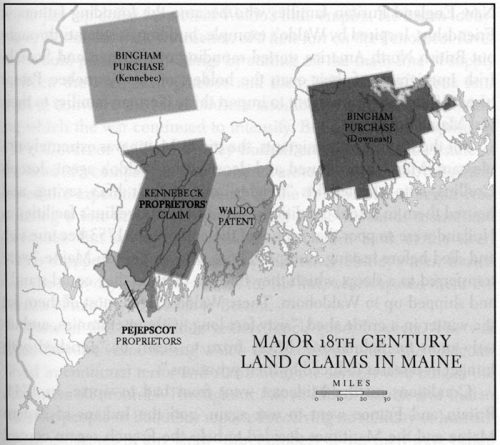
Illustration: Major 18th-century land claims in Maine. From the book The Lobster Coast: Rebels, Rusticators, and the Struggle for a Forgotten Frontier by Colin Woodard.
Bibliography:
Bertesman, D. (2025) The Germans of Waldoboro. Meander Maine https://meandermaine.com/tale/the-germans-of-waldoboro/
Ghere, D. L. (1994) European diplomacy with the Eastern Abenaki, 1725-1750, Proceedings of the Meeting of the French Colonial Historical Society 19: 87 – 100,
Saxine, I. (2014) Performance of Peace: Indians, Speculators, and the Politics of Property on the Maine Frontier, 1735-1737. The New England Quarterly, 87(3): 379-411.
 Turmoil in Dawnland