When Colonel Thomas Westbrook was not chasing Indians in the 1720s during Rale’s War, he was building a successful business around Portsmouth, serving as a King’s Agent specializing in eastern white pine masts. In 1729, as the number of desirable white pines in New Hampshire began to run low, 52-year-old Westbrook decided to move his operation from Portsmouth to Falmouth, on the edge of the Maine frontier. Wesbrook’s move mirrored a geographic shift in the whole mast industry.
According to Vietze (2008, p. 61):” Portsmouth had been the busiest and most important port for the lucrative mast trade in the colonies, with a steady stream of white pine spars flushing down the wide Piscataqua River. Once the pines near Portsmouth had been felled, cutters moved up the streams and rivers that fed the mighty waterway, and soon the forests were thinned on the Cocheco, Bellamy, Oyster, Lamprey, and Salmon Falls, too. The navy’s contractors found themselves traveling further and further afield to find a grove of pines, and the Falmouth area was seen as an ideal alternative. Many rivers sluiced their way to the deepwater port at Casco Bay, perfect for carrying masts. And the surrounding woods were full of tall, stately Pinus strobus.”
Westbrook would be one of the first permanent citizens in Falmouth in 1629. He dropped his first trees at a lumber camp established a few miles north of Stroudwater on the Fore River. For his home, he selected a 69-acre lot on a hill at the conjunction of the Stroudwater and Fore Rivers. He surrounded his habitation, Harrow House, with a fifteen-foot-high stockade and trained gun emplacements. It would serve as shelter for the rest of the growing community during periodic Wabanaki raids.
Soon after arriving in Falmouth, Westbrook partnered with another Boston land investor, Samuel Waldo in his growing enterprises. The two of them came to control all of the falls of the Presumpscot River from Gorham to Falmouth, and they built several sawmills and the first paper mill in Maine. The ventures would make both of them wealthy men, but Westbrook would go bankrupt in the early 1740s, when his old partner, Waldo, turned on him, and sued him twice using shady legal tactics. He would die penniless, secretly buried on his sister’s property, so that his dead body would not be held “for ransom” until the debts were paid.
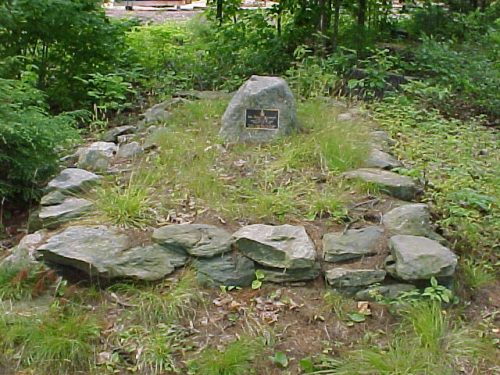
The grave remained hidden for over 200 years until 1976, when descendants Roger Knight and Frances Marsh, with assistance from the Westbrook Historical Society, obtained an exhumation permit. During the excavation, they uncovered the side of a coffin, a thigh bone, and the skeleton of a man approximately 5 feet 6 inches tall.
Wabanaki outrage
The logging and damming activities of Westbrook and Walton were of great consternation to the Wabanaki of the Presumpscot River. These activities blocked the free movement of fish down the river, which had long been an important form of sustenance for them. The Penobscot repeatedly complained to the authorities in Massachusetts, in both letters and at annual conferences, about the logging activities of Westbrook and Waldo. One leader of the Penobscot, Chief Polin, would become the lightning rod of dissent. As told by Lisa Brooks: “ Wabanaki leader Polin traveled from Maine to Boston [by foot] in 1739 to protest the damming of the Presumpscot River, on which his people depended for sustenance. Meeting Governor Jonathan Belcher, Polin said he desired “only that a place may be left open in the dams so that the fish may come up in the proper seasons of the year.” In return, he offered to continue sharing space with settlers, subject to certain restrictions.
Polin’s protest centered on the dam being built by Westbrook at Ammoncongin Falls along the Presumpscot River. Polin observed that the dams blocked the vital fish runs on the river, which he called the “river to which I belong.” Governor Belcher proved sympathetic and ordered that Westbrook “leave open a sufficient passage for the fish…in the proper season.” However, Westbrook ignored the order.
In response, Chief Polin and his tribe began a guerrilla war. They resorted to attacking the dams and settlements in protest. There were many angry confrontations, where fences and crops were destroyed, and cattle were slaughtered. The assaults continued sporadically for well over a decade until a group of settlers killed Chief Polin in 1756.
Illustration: Gravesite of Thomas Westbrook. https://www.findagrave.com/memorial/119501960/thomas-westbrook
Bibiography
Brooks, L. T. and Brooks, C. M. (2010) The Reciprocity Principle and Traditional Ecological Knowledge: Understanding the Significance of Indigenous Protest on the Presumpscot River. International Journal of Critical Indigenous Studies. 3(2):11-28. p. 13.
Vasquez, A. M. P. (2010) Remembering Westbrook: The people of the paper city. Arcadia Publishing
Vietze, A. (2017). White Pine: American history and the tree that made a nation. Rowman & Littlefield.

