In response to Rale’s guerrilla activities, Massachusetts declared war on the Eastern tribes, stopped all trade, and demanded the surrender of all Jesuit priests. The General Court voted to maintain a standing army of about a thousand men, of which 100 were stationed at York, 30 at Falmouth, 20 at North Yarmouth, 10 at Maquoit, 25 at Arrowsick, and 25 at Richmond. The rest of the soldiers would be assigned to units tasked with seeking and destroying Wabanaki strongholds throughout the eastern country. A bounty of £15 was offered for every scalp taken from a male Indian 12 years old and upwards, and £8 for every captive woman or child. The soldiers were allowed to freely plunder and share the rewards.
During the French and Indian Wars, it became a common English strategy to seek out the most powerful Wabanaki villages, with the most prominent sagamores, and brutally slay as many occupants as possible, men, women, and children. Clearly, from the English point of view, these were wars of extermination.
The Penobscot stronghold destroyed
In February 1723, Colonel Westbrook, with 230 or 240 men, was sent in whaleboats by the Massachusetts authorities to attack and murder any Wabanaki they could find between the Saco and St. George Rivers. It proved to be a futile endeavor, as they found only deserted campsites and villages to harass. It was winter, and the Wabanaki had moved to their winter hunting grounds.
On 4 March, Westbrook and his marines did come across the abandoned village of Panawahpskek at Old Town on the Penobscot River near Bangor. The Penobscot had built a massive, fortified village on Indian Island there. Covering 195 square feet, it was surrounded by a 12-foot-high palisade and protected by two swivel guns. Within the walls was a large church, 60 feet long, 30 feet wide, and 12 feet high, with a bell. Westbrook and his forces torched this magnificent fortress and church.
Death of Rale
In late 1724, another expedition was commissioned to travel to Narantsouak to either kill or capture Rale, with the aim of ending the war. Captains Jeremiah Moulton and Johnson Harmon, with 200 rangers, were given this task. They traveled by boat up the Kennebec River from Fort Richmond, marched toward Narantsouak, and, this time, surprised the village. In a rout, the English “killed and drove out scores of Indian men, women, and children, while the poorly trained and overmatched Indians apparently killed none of the British” (Kidd, 2002, n.p.).
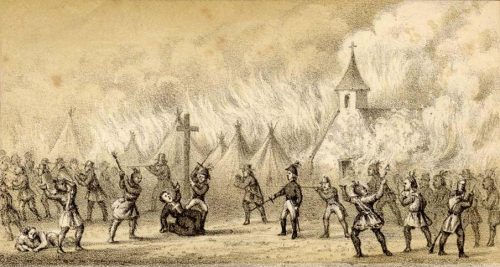
The exact fate of Rale is uncertain; it depends on whose memory you choose to believe. Among the many stories, a French one described Rale as dying submissively holding a large crucifix, and in another one, he ran out of a house alone to draw fire and was killed. A British report suggests that when they came into the village, they located him in one of the houses, firing on them. The soldiers burst in, just as Rale was reloading his gun, and after crying out, he would neither “give quarter nor take none,” one of the lieutenants shot him in the head. In another later account, Rale was found holding a fourteen-year-old English boy hostage and stabbed him in fury upon his capture.
According to one of the oral histories of the Wabanaki, people had gathered unarmed in the church to hear mass when the English quietly surrounded it and opened fire, shooting anybody who tried to escape. In one account, Rale signaled the attack by waving a handkerchief. The English soldiers then set the church ablaze, horribly burning to death all who remained inside. They also hunted down and murdered anyone who had not attended the mass.
Regardless of how Rale died, the affair ended with the soldiers butchering everyone they could find, then plundering the village, destroying the icons and sacred vessels of the mission, and scalping Rale and the rest of the dead Wabanaki. On their return to Boston, the English carried scalps from the dead, including Rale, to redeem for bounty. Of the twenty-eight scalps they took back, only six were from men, and the rest came from women and children.
The death of Rale was cause for celebration among the English. Grov. Dummer defended the killing in a letter to Vaudreuil, dated January 24, 1724. In it, he “readily acknowledge that Rale was slain amongst others of our Enemies at Norrigwalk,” and suggested that “if he had confin’d himself to the professed Duty of his Function to instruct the Indians in the Christian Religion, had kept himself within the Bounds of the French Dominions & had not instigated the Indians to War & Rapine, there might then have been some ground for complaint. But instead of preaching peace, love, and friendship agreeable to the Doctrines of the Christian Religion, he has been a constant & notorious Fomenter & Incendiary” (Baxter, 1907, p. 176).
Illustration: Death of the Jesuit priest Sebastien Rale at Narantsouak, Aug. 23, 1724. Frontispiece from Indian Good Book by Eugene Vetromile (1819-1880). Wikimedia Commons.
Bibliography:
Baxter, J. P. (1907) Documentary history of the state of Maine. Vol. X containing the Baxter Manuscripts. Maine Historical Society. Press of Lefavob-Towee Company.
Dekker, M. (2015) French & Indian Wars in Maine. The History Press. Charleston, South Carolina.
Kidd, T. S. (2002) “The devil and Father Rallee”: The narration of Father Rale’s war in provincial Massachusetts. Historical Journal of Massachusetts.
Smith, A. E. (2017) Re-Membering Norridgewock stories and politics of a place multiple. Dissertation, Cornell University.
Williamson, W. D. (1889) The history of the state of Maine: From its first discovery in A.D. 1602 to the separation, A.D. 1820, exclusive. Glazers, Masters, and Smith, pp. 106-107.

