When Queen Anne’s War ended, Jesuit Missionary Sebastian Rale rebuilt his mission at Narantsouak (Norridgewock), and many of its former inhabitants returned from Canada. He was by then completely fluent in their language and had converted most of them to Catholicism. He had compiled a dictionary of their language and had become deeply invested in their well-being.
As it became clear that the English had absolutely no intention of stopping or even slowing their expansion, Rale decided that the Wabanaki would have to resist the English to stop their uncontrolled growth. He believed that, if the English became masters of the country, they would chase out the Catholic missionaries, and “that would spell the end of their flocks’ religious fidelity”. This attitude was encouraged by the governors of New France, “in whose opinion the surrender of their lands by the Abenakis of Acadia would open the door to Canada for the English”. The Jesuits were receiving financial aid “from the authorities of New France secretly, since it could not be given openly because of the treaty of Utrecht (1713)”. (Charland, 2003)
Rale wrote to the Governor General of New France, the Marquis de Vaudreuil, requesting reinforcements to obtain more firepower, and he was promptly sent hundreds of Algonquin allies from Quebec. In August 1721, Rale led a force of 250 warriors downriver to Georgetown in a fleet of 90 canoes with a letter demanding, “that if the settlers did not remove in three weeks, the Indians would come and kill them all, destroy their cattle and burn their houses” As justification, the letter stated “ you Englishmen have taken away the lands which the Great God has given our fathers and us”. (Williamson, 1889, pp. 106-107).
The Wabanaki raids begin
In the spring and summer of 1722, bands of Kennebec and Penobscot, often led by Rale, went on a rampage across the mid-coast region, attacking settlements and forts in Woolwich and Brunswick, moving along the coast to the mouth of the Penobscot, taking hostages, and burning villages. Thus began the war, variously known as Father Rale’s War, Drummer’s War, Lovewell’s War, or the Three Years’ War.
Both large and small parties of Wabanaki and Frenchmen participated in the mayhem. A rampaging group of 60 Penobscot warriors took nine families captive along Merrymeeting Bay, releasing most but keeping five male hostages. Homes at Damariscotta, Pemaquid, and Boad Cove along Muscongus Bay were also attacked and pillaged. All the crew and passengers on a ship traveling from Annapolis to Boston were brutally taken captive by a mixed group of Wabanaki and Frenchmen. While many escaped, several remained prisoners for later ransom. A man was shot point-blank on July 12 on Casco Neck, and all the English were driven fleeing into the garrison. Five hundred to six hundred Penobscot warriors besieged Fort St. George for 12 days. They failed to get inside when an underground tunnel collapsed during heavy rainfall, but as they withdrew, they destroyed the surrounding community, burning to the ground a local sawmill, a large sloop, many houses, and butchered a large herd of cattle. Five Englishmen died in the assaults, and seven were taken prisoner. A band of Wabanaki also descended upon Brunswick, reducing all structures to ashes and taking many captives.
The mayhem continues
Throughout 1723, Father Rale and the Wabanaki made at least 14 more bloody raids across coastal Maine, killing or taking captive between 20 and 30 people. In Scarborough, the garrison house of Roger Deering was attacked, and his wife, two other inhabitants, and two soldiers were slain. Nearby, John Hunnewell, Robert Jordan, Mary Scammon, and Deering’s three children were taken captive while picking berries. In Saco, Dominicus Jordan was badly wounded by five Wabanaki but was able to stay upright, bleeding profusely, and retreat backwards into the garrison. A group of 250 warriors from Narantsouak and St. Francis, led by Rale, ambushed the settlement at Arrowsic, burning 37 dwellings to the ground and killing 300 cattle. The 40 inhabitants of there managed to flee to the garrison, with only a single child lost. About 60 Wabanaki besieged Fort St. George for 30 days, but were unable to breach the palisade, and were chased off when Col. Westbrook arrived with reinforcements. 9
The raids on unprotected communities continued throughout 1724. By now, any Englishman who remained in Maine was forced to hide in fortified garrisons at night and could only work during the day, protected by armed guards. Wabanaki war parties lay in wait, lurking, looking for “exposed, isolated, and unprepared targets of opportunity”. (Dekker, 2015, p. 65).
With New England’s long-held fears about a Jesuit/Indian alliance finally coming true, English clerics began to view the hostilities as almost a holy war. Colman, Mather, and others described the war as a battle between Catholicism and Protestantism, an idea that had filled the Boston presses for years.
It was now time for English retaliation.
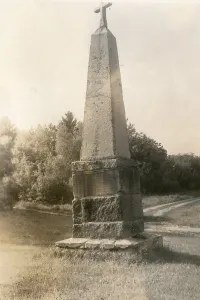
Illustration: Father Sébastian Rale monument in Madison, Maine (erected in 1833).
Bibliography
Charland, T-M. (2003) Lauverjat, Étienne In: Dictionary of Canadian Biography, vol. 3, University of Toronto/Université Laval.
Dekker, M. (2015) French & Indian Wars in Maine. The History Press. Charleston, South Carolina.
Kidd, T. S. (2002) “The devil and Father Rallee”: The narration of Father Rale’s war in provincial Massachusetts. Historical Journal of Massachusetts. https://www.westfield.ma.edu/historical-journal/wp-content/uploads/2018/06/Kidd-Summer-2002-complete.pdf
Williamson, W. D. (1889) The history of the state of Maine: From its first discovery in A.D. 1602 to the separation, A.D. 1820, exclusive. Glazers, Masters, and Smith.

