Scarborough was resettled quite slowly after Queen Anne’s War and had no town government until 1620. In Southgate’s History of Scarborough (1853, pp. 141-142), he relates: “Amongst the early proprietors in town, during the second settlement, were some who paid no attention whatever to agriculture, but subsisted altogether by fishing and hunting. The houses of such were scattered along the shore from Blue Point to Spurwink, several of them standing on “Pine Point…” [which] received its name from Charles Pine, a famous hunter, whose residence was there. He was celebrated for very many brave exploits with the Indians. “Newbry’s Point” on the South extremity of Pine Point was so named from Wm. Newbury, also a hunter, who lived upon it. The reputation of these hunters as ” excellent shots” proved very serviceable to their neighbors, as a safeguard against skulking Indians.
Much of their time was devoted to catching beaver, which were then abundant in the Nonsuch and other streams, where parts of their dams yet remain. They had, besides, larger and more interesting game, such as bears and wolves. These infested the woods in this vicinity until late in the century. In 1730, the town voted that ” 4 pounds be paid to any person that may kill a grown wolf within this township this year,” and ” one pound to any person that may kill a bear upwards of a year old;” and in 1739, £25 was raised to pay the bounty on wolves killed during the preceding year.”
The settlers who first returned to Scarborough were very spiteful towards the handful of Wabanaki who still resided in the region. Southgate (1853, pp. 146-151) tells of a couple of unfortunate examples:
“The Indians were in the habit of showing themselves upon the beach between the Ferry and the Neck, and amusing themselves by insulting and provoking the garrison, with the aid of certain significant attitudes and gestures. Pine volunteered to put a stop to this recreation … he went out upon the beach one morning before day and covered himself with rock weed near the usual scene of the Indians’ sport … The Indians at length appeared and began their sport. Presently, an enormous fellow stepped out from the crowd … and, turning his back towards the garrison, exposed a part of his huge body which, in the words of Pine, ” shone like a glass bottle.” The hunter immediately sent his bullet to the precise spot indicated by the Indian’s hand. The astounded savages seized their falling comrade and rushed headlong into the woods.
Hunniwell, the ” Indian Killer,” was a more ferocious and irreconcilable foe to the savages. Pine’s most cruel acts against them were always of a sportsman-like character—he was fond of the adventure; but Hunniwell’s hatred of them was such that he would kill them whenever and wherever he met them, regardless of all public treaties of peace. This is, without doubt, to be attributed to his unsatisfied desire for revenge for the death of a dear wife and child, whom the Indians are said to have murdered.
A number of the Blue Point planters were warming themselves by the fire in a clam house on what is now called “Seavey’s Landing” when two Indians came in and, setting their guns in the corner, took places by the fire with the planters. Hunniwell entered soon after … went to the corner, where the guns stood, and taking one up, put it to his shoulder and moved it from side to side as if taking aim at birds on the wing … until, getting the heads of the Indians in range, he fired and killed them both. On another occasion, he killed three Indians at once on the shore of Great Pond …
He also cut off the head of an Indian with a scythe while mowing on the marsh opposite Jane’s Point. While mowing, he noticed the Indians on the opposite side of the River, but supposed they were too far off to trouble him. But one of them … undertook to entrap him by silently crossing the River and creeping up to a gun under cover of the bank. The Indian succeeded in crossing the River and in getting possession of the gun before Hunniwell saw him. He continued mowing, however, apparently unconscious of his approach, until the Indian had come within a few yards of him, raised the gun and called out to him—’Now me kill you Hunniwell.’ The words were hardly out of the Indian’s mouth when Hunniwell sprang towards him, shouting at the top of his voice: ‘You infernal dog, if you fire at me, I will cut you in two with this scythe.’ The Indian fired as Hunniwell approached, but fired over his head, and before he could recover …. Hunniwell had severed his head from his body with the scythe, and fixing it on a pole, he held it up in the sight of the Indians on the opposite shore and loudly called to them to come over and share the same fate.”
This time, the Indians chose to remain in place. However, Hunnewell would later be killed with eighteen others in an ambush at Massacre Pond, near Prout’s Neck.
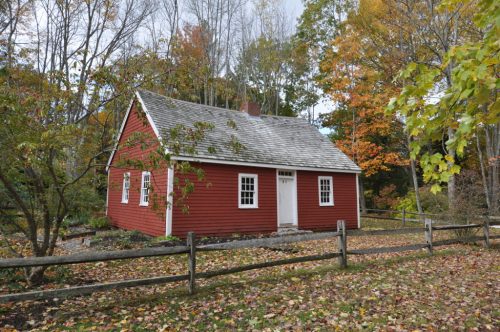
Illustration:
The Hunnewell House is one of the oldest surviving structures in Maine. Located on Old County Road near Black Point Road in Scarborough. It was probably built in 1702 – 03.
Bibliography:
Southgate, W. S. (1853). The history of Scarborough from 1633 to 1783. Collections of the Maine Historical Society. Vol. 3. Published for the Society, Portland.
‘

