After Queen Anne’s War, most of the English settlements in Maine lay wasted. After ten years of war, probably two-thirds of the English population had been killed or fled, leaving less than 2,000 hardy souls out of a former peak population of about 6,000.
The eastern front of the English population in Maine was now at Wells, where there were thirty fortified dwellings, many surrounded by palisades, a meeting house, and a couple of mills. The other substantial groups of colonists left in Maine were at York and Kittery. York, devastated by the massacre of 1692, still had a meeting house, a stockaded parsonage, and a few garrison houses. Kittery was represented by a small agricultural settlement at Berwick and a little fishing community at Kittery Point. Once mighty Falmouth, further north on Casco Bay, was now reduced to a small garrison of twenty ragged and starving militia. The whole mid-coast region had been emptied of English for twenty-five years.
The wars had also taken a terrible toll on the Wabanaki. Over the last 10 years, over a third of their population had been killed or wasted away by hunger and disease, and there were probably fewer than 300 warriors left. Many of the survivors had been forced to relocate to the Canadian missions of Odanak (St. Francis) and Wowenoke (Bécancour) during the war, where the French struggled to provide them with enough food.
After the Peace of Portsmouth, many Wabanaki returned from the Canadian Missions to the forests of Maine, coalescing into political groupings still recognizable today. They moved into the major river drainages of the St. John, Penobscot, Kennebec, Androscoggin, and Saco. The Jesuit Missionary Sebastian Rale returned to Narantsouak on the Kennebec River and rebuilt his mission village, along with Father Étienne Lauverjat, who also rebuilt his on the Penobscot.
Early English resettlements
After the war, many of the English who had fled returned to their previous homes and farms. They were joined by many new settlers who had purchased land from absentee landlords who had bought it from desperate returning refugees. In 1713, a “Committee of eastern claims and settlements” was appointed by the General Court of Massachusetts. They were directed “to receive and examine all exhibited claims to lands in Maine or Sagadahoc, to sanction the titles of such as appeared sound and clear, and report the residue” (Williamson, 1889, p. 81). This would be a daunting task, as many records of sale and deeds were lost in panicked abandonments of homes and farms.
To rebuild the wasted towns, a plan was devised in which neighborhoods of 20 or 30 families would be established near the coast, on lots of three or four acres per family. The homesteads were to be closely clustered in a defensible manner. The General Assembly authorized the resettlement of five towns – Saco, Scarborough at Black Point, Falmouth on the Casco Peninsula, North Yarmouth, and one at the mouth of Sagadahoc, including Arrowsick Island. People were prohibited from resettling anywhere other than these locations without licenses from the Governor and Council.
The first families began migrating to these towns the following year. Falmouth led the way after the fort at Casco was demolished and its remaining stores transferred to Boston. Now in disrepair, the fort was deemed too expensive to maintain and ineffective at protecting the surrounding community. Major Moody, the fort’s commander, and his second in command, Benjamin Larrabee, along with fifteen other soldiers and their families, moved to Falmouth Neck.
The first of the former inhabitants to return to Falmouth were Benjamin Skillings and Zachariah Brackett, who occupied adjacent farms at Back Cove that had belonged to their fathers. Early the same year, Dominicus Jordan, whose father had been killed in the last war, reoccupied the paternal estate at Spurwink. At Purpooduck, Gilbert Winslow, called Doctor, who probably had been surgeon at the garrison, built a new house in 1716 or 1717. In total, twenty other families moved back to Falmouth Neck by 1716, and they built a meeting house there.
The resettlement of Saco, now renamed Biddeford, was also rapid, and by 1717, a compact community had been established at Winter Harbor (Biddeford Pond) with a minister, supported by the provincial treasury. The resettlement of Scarborough began at Black Point in 1714, and the settlers soon spread out to Blue Point and Dunstan. By 1719, about 30 families had resettled in the area, and their first town meeting was held that December.
The first of the old North Yarmouth returnees also arrived between 1715 and 1718. However, the resettlement of North Yarmouth was delayed until 1728, with Cape Porpoisebeing resettled in its place. This town was re-established as Arundel [today Kennebunkport].
The first to return to Arrowsic was a group of twenty-four colonists organized by John Watts of Boston in 1714. Watts was married to a granddaughter of Thomas Clark. They settled at the mouth of the Sagadahoc, and Watts built a substantial home of bricks that he had brought from Medford, Massachusetts. In the spring of 1715, Watts and the other settlers petitioned the General Court to be incorporated into a town named Georgetown. A sawmill and a gristmill were built in 1716. By 1718, Georgetown had 40 dwellings, of which five were garrisons. In 1720, the people of Georgetown built Fort Menaskoux (also called Arrowsic Fort and Georgetown Fort) on the south side of Fisher Eddy. Captain Samuel Penhallow was put in command.
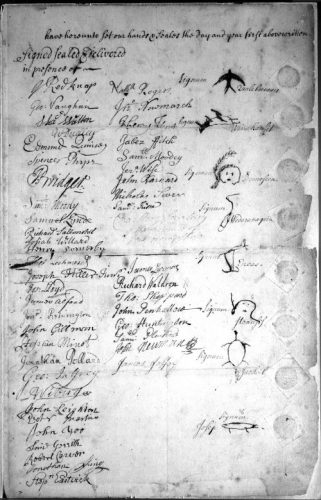
Figure: Signatures on the Treaty of Portsmouth (1713). Note pictographs of the Wabanaki on the right side of the document. Wikimedia.
Bibliography:
Clark, C. E. (1983) The Eastern Frontier. University Press of New England, Hanover and London
Saxine, I. (2019). Properties of Empire: Indians, colonists, and land speculators on the New England frontier. New York University Press. pp. 59-60.
Williamson, W. D. (1889) The history of the state of Maine: From its first discovery in A.D. 1602 to the separation, A.D. 1820, exclusive. Glazers, Masters, and Smith.
 Turmoil in Dawnland