The Euro-Wabanaki Wars (17): Beginning of Queen Anne’s War

In 1701, the War of the Spanish Succession (1701-1714) broke out in Europe. It was triggered by the death of childless Charles II of Spain, leading the French Bourbons and the Austrian Habsburgs to begin fighting over the Spanish Empire.

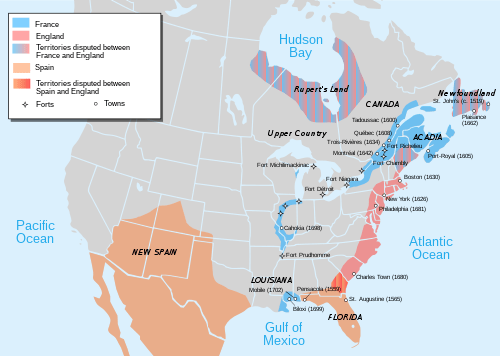
The War of the Spanish Succession spilled over into North America, where it was known as Queen Anne’s War, and involved the colonial empires of Great Britain, France, and Spain.  It was battled with Indigenous allies on three fronts: 1) Spanish Florida and the English Province of Carolina, 2) English St. John’s and Newfoundland, and the French at present-day Placentia, and 3) French Acadia with English New England on the Maine frontier.   

On August 6, 1703, the War began in Maine when the Royal Governor of New France, Philippe de Rigaud Vaudreuil, sent an expedition force of 500 French and Mi’kmaq from the St. Lawrence River Valley to make a massive assault on all the English coastal towns and forts stretching from Wells to Falmouth.

This expedition force laid coastal Maine to waste once again. As described by Willis (1833, pp. 7-8): “The inhabitants of Purpooduck [near Cape Elizabeth] were the most severe sufferers in this sudden onset. There were nine families then settled upon and near the point who were not protected by any garrison. The Indians came suddenly upon the defenseless hamlet when the men were absent, killed 25 persons, and took several prisoners. Among the killed were Thomas Lovitt and his family, Joel Madeford or Madiver, and the wives of Josiah and Benjamin Wallis and Michael Webber. The wife of Joseph Wallis was taken captive; Josiah Wallis made his escape to Black Point with his son John, then 7 years old, part of the way upon his back.

Spurwink, principally occupied by the Jordan family, was attacked at the same time, and twenty-two persons by the name of Jordan were killed and taken prisoners. Dominicus Jordan, the third son of the Rev. Robert, was among the killed, and his family, consisting of six children, was carried to Canada. His brother Jeremiah was among the prisoners, who was subsequently called French Jeremy, from the circumstance of his having been carried to France.

The whole country, from Purpooduck Point to Spurwink, was covered with woods, except the few spots which the inhabitants had cleared. This afforded facilities to the Indians for concealment and protection. From these coverts, they made their sudden and cruel visits, then returned to mingle again with the other wild tenants of the forest, beyond the reach of pursuit.”

At this point, only the fort and settlement at Falmouth remained. “This was the most considerable fort on the eastern coast and was the central point of defense for all the settlements upon Casco Bay; under its protection, several persons had collected to revive the fortunes of the town” (Willis, 1833, p. 8). The veteran Major John March was in command of the fort.

The assault began by deception and treachery (Drake, 1910, pp. 159-160):  “While the main body of assailants was kept out of sight, three chiefs boldly advanced to the gate with a flag of truce. At first, March paid no attention to the flag bearers but finally went out to meet it, taking with him two others, all three being unarmed. His men were, however, warned to be watchful against treachery. Only a few words had been exchanged when the Indians drew their hatchets from under their blankets and fell with fury upon March and his companions. Being a man of great physical strength, March wrested a hatchet from one of his assailants, with which he kept them at bay until a file of men came to his rescue. Luckily, he escaped with a few slight wounds …

Having failed to gain the fort by treachery, the savages next fell upon the scattered cabins outside, which were soon blazing on all sides. After this was done, they returned to attack the fort. For six days, the weak garrison defended itself unflinchingly. During this time, the besiegers were joined by the confederate bands, Falmouth holds, who had been destroying all before them out at the west. Beaubassin, the French leader, now pressed the siege with greater vigor and skill. Covered by the bank on which the fort stood, the savages set to work undermining it on the waterside. For two days and nights, they steadily wormed their way under the bank toward the palisade without any hindrance from the garrison and were in a fair way to have carried the fort by assault when the arrival of the provincial galley compelled them to give over their purpose in a hurry, as that vessel’s guns raked their working party. On the following night, they decamped. Two hundred canoes were destroyed, and an  English shallop retaken by the relieving galley.”

One hundred and thirty persons were either killed or taken captive during this bloody conquest. Fear and dismay now filled the hearts of the settlers, for Maine had come very close to receiving a death blow. Only the strongest-willed remained, hunkered down in their garrisons, performing only the most necessary outside labor under armed guard.

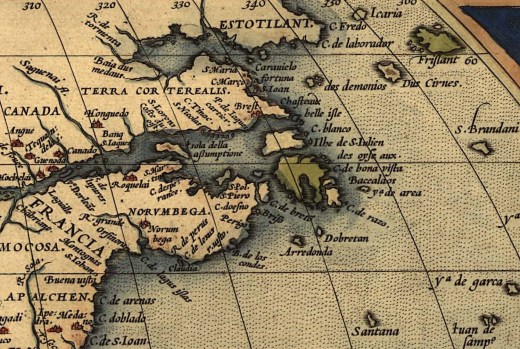
Illustration: European occupation of North America at the start of Queen Anne’s War. Wikimedia

Bibliography

Drake, S. A. (1887). The Border Wars of New England, commonly called King Williams and Queen Anne’s Wars. Charles Scribner’s Sons: New York.

Willis, W. (1865) The history of Portland from 1632 to 1864. Bailey and Noyes: Portland.
The Euro-Wabanaki War (16): Maine after King William’s War  

When King William’s War ended in 1698, many of the settlers who had fled the bloodshed returned to their shattered settlements and homes. These early colonists were built of incredibly resilient stock.

As Williamston (1889, pp. 29 – 31) describes: “Destitute of homes, yet attached to the places of their birth, hundreds of freeholders, or the heirs of deserted realties, returned, during the season, and visited former abodes, or half wilderness lands; many repaired their dilapidated cottages, and more perhaps constructed habitations. Men with their families removed to the peninsula of Casco, Purpooduck, and Spurwink, in Falmouth; to Black Point and Blue Point in Scarborough, to Winter Harbor and the Falls in Saco; to Cape Porpoise; and to Cape Neddick; and during the present and succeeding summer, those places were repeopled with several abiding families.”

The returning settlers felt compelled to take up a quasi-military life: “Garrisons, usually under a militia command, provided nuclei for small settlements either just outside or within a stockade. During daylight, men and women worked in their fields under the protection of scouts and guards. For most of the period, English Maine lived in a state of virtual siege. Only the larger seaports – Boston, Salem, Portsmouth, Kittery – enjoyed sufficient security to benefit from the military expenditures from Great Britain (Anonymous, 2010).”

Postwar Wabanaki migrations

As the 18th century drew to a close, the Wabanaki were hungry, exhausted, and largely displaced from their traditional fishing and hunting grounds. Prins and McBride (2008, p. 189) suggest: “The surviving Wabanakis were desperate to return to their village gardens, and to hunt, fish, trap and trade as before. But the fur market had crashed. With the flow of furs from the Great Lakes no longer checked by Iroquois warfare, supplies rose just as the European demand dropped. For Wabanakis these market changes added to their problems.

Under the watchful care of Jesuit missionaries, many Wabanaki relocated to the Missions of Bécancour, and St. Francis. “Although they created new lives for themselves in French Canada, many exiles never gave up the hope of retaining their lands in Maine from the English. While life in the mission villages provided residents with a safe haven and ready access to food, firearms, and other trade goods, physical and material security came at a cost. Although the native people of the mission villages could come and go as they pleased and maintain their own political structure, they remained fundamentally dependent on French aid and hospitality. Seeing the native people as ready allies in their war with the English, the French routinely used the flow of trade goods to exert Influence over the native peoples’ collective and individual choices of war and peace. … As the frontier wars progressed over the first half of the eighteenth century, native war parties striking the communities of coastal Maine increasingly originated from French Canada rather than the resident native populations.” (Dekker, 2015, p. 4)

Sébastien Rale builds a mission at Norridgewock (Nanrantsouak)

In 1694, Jesuit Sébastien Rale arrived at Norridgewock on the Kennebec River and built a mission at the site where Father Druillettes had toiled almost a half-century earlier. The faith had been kept alive at Norridgewock by occasional visits of missionaries, but no permanent pastors had been in residence until Father Rale arrived.  

Father Rale soon became an expert on the Wabanaki dialect and gave his catechetical instructions in their native tongue. He wrote a detailed Wabanaki dictionary, which was later stolen in an English raid. Rale would become a powerful opponent of the English, but in his early years at Norridgewock, he toiled quietly among the Wabanaki.

Not much is known about his early activities, but Rale’s arrival during King William’s War certainly placed him in a precarious position. As described by Schuyler (1915, pp. 167-168): “The English colonists greatly outnumbered the French, but the Indians were mostly allied with the latter. At the very beginning of his career at Norridgewock, Father Rale must have realized how difficult and how dangerous his position was. His was the most western of the Acadian Missions. The New England colonists were uncomfortably near him, and many were the anxieties and sorrows caused by this proximity. He became almost at once the object of English suspicion and accusation and later of armed attack. Every foray of New England colonists was attributed to him as the prime cause.

Rale became known as the “Apostle of the Abnakis” and was one of the most prominent names in the history of missionary activity on Maine’s frontier. He would be a central player in the French and Indian Wars for thirty years.

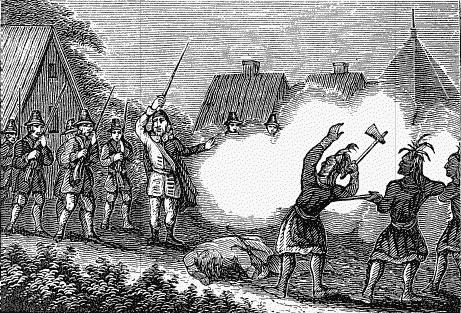
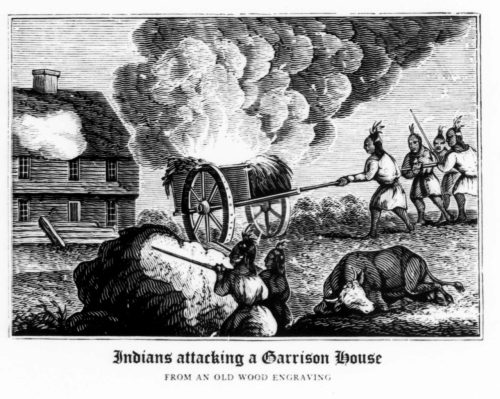
Illustration:  Indians Attacking a Garrison House, from an Old Wood Engraving. Collection of the Dover Public Library, New Hampshire

Bibliography:

Anonymous (2010). 1668-1774, Settlement and Strife. Maine History Network. The Maine Historical Society, Portland.  https://www.mainememory.net/sitebuilder/site/897/page/1308/print

Dekker, M. (2015) French & Indian Wars in Maine. The History Press. Charleston, South Carolina.

Prins, H. E. L., & McBride, B. (2007). Asticou’s Island Domain: Wabanaki Peoples at Mount Desert Island 1500-2000. Acadia National Park. Ethnography Program. National Park Service.

Schuler, H. C. (1915) The Apostle of the Abnakis: Father Sebastian Rale, S. J. (1657-1724). Catholic Historical Review 1(2): 164-174.

Williamston, W. D. (1889) The history of the state of Maine: From its first discovery in A.D. 1602 to the separation, A.D. 1820, exclusive. Glazers, Masters, and Smith.

Euro-Wabanaki Wars (14): The Stagger Towards Peace in King William’s War

In the spring of 1693, James Converse was made Commander-in-Chief of the eastern forces, consisting of all the garrison soldiers and 350 new recruits. He began a campaign along the coast, hunting down and harassing groups of Wabanaki at  Piscataqua, Wells, Sheepscot, Pemaquid, Teconnet, and Saco. This rampage brought many of the starving and exhausted Wabanaki to desire peace. 

On August 11, thirteen Sagamores representing tribes from Saco, Androscoggin, Kennebec, and Penobscot, including Sagamores Madockawando and Moxus, came to the garrison at Pemaquid and asked to treat. 

The English commissioners, John Wing, Nicholas Manning, and Benjamin Jackson demanded that “the Wabanaki pledge total subservience to the British Crown, confess to having caused the war, and admit that the French had instigated it. The treaty stipulated that the eastern tribes cease hostilities with the English, release all English captives without ransom, settle disputes in English courts rather than through armed conflict, and recognize English land claims”. (Dekker, 2015, pp. 41 – 42)

Despite the harsh stipulations, the thirteen sagamores felt compelled to sign the agreement. However, its signing provoked outrage among the Wabanaki sagamores, who were not present. They flatly rejected the treaty due to its blatant English bias.

“Acceptance of the treaty was further undermined when it was learned that Madockawando, despite questionable authority to do so, had sold a large parcel of land to Sir William Phips in the area now encompassing Thomaston, Warren, and Cushing” (Dekker, 2015, p. 42).

Dismayed by the breach within the Wabanaki Confederacy, the French also depicted the peacemakers as traitors. Under pressure, the thirteen signatories were forced to close ranks with the rest of the Wabanaki sagamores, and a reunified Wabanaki Confederation resumed its fight against the English.

On the 18th of July 1694, a force of 250 under Madockawando, Bomaseen, and Toxus, “again destroyed Dover in New Hampshire and, after plundering places further westward, returned to Piscataqua on August 20th, when a large party of them crossed over into Kittery with intent, manifestly, to complete the ruin of Maine. At Spruce Creek, they killed three, and at York, one, where they also took a lad prisoner. On the fifth day of their visit, they made a bold attack upon Kittery, and slew eight persons …” (Williamson, 1889, p. 640)

The bloody war would continue on for another two years. Periodic attempts by the Wabanaki for peace were consistently thwarted by English deceit.   “In November 1694, four Wabanaki were killed under a flag of truce at Saco, and three others were taken prisoner a few weeks later in similar circumstances. When the Wabanaki released some of their captives during the following spring, the English refused to reciprocate. Then, in February 1696, several Indians were killed after they were lured into Fort William Henry to negotiate a settlement” (Ghere, 1995, p.127).

Last battle of King William’s War

In the late spring of 1696, in what turned out to be the final battle of King William’s War, Fort William Henry fell to a mixed force of 80 French and Canadian soldiers and several hundred Wabanaki, led by Pierre Le Moyne d’Iberville.  Under siege by d’Iberville’s warships, the fort, which was considered so formidable, was found to be quite the opposite. The stone walls were built with poor-quality mortar and soon began to crumble under the concussive force of their own guns. Making matters even worse, the fort had no water source within its walls.  Greatly outnumbered,  the commander of the fort, Captain Pasco Chubb, was forced to surrender. He and his men were escorted to Boston and exchanged for French and Indians imprisoned there.

In 1697, Boston received news that England and France had signed the Treaty of Ryswick in the Netherlands, bringing an end to the Nine-Years’ War. However, it was not until the summer of 1698 that the French allies in the Wabanaki Confederation learned of the European peace and initiated their own negotiations with their enemies in New England. In January 1699, representatives of the Confederation (Penobscot, Kennebec, Androscoggin, and Saco) traveled to Mere Point in present-day Brunswick to make peace. On January 8, they signed a treaty that closely mirrored the one they had signed at Casco in 1693, which they had been furiously rejecting for the last six years. Now, so exhausted and desperate for peace and the resumption of trade, they were resigned once again to signing the humiliating document.

The only protest that they made was: They refused to accept the English king as “our common father,” pointing out that the King of France held that honor.  However, now that the French and English Kings had made peace as “brothers,” the Wabanaki would be willing to call the English monarch “Uncle King William.” As such, they said they were thankful that their “uncle” had accepted them “into the league of friendship” (Prins, 2002, p. 364).

As the 18th century drew to a close, the boundaries between French and English claims in North America remained unresolved, and the coast east of Wells was nearly devoid of English settlers. The Wabanaki’s suffering would continue unabated, now with little aid from the French and an English trade embargo.  An uneasy peace settled over Maine, but it would be very ephemeral, as the fighting would be renewed just four years later.

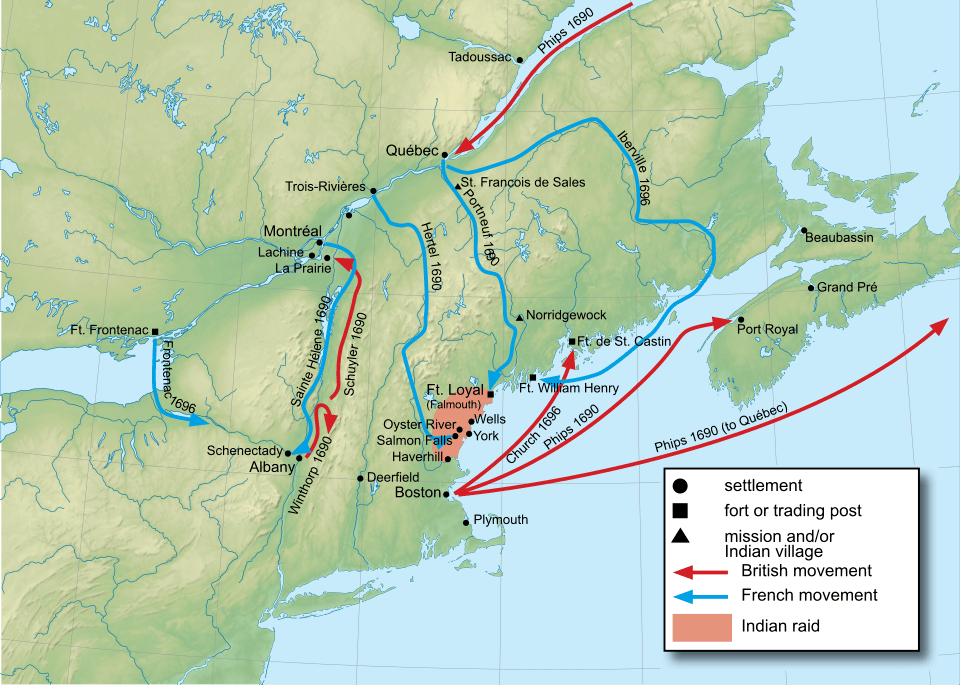
Illustration: Map of King William’s War. Wikimedia Commons.

Bibliography:

Dekker, M. (2015) French & Indian Wars in Maine. The History Press. Charleston, South Carolina.

Ghere, D. L. (2015) Diplomacy & War on the Maine frontier, 1678-1759. In: Judd, R.W., Churchill, E. A., and Eastman, J. W. (eds.). Maine: The Pinetree State from Prehistory to the present. University of Maine Press, Bangor. pp. 51–75.

Prins, H. E. L. (2002) The crooked path of Dummer’s treaty: Anglo-Wabanaki diplomacy & the quest for aboriginal rights. H. C. Wolfart (ed.). Papers of the Thirty-Third Algonquian Conference, University of Manitoba: Winnipeg. pp. 360 – 377.

Williamston, W. D. (1889) The history of the state of Maine: From its first discovery in A.D. 1602 to the separation, A.D. 1820, exclusive. Glazers, Masters, and Smith.

Euro-Wabanaki Wars (13): Murderous raids of Madockawando in 1692.

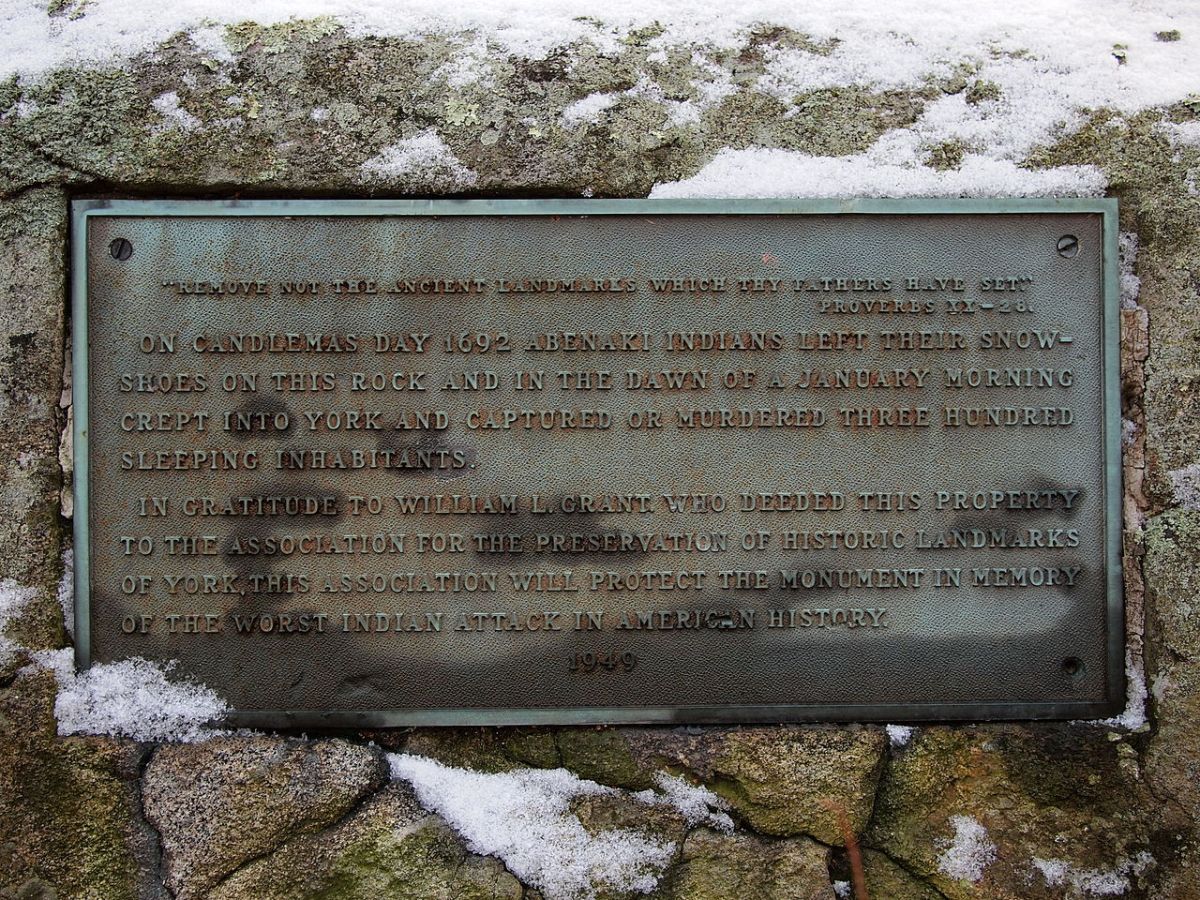
In King Philip’s War, raids on English settlements were rare during the winter months, when the Wabanaki disappeared into the forest on their yearly hunts. This all changed dramatically in the winter of 1692, when Madockawando and Father Thury led 200-300 Wabanaki on snowshoes in a bloody raid on York during King William’s War.

 As Drake (1910, p. 73) tells the story, “On the morning of February 5, 1692, the village of York lay locked in the arms of winter. Since daybreak, it had been snowing heavily, so few of the inhabitants were stirring. At this hour, nothing could be heard but the muffled roar of the waves beating against the ice-bound coast or the moaning of the wind as it swept through the naked forest. All else wore its usual quiet.

Suddenly, a gunshot broke the stillness. At that sound, the village awoke. The startled settlers ran to their doors and windows. Out in the darkness and gloom, they saw a body of armed men fronting them on every side. Some tried to escape by their front doors. A storm of bullets drove them back. They next made for the back doors. Death met them at the threshold. They saw themselves surrounded, entrapped. On every side, the rattle of musketry, mingled with the loud yells of the assailants, drowned the voices of nature—moaning sea and rising storm. The village was surrounded, and retreat cut off, and a carnival of murder was to join its horrid uproar to that of the elements.

… The savages quickly burst open the doors with their axes, killing and scalping all whom they met. As soon as one house was carried and its inmates butchered, it was first ransacked and then set on fire; the assailants then rushed off in pursuit of new victims. In a short time, the village was blazing in twenty places.”

 Accounts differed on the number slain, but the death toll was substantial, with 50 to 100 being slaughtered. Dozens of others were taken captive, and all but four garrison homes were burned to the ground.

To the east of York, the small, struggling village of Wells was initially spared. However, in June, it was assaulted by a formidable body of warriors led by Madockawando and Moxus, supported this time by a small group of Acadian French led by Portneuf and St. Castin. The battle started with the assailants swooping out of the surrounding forest, “screeching, brandishing their weapons aloft, and hurling shouts of defiance at the garrison as if they expected to frighten it into surrender by a show of numbers and noise” (Drake, 1910, p. 78).

The stockade was defended by twenty-nine soldiers commanded by Captain James Converse. Fourteen had just arrived a few days earlier in two sloops. In a bitter firefight, the soldiers held fast in their garrison, their guns reloaded by several stout-hearted women. Failing to breach the walls, the assailants then tried to capture the sloops, with several losing their lives in the attempt, including a Frenchman. ” When night put an end to the fighting, Storer’s men had everywhere more than held their own.” (Drake, 1910, p. 79).

Throughout the night, the warriors shot flaming arrows into the fort to keep the besieged on alert and to wear them out. The combatants lay so close together that the firing was interspersed with boastful bantering on both sides.

In the morning, the assailants made another frontal assault on the stockade, but a rapid discharge of musketry again repulsed them.

Exasperated by repeated failures, the savages next made another dangerous attempt upon the sloops, now lying lashed together for mutual protection out in the stream. A fire raft was hurriedly put together, the combustibles lit, and the raft shoved off from the shore and left to drift down upon the vessels with the tide. The same fatality attended this effort as the others. A puff of wind drove the blazing mass against the bank, where it burned harmlessly out.

Force having failed, the discouraged besiegers resorted to stratagem. A flag was sent to demand a surrender. Ensign Hill went out to meet it. When the message was brought to Converse, he returned for an answer “that he wanted nothing but men to come and fight him.” The wrathful envoys retorted the threat to cut the English “as small as tobacco” before morning. Converse then broke off the conference with a brusque invitation to make haste, for he wanted work. “The savage, who held the flag, then dashed it to the ground in a rage and ran off one way, while Ensign Hill ran off in another, each one eager to get under cover as quickly as possible. It was well for Hill that he took the alarm when he did for a number of shots were fired at him from an ambush, treacherously contrived by the savages, in case their demand was refused. Thanks to fleetness of foot, Hill got into the garrison unhurt.

After putting their one captive, John Diamond, to death with excruciating torture, the discomfited crew of white and red savages slunk silently away between dark and daylight, leaving some of their unburied dead behind them.” (Drake 1910, pp. 80 – 81).

Illustration: Memorial plaque in York, Maine.

Bibliography:

Drake, S. A. (1887). The Border Wars of New England, commonly called King Williams and Queen Anne’s Wars. Charles Scribner’s Sons: New York.

Euro-Wabanaki Wars (12): Expedition of Benjamin Church in 1690

In 1690, Benjamin Church was sent to Maine by the Massachusetts authorities to wage a major offensive against the Wabanaki. He was ordered to root out and destroy their permanent villages upstream that had been harassing the coastal English settlements. 

As Drake (1887, pp. 66-67) describes, “At safe distances up these rivers, varying from sixty to a hundred miles, the tribes who usually acted together against the English had permanent villages, whence war parties could easily slip down unperceived to the coast, join their forces at some point mutually agreed upon, and fall upon such settlements as had been marked for destruction. Small and insufficient garrisons posted at the mouths of these rivers had utterly failed to put a stop to these inroads. Scouting the border could not do it. To destroy the enemy’s villages was the only alternative. Root out the nests, and the vultures would fly away.”

Church, leading 300 men, arrived in Casco Bay on September 11th. Landing at Maquoit Bay, he marched directly to Fort Andros, which he found abandoned. Then he continued for another forty miles to the principal Penobscot village at Great Falls (in today’s Lewiston). As he approached, they were spotted, and most of the warriors fled, leaving the women and children to their fate. Three or four men were shot in the river while trying to escape. Once inside the village,  Church discovered five gaunt and starving English captives, and in retaliation, butchered seven random villagers. 

From the captives, Church learned that the warriors had gone to Saco, and he resolved to chase after them. After burning the village to the ground and destroying the Indian’s store of corn, Church and his men clambered aboard his ships, taking as hostages nine family members of the sachems Kancamagus and Worumbo (Dow, 2025). The rest of the women and children of the village were then brutally slaughtered, except for a few old women, left to tell the tale.

As Williamston (1889, p. 66) related, “The wives of the two Sagamores and their children were saved and sent on board his vessels in consideration of a solemn promise made by the women that eighty English prisoners should be restored. But it is painful to relate, and nowise creditable to the usual humanity of Major Church, that the rest of the females, except two or three old squaws, also the unoffending children, were put to the tomahawk or sword.—The old women, he left with some necessaries and this errand – tell the Sagamores, they may find their wives and children at Wells.”

Just before sailing, the group was joined by Anthony Brackett, who had escaped his captivity at Falmouth. He would serve as a valuable guide.

Church then sailed to the mouth of the Saco River, where he surprised some Wabanaki who were fishing. He killed two of them in a brief skirmish and freed from them a captive, Thomas Baker, who told him that the Indians had hidden beaver pelts at Pejepscot (Brunswick). Backtracking, Church found the pelts but no more Wabanaki to harass.  At this point, some of his weary men demanded that it was time to return home, and when his full council agreed,  Church accepted, and the group loaded up and headed across Casco Bay to Cape Elizabeth.

After spending the night, his group was viciously attacked by some of the warriors he had been pursuing but had not yet found. Seven of his soldiers were killed and twenty-four wounded before the Wabanaki evaporated into the woods again. Church searched high and low for them to re-engage, but to no avail. He finally gave up and returned to Portsmouth on September 26 to an icy cold reception from the local authorities.

Meanwhile, as he had hoped, his capture of the Indian women at Androscoggin yielded for him a positive result. In October, several chief sagamores came to Wells, hoping to retrieve their women and children. Under a flag of truce, they told  Captain Elisha Andros “with real or pretended sincerity- it is hard to say which – they declared that the French had made fools of them, that they would not fight against the English anymore, and that they were ready to make a treaty whenever the English were”  (Drake, 1887, p. 69).

It seems likely that the Wabanaki’s statement was disingenuous. By now, they must have known of Phips’ defeat at Ontario and likely had no intention of giving up anything more than the minimum to regain their women and children. They had brought with them only ten captives, and after a drawn-out negotiation that took six days, they promised to deliver more captives the following May and remain peaceful until then.

When the English commissioners returned in May for those captives, no one came to meet them, and the local Wabanaki claimed they knew nothing of the expected rendezvous. This, as told by Drake (1887, p. 70),  “was a sinister omen and forewarned another outbreak. Breathing time, however, had been gained, which was much to people who were worn down and dispirited by last year’s reverses. It proved, however, a mere lull inthe storm.”

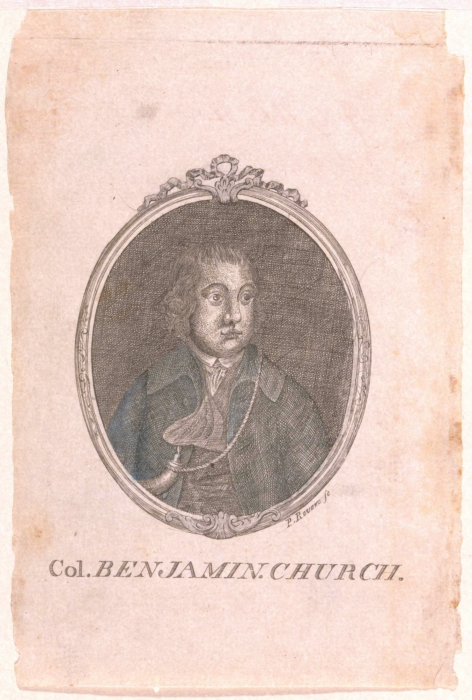
IllustrationEngraved portrait by Paul Revere that was believed to be of Benjamin Church.  Yale University Art Gallery.

Bibliography:

Dow, C. (2024) Adaptation and resistance, Indigenous history of the Pejepscot region. Virtual Exhibit at the Bowdoin College Museum.

Drake, S. A. (1887) The Border Wars of New England, commonly called King William’s and Queen Anne’s Wars. Charles Scribner’s Sons: New York.

Williamston, W. D. (1889) The history of the state of Maine: From its first discovery in A.D. 1602 to the separation, A.D. 1820, exclusive. Glazers, Masters, and Smith.

Euro-Wabanaki Wars (11): Sir William Phips tries to take Canada in 1690

On March 22, 1690, Massachusetts appointed Sir William Phips as a major general to command an expedition to French Acadia. It had become abundantly clear that King William’s War was not just a struggle between the English and Wabanaki. Instead, it was a war between the English and French, who led the attacks and provided the Indians with the means to carry on the hostilities. The Massachusetts authorities decided it was time to take the battle directly to the French and attack Port Royal in Nova Scotia.

Native Mainer Phips had risen to prominence in an extraordinary career. He was born at Nequasset (present-day Woolwich, Maine) near the mouth of the Kennebec River. Phips herded sheep for the first 18 years of his life and then began a four-year apprenticeship as a ship’s carpenter without having any formal schooling. He rapidly advanced from a shepherd boy to a shipwright and then a ship’s captain. In 1675, he established a successful shipyard on the Sheepscot River at Merrymeeting Bay just before King Philip’s War. He became a hero during that war when his village was attacked, and he took many fleeing settlers on board one of his ships.

Phips then became a successful treasure hunter, seeking sunken ships, and won a knighthood after recovering a Spanish galleon near Hispaniola, worth approximately 20 million dollars in today’s gold. After the war, Phipps became the 1st Royal Governor of the Province of Massachusetts Bay. He gained notoriety by establishing the court that conducted the Salem Witch Trials. Many historians believe this hysteria was partially due to the tension and stress of King William’s War.

For the assault on Fort Royal, Phipps was given a squadron of eight vessels and eight hundred men. He easily took the fort on May 9, 1690, for it was being rebuilt when he arrived, and none of its cannons were mounted. Its governor, Louis-Alexandre des Friches de Meneval, had no choice but to surrender. However, when Phips came ashore the next day, he discovered that the Acadians had been removing valuables from the fort, and Phips declared the terms of capitulation null and void. In a highly controversial decision, he then allowed his troops to pillage the town and destroy the church, and he had the fort destroyed. He then sailed back to Boston carrying Meneval and his soldiers as prisoners of war. He was received as a hero with great accolades, although he will long be vilified in Acadian histories for the sacking of the Fort.

In the wake of this success, in August 1690, the Massachusetts government decided to send a much larger expedition against Quebec, the capital of New France, and gave its command to Phips. An attack against Quebec made much sense, as it was the origin of the raiding parties that had hassled and destroyed Schenectady, Salmon Falls, and Falmouth.

On August 20, 1690, Phips headed to Quebec with a fleet of thirty-two ships and two thousand three hundred men on what would be a disastrous mission. As told by Williamson (1889, p. 598): “The fleet, retarded by fortuitous incidents and events, did not arrive before Quebec till the 5th of October. The next morning, the Commodore addressed a note to Count Frontenac, the Governor, demanding a surrender. But the haughty nobleman, rendered more insolent by tidings from Woodcreek, returned a contemptuous answer, adding, —You and your countrymen are heretics and traitors, and Canada would be one, had not the amity been prevented by your Revolution.

Phips, though thwarted by contrary winds, was able, on the 8th, to effect a landing of about thirteen hundred effective men upon the Isle of Orleans, four miles below the town, and to commence a cannonade from his shipping, among which were frigates carrying 44 guns. But their approach was repelled and prevented by the long guns in the French batteries, and the land forces were violently assailed and harassed by the French and Indians from the woods. Amidst these and other discouragements, the Commodore, on the 11th, learned from a deserter the condition and great strength of the place; and the same day, he and his troops reembarked with precipitation. The fleet, overtaken in the St. Lawrence by a violent tempest, was dispersed; two or three vessels were sunk; one was wrecked upon Anticosta; some were blown off to the West Indies; and the residue of the shattered squadron were more than a month on their way home; Sir William himself not arriving in Boston till the 19th of November. His losses by the smallpox, the camp-distemper and other sickness, by the enemy and by shipwreck, were two or three hundred men; and the expenses of the expedition, like its disasters, were great.”

An English defeat of the French in Acadia would have to wait another two decades, when the Treaty of Utrecht was signed in 1713.

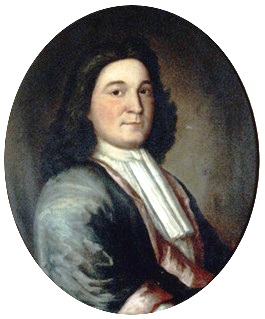
Figure: A portrait by Thomas Child of Sir William Phips, first royal governor of the Province of Massachusetts Bay.

Bibliography:
Brooks, R.B. (2019). History of King William’s War. https://historyofmassachusetts.org/king-williams-war/

Faragher, J. M. (2005). A great and noble scheme: the tragic story of the expulsion of the French Acadians from their American Homeland. W. W. Norton, New York.

Lounsberry, A. (1941) Sir William Phips. Charles Scribner’s Sons, New York.

Williamston, W. D. (1889). The history of the state of Maine: From its first discovery in A.D. 1602 to the separation, A.D. 1820, exclusive. Glazers, Masters, and Smith.

Euro-Wabanaki Wars (10): King William’s War – Destruction of Falmouth (May 25, 1690)

As the Nine Years’ War began to reach a fevered pitch in Europe in 1690, the French authorities decided to extend the war to the frontier of Maine. In that year, Comte de Frontenac, the governor-general of New France, began directly supporting groups of Canadian Indians led by Frenchmen (soldiers and priests) against the English settlements. He hoped to annihilate the frontier communities by murdering as many inhabitants as possible and burning their buildings to the ground. He would deploy three significant missions to Schenectady, New York, Salmon Falls near Dover, New Hampshire, and Falmouth (Casco), Maine.

Frontenac sent a group led by Sieur de Portneuf, to attack Falmouth, now the most easternmost surviving settlement of the English. The force consisted of fifty French soldiers and fifty Wabanaki from the mission of St. Francis.

The force left Quebec in January 1690, traveling slowly but steadily through the wilderness and mountain ranges that separate the waters of the St. Lawrence and those of the Kennebec. They sustained themselves by hunting and fishing.

“They rested at the Indian villages as they proceeded and added to their numbers from the Indian recruits who offered. Previous to the departure of this party. Count Frontenac, during the winter previous, had sent messengers to the Baron de Castine on the Penobscot,” stating his intention to attack the white settlements in Maine in the spring, and requesting his assistance with a force of the Penobscot tribe. Castine readily complied … During the winter months, he selected the best of the Tarnitine [Tarrentine] warriors, gathered ammunition and stores, and with his father-in-law Madockawando, the chief of the Penobscots, accompanied by at least one hundred of the warlike men of that tribe, they started to meet the expedition from Quebec, in April, 1690.

They, carrying their canoes, traversed the short distance between the waters of the Penobscot and the river Sebasticook, and floated down the stream to its junction with the Kennebec in the present town of Winslow … When on the waters of the Kennebec they were in communication with the Indians in that vicinity, and they were soon joined by the party from Quebec under the command of Portneuf. Soon, A  party of Hertel [Francois], who had destroyed Salmon Falls, came up with them, and an agreement was made respecting the expedition against Casco. The different parties rendezvoused at Merrymeeting Bay, and they comprised a force of between four and five hundred.“ (Hull, 1885, pp. 63-64)

The battle

The forces that had gathered to attack Falmouth came into Casco Bay from the Kennebec via the New Meadows River. “It was but a short carry for them to transport their canoes across the neck of land which separates the two waters. No white settlements were on their track, as the whole country was deserted by the inhabitants, who had retired to the protection of Fort Loyall. After reaching Casco Bay, they made their rendezvous on some of the Islands.” (Hull, 1885, p. 69).

“The battle began on May 25, 1690, when a settler happened upon an Algonquian scout and shot him. The shot alerted about 30 men who rushed to the scene only to receive a murderous volley, almost at the muzzles of the enemy’s guns, which brought thirteen to the ground and put the rest in disorder. The enemy then sprang from their coverts, behind the fences, and fell with swords and hatchets upon the survivors, only four of whom succeeded in regaining the fort, and they were wounded … Elated by this success, the invaders then rushed into the village. The undefended houses were easily carried, but the assailants met with such a rough reception at the garrisons that they were obliged to draw off at nightfall, and Portneuf even began to doubt his ability to take the fort.” (Drake, 1910, p. 51).

That night, those still in the garrisons quietly withdrew to the fort. Finding the village deserted the following day, the enemy plundered and burned it and then turned their attention to the fort. A deep gully was found to run within fifty yards of the stockade, from which the assailants could fire freely at the garrison but not successfully assault it.

“Hertel had his men, French and Indian,  dig a trench to the palisade with a pick and shovel taken from the village and, on the third day, when the besiegers were at the base of the palisade, demanded that Davis surrender.  Expecting the return of his detachment, Davis asked for a six-day truce, which was denied, and the besiegers began hurling hand grenades over the stockade into the fort while they fired upon it under cover of the trenches. A barrel of tar and other combustibles was pushed up against the stockade wall, and made ready to light, forcing Davis to hoist a white flag. Davis tried to negotiate directly with the French to allow the English survivors safe passage to another village. However, instead of finding the promised protection, the survivors were abandoned to the fury of the Indians, who wreaked their vengeance unchecked. Davis’s indignant remonstrances were treated with derision. He was told that he was a rebel and traitor to his king, as if that fact, were it true, absolved his captors from all pledges. After plundering the fort, the invaders set it on fire, and it was soon burned to the ground, leaving Casco untenanted, save for the unburied bodies of the slain.” (Drake, 1910, p.51)

About 200 English lost their lives that day and were left piled in a grisly mound outside the fort. Only ten or twelve survived and were taken into captivity. 

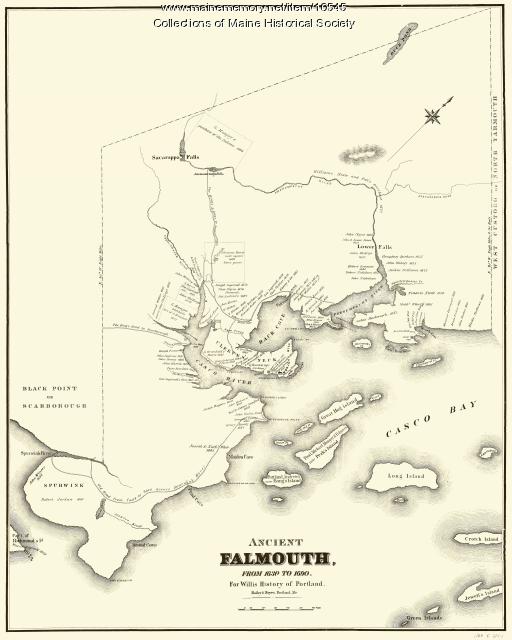
IllustrationFalmouth in 1690 (Willis, 1865)

Bibliography:

Drake, S. A. (1897). The border wars of New England, commonly called King William’s and Queen Ann’s Wars. Charles Scribner’s Sons, New York.

Hull, J. T.  (1885) The siege and capture of Fort Loyall, Destruction of Falmouth, May 20, 1690.  (O.S.). Maine Genealogical Society. Owen, Strout & Co., Printers, Portland, Maine.

Willis, W. (1865) The history of Portland from 1632 to 1864. Bailey and Noyes: Portland.
Euro-Wabanaki Wars (9): Baron Saint-Castin, Guerrilla Leader of the Wabanaki


One of the dominant figures in the French and Indian Wars in Maine was Jean-Vincent D’Abbadie de Saint-Castin. He would build a trading station at Pentagoet (Castine), become a Wabanaki leader,  and then lead at least a dozen bloody raids on English settlements along the Gulf of Maine from 1688 to 1690.

How St. Castine wound up at Pentagoet is a remarkable story. He was born in France in 1652, the second son of a French baron. His mother was a direct descendant of Louis VIII. Little is known of his early life other than his mother died of the plague in his infancy, and his father died when he was a young boy. He arrived in 1665 in Quebec, only 13 years old, as an ensign in the company of Hector Andigne de Grandfontaine, an officer of the Carignan-Salieres Regiment. This unit was brought to New France to fight the Iroquois.

Five years later, Saint Castin was selected as one of the two officers to accompany Grandfontaine, the new Governor of Acadia, to Pentagoet, where he would establish the capital of French L’Acadie. Pentagoet was chosen for its commanding position at the mouth of the Penobscot River Estuary, an area rich in furs and timber. It was also near where the great Penobscot sagamore, Madokawando, and his family spent their summers fishing and hunting.

Saint-Castin found the wilderness of Maine very much to his liking. He became fluent in the Algonquian language and adopted many of the Wabanaki’s ways.  However, the rest of his little group of 30 soldiers at Fort Pentagoet struggled. The government of New France paid little attention to them, and to survive, Grandfontaine was forced to trade with the English, which was forbidden by France.  Grandfontaine was subsequently replaced in 1673 by another army officer named Jacques de Chambly, who made Saint-Castin his liaison officer with the Wabanaki.

On August 10, 1674, a Dutch expedition led by Capt. Jurriaen Aernoutsz attacked Pentagoet with 125 men. They easily overpowered the small garrison and took the officers to Boston as prisoners. With the help of some Amerindians, Saint-Castin escaped and traveled to Québec, where he reported the incident to New France’s governor, Frontenac, who ransomed Chambly from prison. However, Chambly refused to return to Acadia.

Frontenac decided to send Saint-Castin back to Pentagoet and ask him to enjoin the Wabanaki to serve the King of France. “Frontenac thus launched an obscure army officer into a career that would win him fame and a place in history, for Saint-Castin was destined to become a leader of men and to hold the destinies of Acadia in his own hands” (Chassé, 1985, p. 65.)

Saint-Castin returned to the ruined fort at Pentagoet, but instead of rebuilding the fortress, he constructed a house and a lead-shot factory in a Wabanaki village of 30 wigwams. He completely accepted the lifeways of the Wabanaki, accompanying them to their winter homes upriver. “He enjoyed the company of Indian women – perhaps too much, according to gossip that made its way to the Jesuit missionaries and the leaders of New France. But he remained a staunch Catholic” (New England Historical Society, 2024, n.p.).

Saint-Castin also became a great friend and advisor of  Madokawando and married at least one of his daughters, Pidianske. Saint-Castin married her both in the Amerindian way and a Catholic ceremony. Before marrying, she converted to Catholicism and took the name Marie-Mathilde, also known as Molly Mathilde.

Saint-Castin served as a military advisor to Madokwando during numerous confrontations with the English. The historian Geor Cerbelaud  suggests  “… Madokawando was the sole great chief of the Penobscots; he had his lieutenants who were in command of the warriors, led expeditions, and parleyed with them when truces were made, but it was known everywhere that nothing was done without his son-in-law’s advice, and that the latter had only to express a wish for it to be instantly complied with.” (New England Historical Society, 2024, n.p.).

Saint-Castin was a shrewd businessman, and his trading station made him a wealthy man. In 1840, a farmer named Stephen Grindle unearthed treasure six miles north of Saint-Castin’s home, which his daughter had buried. It included between 500 and 2,000 coins originating from France, Spain, England, Massachusetts, Portugal, and Holland.

In 1675, his older brother died childless in France, making him Baron Saint-Castin at the age of 22. However, he stayed in Acadia, prospering greatly and becoming one of the most notorious Frenchmen in the frontier of Maine.

Saint-Castin did not return to France until 1701, when he was forced to answer accusations of treason for trading with the English, and fight an attempt by his sister’s lawyer husband to obtain the family castle in Bearn and his title of baron. He eventually won on both counts, but never returned to Acadia; he died in 1707.  

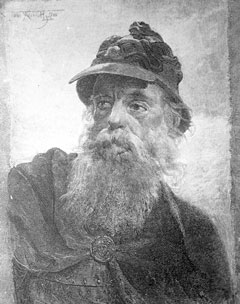
Illustration: Baron Saint-Castin 1881 by Will H. Lowe, Wilson Museum Archives.

Bibliography:

Chassé, P. (1985) The D’Abbaddie de Saint-Castins and the Abnakis of Maine in the Seventeenth Century. Proceedings of the Meeting of the French Colonial Historical Society 10: 59-73.

March, K. (2019) Castine’s Imperial Moment: Baron de Saint-Castine, Governor Edmund Andros, and the Boston Revolution of 1689. The Castine Visitor 29(3): 1-12.

New England Historical Society (2024) Saint-Castin, the French Baron Who Drove the English from Maine.  https://newenglandhistoricalsociety.com/saint-castin-french-baron-drove-english-from-maine/

Euro-Wabanaki Wars (8): Buildup to King William’s War (1688)

At the end of King Philip’s War in Maine, many English returned to their coastal and riverine settlements, joined by a new cadre of migrants, mainly from Massachusetts. Tensions remained high with the local Wabanaki as the English settlers’ insatiable desire for land led to additional acquisitions. They continued to push deeper and deeper into Wabanaki territory. The settlers free-ranging livestock wreaked havoc in Wabanaki agricultural fields, and their fish seines and damns obstructed their fishing. The Wabanaki repeatedly complained to English magistrates about the encroachment of English settlers on their land, but to no avail.

The tensions would boil up in 1688 into what has been dubbed King William’s War. In this War, instead of going alone against the English, the Wabanaki received the active support of the French. The French would enter the conflict as part of the broader European dynastic struggle known as the War of the Grand Alliance, also referred to as the Nine Years War or the War of the League of Augsburg.  This war would drag on for a decade in Maine, and at its end, the French and their Wabanaki allies were very close to driving the English completely out of Maine.

Roots of King William’s War

The War of the Grand Alliance began when King William replaced James II as ruler of England. James escaped to France and teamed up with Louis XIV in a failed attempt to reclaim the English throne and reinstate Catholic rule. The greater war began in late 1688 when the French invaded the Rhineland (Today’s Germany and the Netherlands). In response, England, the Dutch Republic, and the Holy Roman Emperor Leopold formed the anti-French coalition, known as the League of Augsburg, to combat the French.

The war that spilled over into North America was fought along the border between French Acadia and the English Province of Maine. The French felt they had dominance as far west as the Kennebec, while the English believed the border was much further east at the St. Croix River. The English Fort Charles at Pemaquid stood in the center of the disputed territory in 1689, a bulwark against French aspirations.

During King William’s War, the Wabanaki would partner with the French as the lesser of two evils. The English were actively encroaching on their traditional lands, while the French were content to establish small trading posts with less imprint. The French Jesuit missions had also become important sanctuaries for many Wabanaki. The English were not only encroaching on Wabanaki land but also actively supporting their bitter enemies to the northwest, the Iroquois, with guns and ammunition, to take the fur trade away from the French. It simply made sense for the Wabanaki to join the French in their battles with the English, particularly when the French were happy to provide them with guns and ammunition.  King Williams War would become a murderous orgy where Englishmen, Frenchmen, and Wabanaki would all participate in brutal massacres of outposts and whole settlements.

The Wabanaki form a tighter bond 

The English would battle a more organized group of Wabanaki in King William’s War than King Philip’s. Early in the final quarter of the 17th century, the exact date is not known, a loosely affiliated group of northeastern Algonquian tribal communities in the borderlands between New England, French Acadia, and Canada formed a pan-tribal alliance known as the Wabanaki Confederacy. As described by Prins (2002, p. 362): “Threatened by the growing numbers of English settlers invading their lands and increasingly brazen raids by their ancient Iroquois enemies, these Algonquians understood that their very survival was at stake and committed themselves to a bond of peace with each other. Emerging in the complex political landscape increasingly dominated by Anglo-French colonial disputes, their alliance remained a potent force for over 150 years. Although its composition could fluctuate somewhat according to time and circumstances, the core of this pan-tribal alliance originally consisted of a group of neighboring Abenaki communities and extended to similar clusters of Maliseet and Passamaquoddy. Later, it widened even more and included the more numerous Mi’kmaq.”

The members of the Wabanaki Confederation were not always aligned in war and peace, but there was now a vehicle for unified action. During several major raids in King William’s War, Mi’kmaq from the Gulf of St. Lawrence and Maliseet from St. John fought with Wabanaki warriors from as far south as the Saco River (Prins, 2002).

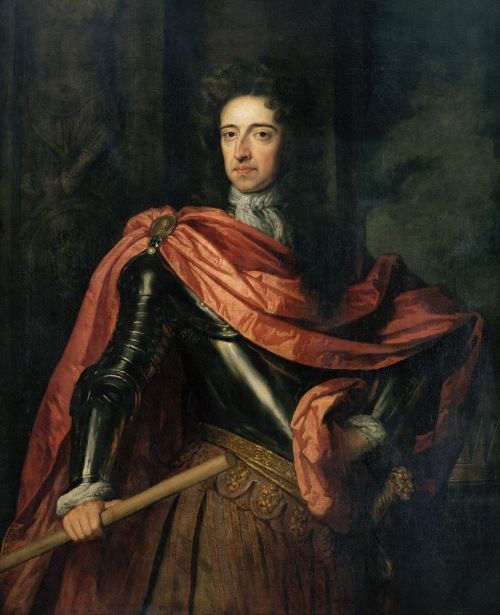
Illustration:Portrait of King William III by Godfrey Kneller (1650-1702). Scottish National Gallery.

Bibliography:

Prins, H. E. L. (2002) The crooked path of Dummer’s treaty: Anglo-Wabanaki diplomacy & the quest for aboriginal rights. H. C. Wolfart (ed.). Papers of the Thirty-Third Algonquian Conference, University of Manitoba: Winnipeg. pp. 360 – 377.

Prins, H. E. L. (2015) The Wabanaki Frontier, 1524-1678. In: Judd, R.W., Churchill, E. A., and Eastman, J. W. (eds.). Maine: The Pinetree State from Prehistory to the Present. University of Maine Press, Bangor. pp. 97-119.

Euro-Wabanaki Wars (7): The End of King Philip’s War

As the year 1677 closed, the Wabanaki had destroyed most of the settlements along the coast of Maine. The only ones remaining were located at the far western corner of Maine’s frontier, at Wells, York, and Kittery. 

After three years of fighting, most of the Wabanaki battle objectives had been met. Now exhausted and desperate for the resumption of trade, the eastern groups located around Pemaquid began to disown any allegiance to Squando and placed the blame for the bloodshed on him. In this mood, they started making peace overtures. Soon, many other eastern tribes, also sick of war, joined them.  Several Kennebec chieftains, including Moxus and Madockawando, were prepared to lay down their arms and surrender their hostages.

In 1678, the representatives of the provincial government of New York and the Wabanaki met at Pemaquid. Many Wabanaki diplomats attended the conference, arriving in thirteen large canoes.

No copy of the treaty survives, but Williamson (1889, p. 552-553) reports that  the articles of peace were: “1. the captives present were to be surrendered, and those absent released without ransom; 2. all the inhabitants, on returning to their homes, were to enjoy their habitations and possessions unmolested; but 3. they were to pay for their lands to the Indians, year by year, a quit-rent of a peck of corn for every English family, and for Major Phillips of Saco, who was a great proprietor, a bushel of corn.”

Williamson also reports that: “Though the close of king Philip’s war in Maine was the cause of universal joy, the terms of peace were generally considered by the English, to be of a disgraceful character,—nevertheless, preferable to a predatory warfare and its consequent deprivations and calamities. Nor were the exactions of the Sagamores unjust. The Aborigines, it was acknowledged, had a possessory right to the country … and their remarkable successes through the late war, might very properly embolden them to dictate these hard conditions of peace.”

This would be the last peace treaty the English would sign acknowledging the Wabanaki’s sovereign rights. The settlers were allowed to reoccupy their homesteads, but the Wabanaki retained their sovereignty. All future treaties would deny this right and demand their loyalty to the King of England.

The human cost of  King Philip’s War in Maine

From a Wabanaki perspective, even though they had won King Philip’s War, the English’s appearance on Dawnland’s shores less than a century before had brought about an “unimaginable change in fortunes.”  As described by Harald Prins (2015, p. 118): “Relations that had begun with mutually beneficial trade deteriorated over the first three-quarters of the seventeenth century into bitter war, and conflict would continue for another century. Wabanaki’s history between 1600 and 1678 reveals the tragic paradox of European migration to the New World: the European quest for a better life in the Americas transformed native American existence into a nightmarish reflection of their former existence. Although the Wabanaki peoples endured, somehow, the dramatic upheavals of the seventeenth century, their struggle for cultural survival had only just begun.”

Father Jean Morain, a French Jesuit missionary at Rivière du Loup between the upper St. John and St. Lawrence Rivers, wrote to his superiors in Quebec that the Etchemin after Metacom’s War were reduced to only about 400-500 people, a decline of almost 90 percent since the European Invasion (Prins & McBride, 2008). 

The losses sustained by the English in Maine during King Philip’s War were also huge. As told by Willamson (1889, p. 553), “About 260 were known to have been killed or carried into captivity, from which they never returned. There were probably many others, the accounts of whose deaths have never been noticed or transmitted to posterity. Numbers were severely wounded who survived, and a hundred and fifty or more, at different times, were made captives who were released. The dwelling houses at Cape-Neddock, Scarborough, Casco, Arrowsick, Pemaquid, and several other places were reduced to ashes. Possessions were laid waste, domestic animals killed, and a great amount of property plundered or destroyed. The cost of the war in Maine to the colony government was £8,000, besides incidental losses.

A very uneasy peace

The uneasy peace following the Treaty of Casco would prove to be short-lived. Festering tensions would erupt again in the summer of 1688, only ten years later, in what came to be known as King William’s War. In this War, the Wabanaki would participate in a much broader conflict against the English, often allied with the French. The French wanted to limit the expansion of the English in the Maine frontier, and they entered into the fray in Maine as part of the larger Seven Years War in Europe.

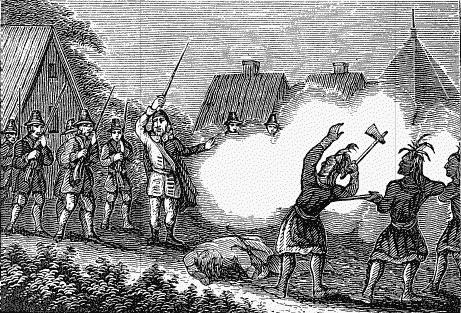
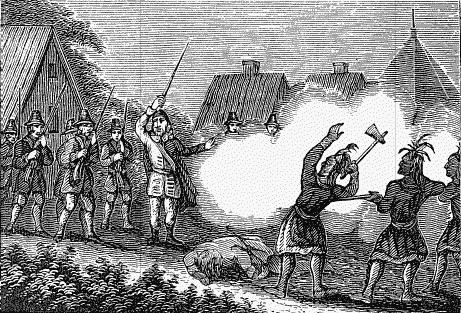
Illustration: Early colonists defending their home. Artist and date unknown.

Bibliography

Brooks, L. (2017) Our Beloved Kin: Remapping a New History of King Philips War. A Digital Awikhigan – The Treaties at Pemaquid and Cascoak.

Prins, H. E. L. (2015) The Wabanaki Frontier, 1524-1678. In: Judd, R.W., Churchill, E. A., and Eastman, J. W. (eds.). Maine: The Pinetree State  from Prehistory to the present. University of Maine Press, Bangor. pp. 97-119.

Prins, H. E. L., & McBride, B. (2007). Asticou’s Island Domain: Wabanaki Peoples at Mount Desert Island 1500-2000. Acadia National Park. Ethnography Program. National Park Service. 

Williamston, W. D. (1889) The history of the state of Maine: From its first discovery in A.D. 1602 to the separation, A.D. 1820, exclusive. Glazers, Masters, and Smith.

Euro-Wabanaki Wars (6): A doleful slaughter at Black Point, Scarborough (June 1677)

In early 1677, while Mogg Heigan was still in Boston, a militia led by Lieutenant Bartholomew Tippen was transported to Black Point and found the fortress to be unharmed and empty. All English had fled from the area after Mogg’s attack, but he had left the structures intact. The militia quickly took residence and were followed almost immediately by thirty resilient families that had been displaced earlier (Hunnewell, 2017).

All appeared well until Mogg returned on May 13, 1677, and attacked the Black Point garrison again. This time, however, the militia was ready for him. The onslaught went on for three days. “Day and night, they heard the wild cries of savage defiance; the war whoops, fierce and revengeful, grew more and more fierce as each desperate assault was repulsed, and the number of their dead multiplied. Surging backward and forward with their forces in front and rear, as the waves of old ocean sweep and surge around the half-hidden rock in the sea, so from all sides came the wild, fierce charge of the determined foe.” (Hight, 1894, pp. 262-263)

In the meager reports available on the details of the fighting, we know that three of the defenders of the garrison were killed, and one was captured and barbarously tortured outside its walls in full view of the occupants. All we know about the Wabanaki invaders is that Lieutenant Tippin made a successful shot on the third day of the fight and killed their leader, Mogg.

After Mogg’s death, the warriors withdrew, but the war was far from over.  

In June 1677, the General Council in Boston decided to deploy more troops to Maine to secure the frontier more fully.  To entice recruitment, the soldiers were offered a reward of twenty shillings for each scalp they brought back and twice that for each prisoner they took (Hunnewell, 2003).   One group of soldiers was transported by sea to Scarborough in two sloops, commanded by Major Thomas Clark and Benjamin Swett, while another group, under James Richardson, marched by land through the Merrimack and Piscataway valleys.

Soon after the two militias’ arrival, an alarm was received at the garrison that a small group of Wabanaki had been spotted approximately a mile east of the ferry servicing Black Point and Blue Point. In response, about one hundred men marched off to meet them, led by Major Clarke and Lieutenant Tippen. After the group had traveled for about two miles, they were ambushed in a horrific slaughter by Squando and a large group of his warriors.

As Hunnewell (2003) relates: “Lieutenant James Richardson was cut down soon after the first volley along with others of his men. English and friendly Indians fell wounded or dead; others tried to carry the wounded to safety, but shelter was two miles away, and they were facing an enemy that knew the territory well. Some badly wounded English found ways to hide. Some men, many of those who served with Swett before, must have held their ground. There is no doubt that some of the men, inexperienced soldiers “shifting for themselves,” left their comrades to bear the brunt of the attack. There is good reason to believe that the friendly Indians stood their ground, and there is no record that shows any treachery or perfidy on their part. The townsmen had shown their lack of resolve earlier in their encounter with Mogg the preceding year, but how they reacted now is unknown. Soon, the English and friendly Indian ranks were thrown into disarray.

Swett, showing great courage, rallied what men he could again and again and made a torturous retreat towards the garrison on the neck. The rout had turned into a tremendous defeat, and by the time Swett was within sight of the garrison, he had suffered many wounds and was taken bodily by the Indians and hewn to death. Of the nearly one hundred men who left the garrison, less than half a dozen came back without a scratch. Nineteen out of twenty of Major Clarke’s men were cut down. A doctor treated those who returned wounded. Fifty to sixty of the New England forces were dead or mortally wounded, including eight friendly Indians.”

The Indians made quick work of the wounded men left on the field. Those who were wounded and hiding were quickly dispatched, and there are no records of any captives being taken. The victorious Wabanaki then left the area, after once again culling many English. Squando is thought to have gone to Canada and did not participate in any further engagements.

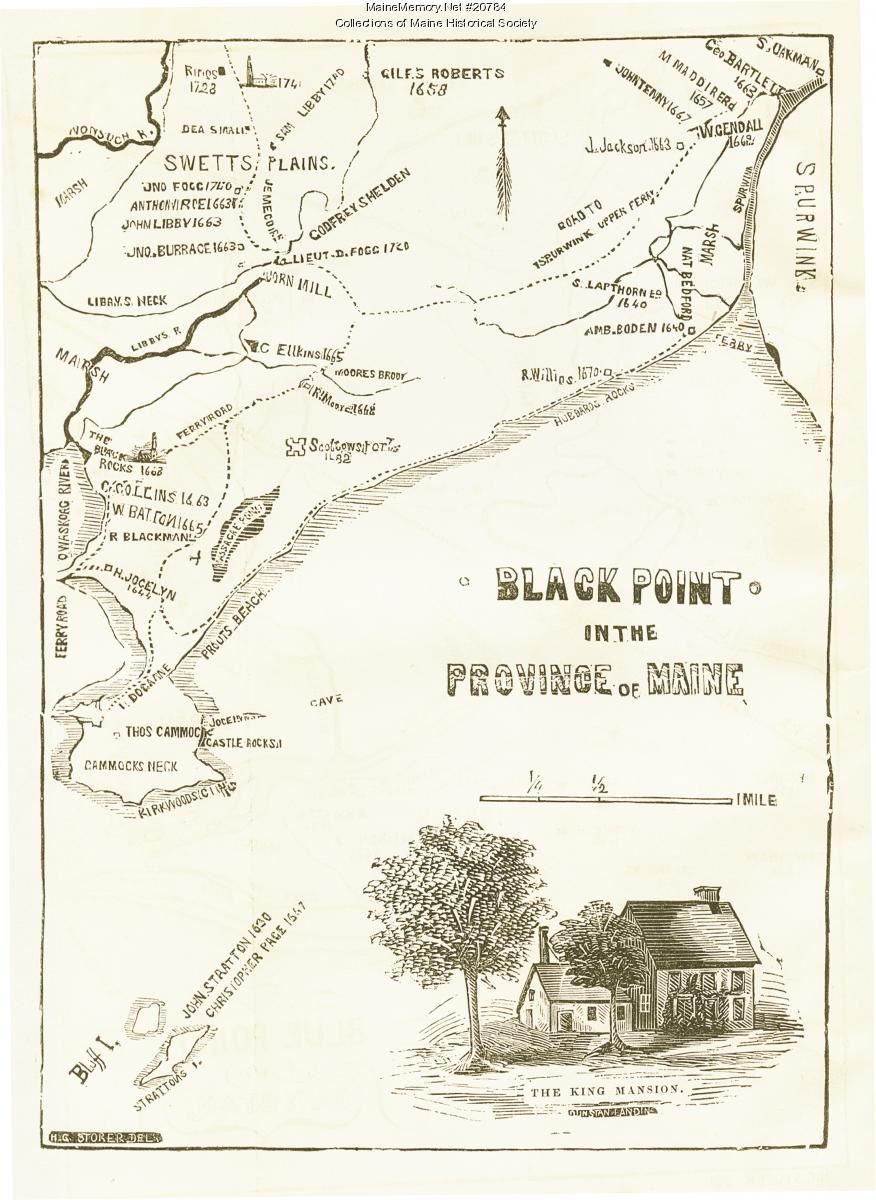
Illustration:

Map showing the supposed locations of early settlements in the Black Point area of Scarborough. Visible are Scottow’s Fort, Strattons Island and landowners’ names as well as an engraving of the King Homestead at Dunstan Landing. This map was published in 1853 to accompany William S. Southgate’s “The History of Scarborough from 1633 to 1783. From Maine Memory Network.

Bibliography:

Hight, H. (1894) Mogg Heigon- His life, his death, and its sequel. Part 1. Maine Historical Society. Vol.5: 345-360

Hunnewell, S.G. (2003) A doleful slaughter. The Maine Genealogist. 25: 51-72, 99-120.

Euro-Wabanaki Wars (5): Mogg Hagen of Saco – Warrior and Diplomat

On October 12, 1676, 100 Wabanaki warriors, led by Saco sagamore Mogg Hagen, surrounded the garrison at Black Point, demanding its surrender. Aged John Jocelyn, the village’s founder, was overseeing the garrison while its commander was away. Trying to avoid bloodshed, Jocelyn went outside the walls to talk peace with Mogg, who had long been his friend.  

Mogg, showing great courtesy, told him that he would allow everyone to go free if the garrison surrendered.  However, when Jocelyn went back inside, to his chagrin, he found the garrison empty except for his family members. All the others had fled to a vessel lying off the Neck. Jocelyn and his family had no recourse but to surrender, and Black Point was now wholly under Mogg’s control. 

Later that day, leaving the garrison intact, Mogg captured a 30-ton vessel on Richmond Island that local settler Walter Gendal and eleven others were loading to escape the hostilities. They were unaware that the garrison had been taken and were caught completely by surprise, and quickly surrendered.  

In a single day, Mogg had captured, without shedding a single drop of blood, the most substantial garrison remaining in Maine, along with eleven prisoners and a schooner—a remarkable accomplishment. 

At this point, the warring party separated into two groups and divided the captives between them. One group headed back eastward to Penobscot in the schooner, while Mogg and his tribesman traveled by land to Wells, where a few lingering settlers manned another garrison. Here, Mogg’s warriors attacked and killed two men and wounded another three outside the garrison walls, but were not able to take the fort. Considering this garrison of trifling importance, Mogg now made the epic decision to travel to Boston to seek a treaty with Governor John Leverett. He believed that with the English now largely purged from Maine, they would be ready to sue for peace and restore trade.

The scenes in Boston must have been quite an experience for Mogg. As Horacio Hight (1887, pp. 357-358) suggested: “It is fair to presume that no pains were spared to impress upon this half-civilized savage the greatness of the metropolis of New England. Boston was then a town of five thousand inhabitants. Some of the streets were paved; many of the buildings stood close together on both sides of the streets. The city contained three meeting houses and a townhouse. Besides these, there was the governor’s residence and two constant fairs for daily traffic thereunto. Undoubtedly, he was shown the stores of great artillery and heard much concerning the powerful army then making war on the Narragansetts”.

Alone and without counsel, Mogg forged ahead with Leverett to make a treaty. However, the still arrogant Governor presented Mogg with terms that heavily favored the English, completely ignoring the fact that the English had been overwhelmingly defeated. Levett demanded that Mogg go back to Maine and get the Penobscot superchief Madockawando to 1) stop all hostilities against the English and declare war on any Indians that continued them, and 2) return all English captives, ships, and goods, including arms and artillery, that they took from the English, and compensate them for all injuries, losses, damages to houses, cattle, and estates, either immediately or in yearly fees paid to the government of Massachusetts Bay. If this were all done, the English agreed to supply the Wabanaki with powder, firearms, ammunition, and other necessary supplies, but only from traders approved by the governor and council.

Incredulously, Mogg signed the treaty, undoubtedly fearing for his life if he did not. It is very hard to believe that he intended to adhere to its stipulations.

On November 21, the Governor sent Mogg under guard to the Penobscot to seek Madockawando’s signature on the peace accord and secure the release of the remaining captives under his control.  Madockawando agreed to sign the treaty but, at present, had only two of the captives with him, as other sagamores had taken the rest further east. Mogg was set free by the English authorities to find and bring back these prisoners for release. Of course, once given his freedom, Mogg defied the authorities and fled directly home. 

Upon his return, Mogg found that his people were far from ready for peace. As Hight (1896, p. 258) describes: “Mogg found, upon returning among his people, that he had incurred the displeasure of those who were only too happy in the enjoyment of the spoils gathered from the various English settlements. The large quantity of goods captured by them at Arrowsick Island and other places, with English captives, to make garments for them, the grain and corn harvested after their fashion, with cattle and horses that supplied the place of moose meat, came nearer to giving them a comfortable living than any other turn of affairs in all their savage lives. These were affording them too comfortable maintenance for them to think of a treaty that required restitution.”

In no way was the first Wabanaki-Anglo War about to end! The spoils of war had made the Wabanaki way too comfortable.

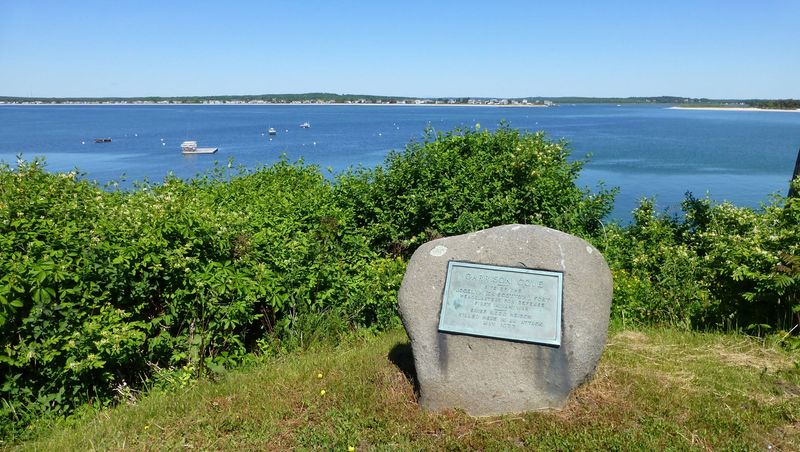
Illustration: Black Point Forts Garrison Cove Marker, photo by John Stanton 5 Jun 2013.

Bibliography:

Dekker, M. (2015) French & Indian Wars in Maine. The History Press. Charleston, South Carolina.

Ghere, D. L. (2015) Diplomacy & War on the Maine frontier, 1678-1759. In: Judd, R.W., Churchill, E. A., and Eastman, J. W. (eds.). Maine: The Pinetree State  from Prehistory to the present. University of Maine Press, Bangor. pp. 51-75.

Higgins, P. (2000) Mogg Hegon & Henry Jocelyn come to an agreement. The Maine Story. https://mainestory.info/maine-stories/mogg-hegon–henry-jocelyn.html

Hight, H. (1889) Mogg Heigon- His life, his death, and its sequel. Part 1. Maine Historical Society. Vol.5: 345-360

Hight, H. (1896) Mogg Heigon- His life, his death, and its sequel. Part 2. Maine Historical Society. Vol.6: 256-279

Euro-Wabanaki Wars (4): Wabanaki Raids in 1676

Waldron’s taking of slaves at Machias galvanized Wabanaki opposition throughout Maine, and the tribes began making bloody lightning raids.  Their actions were not coordinated, but they nonetheless presented a united front; Pigwackets, Sacos, Androscoggins, Kennebecs, and Penobscots all participated in the violence. They would fight the English via small raiding parties of rarely more than twenty warriors, falling upon outlying farms and poorly defended villages.

The entire frontier was lit up with these raids, but the English had no way to counter them without a center of operations to attack.  They had no defense “against these numerous, tiny, highly mobile groups of extremely skilled Wabanaki warriors who attacked in uncoordinated, minimally planned, and minimally strategized yet relatively spontaneous raids” (Bilodeau, 2013, p. 26).

In the summer of 1676, Falmouth and several other locations around Casco Bay were subject to brutal raids, and a total of 34 English were slaughtered or taken captive. From their farm on the Back Cove, Anthony Brackett, his wife, five children, and a slave were taken prisoners, and Mrs. Brackett’s brother was killed and scalped. Along the mouth of the Kennebec, more than a dozen settlements were destroyed.

Also, that summer, a series of Sagadahoc settlements came under murderous attack (Dekker, 2015). The first was Richard Hamilton’s trading post at Days Ferry, located in today’s Woolwich. Hammond was butchered along with two other men, and 16 were taken captive. The fortified trading post of the Clarke and Lake Company at Arrowsic was also taken in bloody hand-to-hand combat. Thirty-five people were slain, and the fort, mills, mansion houses, and outbuildings were burned to the ground.

In a panic, the residents of Sheepscot fled to Cape Newagan on the tip of Southport Island, leaving everything behind, including hundreds of cattle. They watched in horror as “the whole circle of the horizon landward was darkened and illuminated by the columns of smoke and fire rising from the burning houses of the neighboring Main … From there, they fled to Damariscove Island near what is now Boothbay. By the end of August, the island was home to an estimated 300 English war refugees. Unable to adequately support and defend themselves on the Island, the English exiles from mid-coast Maine soon made their way westward to Massachusetts and the Piscataqua River” (Dekker, 2015, p. 31).

In only five weeks, 60 miles of the coast east of Casco Bay had been “wiped clean of English settlements” (Anonymous, 2010). The mid-coast region of Maine would remain devoid of any English settlers for the next 25 years!

To the fleeing colonists, it was clear why they had been attacked. In a petition to the Council from trader Thomas Gardner and several others,  they suggested the assaults were due to a combination of outside instigation, anger at Waldron’s abductions, and the ban on gun sales.

The petition read: “The Cause of the Indianes Riseing Apeares to us to be threfold the first & Cheefest being the Coming of diners Indianes from the westwards who by ther perswation & Asistance have set these Indianes on this vngodly Enterprise. The Second Cause being the perfidious & unjust dealing of som English as we Supose who haue Stouen Eight or Nine persones from the Indianes About Micheas River & Caried them Away. the Indianes being Incensed for their lose we desier that Enquiry may be made of one Lawton that went in A Cach of Mr Simon Lines one John Lauerdore being of Company About it.  The Third Reason which thay likewise Render : the last winter for want of Powder died in the Conntry haue in of nothing to kill food & thay say that After their present Crop ot Corne be spent this winter thay must Starve or go to Cannade” (Baxter, 1900, pp. 118-119).

King Philip’s War was now a full-blown, bloody confrontation.

Illustration: Colonists defending their settlement. circa 1800s, unknown illustrator

Bibliography:

Anonymous (2010). 1668-1774, Settlement and Strife. Maine History Network. The Maine Historical Society, Portland. 

Baxter (1910) Documentary History of the State of Maine, Baxter Manuscripts.  Vol.14. Maine Historical Society, Portland.

Bilodeau, C. J. (2013) Creating an Indian Enemy in the Borderlands: King Philip’s War in Maine, 1675-1678. Maine History 47(1): 10-41.

Dekker, M. (2015) French & Indian Wars in Maine. The History Press. Charleston, South Carolina.

Siebert, F. T. (1983). The First Maine Indian War: Incident at Machias. Algonquian Papers – Archive, 14. https://ojs.library.carleton.ca/index.php/ALGQP/article/view/837

Euro-Wabanaki War (3): William Waldron’s Deceit (1675)

In November 1675, Dover trader and slaver Richard Waldron decided to use the ongoing Wabanaki raids along the eastern coast of Maine as a justification for profit.  He commissioned his nephew, Willian Waldron, to travel up the Maine coast to seek out and capture Wabanaki for sale as slaves.

The full commission  read (Brooks, 2017a): “The Insolency of ye Indian enemy being such as that in ye Eastern parts they have Made sundry Assaults upon us to ye great prejudice of ye people there both in ye loss of ye lives and Estates of many of them & as yet no considerable damage done them by ye soldiers or Inhabitants[.] that yourself being bound into those parts these are to Im[power] and commission you with what company shall [g]o along with you as the opportunity presents to pursue kill & destroy & by all ways & means to Annoy ye said Indian Enemy[.] Attending such further order as you shall receive from myself or other superior authority.”                                                       

Richard Waldron was a major in the militia, a deputy in the Massachusetts General Court, and a prominent sawmill owner and trader in Dover. He had a particularly odious reputation among the Algonquians as an unscrupulous dealer. He turned to slavery as a more lucrative alternative to fur trading when beaver pelts became less plentiful.

Waldron was most notorious for taking four hundred Algonquians into captivity in 1674. The Algonquians, fleeing the militia, were invited by him to participate in a mock battle. When they all fired their first round, he took them prisoner. He sent their leaders to Boston for execution, while the rest were sold into slavery, mostly in Barbados.

The depth of Waldron’s animosity towards the Algonquians seems unconscionable today but was very typical among the English of his time. As Siebert (1983, 151) relates: “the majority of the English regarded the Indians with ill-concealed contempt as inferior beings who were to be tolerated until they could be either acculturated or driven away.”  However, not all English felt this way. A particularly notable exception was trader Thomas Gardner of Pemaquid, who wrote a letter to Waldron in 1676 begging him “not to take any Indians east side of Kenibek River because we had made peace with them” (Brooke, 2017a).

William Waldron sailed on the Endeavor, chartered by Henry Lawton, up the Wabanaki coast to Machias, where he managed to take 32 Penobscot prisoners, approximately half of a village’s population, including its Sagamore and his wife (Siebert, 1983). He then sold his captives in Fayal (modern Faial Island), which was then at the crossroads of the slave trade in the Azores.  

The reaction of Boston authorities

Despite the general hatred of Algonquians, Waldron’s abductions did not go down well with the Boston authorities. On August 23, 1676, Edward Rawson, the Secretary of the colony, issued a warrant for the arrest of Lawton and Waldron “for seizing and carrying away 30 Indians where one Sagamore & his squaw to ye Eastward” (Baxter, 1900, p. 120). 

Siebert (1983, p. 140) suggests that “Leverett’s motives were probably threefold: partly humanity and justice; the desire to avoid any more trouble with the Indians of which he already had plenty; and partly to circumvent any protest from the French.” Machias was within the bounds of French Acadia as determined by the Treaty of Breda.

The Governor of the colony, John Leverett, also requested that the English sea captain, Bernard Trott, attempt to rescue the Amerindians. Trott was able to recover the chief and his wife but not the others, for they “had disappeared into the cruel oblivion of slavery” (Siebert, 1983, p. 140).

The warrant for Waldron’s arrest on August 23, 1676, was for the “apprehending” and imprisonment of William Waldron, charging him with “Seazing and Carrying away 30 Indians” from “ye Eastward,” including “a sagamore” and his wife. The indictment of William Waldron, which came later, stated that he “did unlawfully surprise & steal away seventeen Indians men women & children & in your vessel called the endeavor of Boston Carrjed & sent them to fall & there made the sale of them. Henry Lawton, who chartered the ship, was also charged but “broke prison,” while the ship’s master, John Haughton, was “fined.”  Waldron, the merchant, was eventually tried and discharged (Brooks, 2017a).

Waldron likely escaped punishment due to the widespread hostility towards the Amerindians, his family connections, and particularly his uncle’s prominent role in King Philip’s War. In dealing with Indian affairs, the English courts rarely ruled against perpetrators of violence against the Algonquians and made little effort to understand their side of the story. As Bilodeau (2013, p. 22) tells it: “Many Bostonians, and even settlers and traders along the coast of Maine, minimized their interaction with the Wabanakis. Although some traders, such as Thomas Gardiner, understood keenly the differences between Wabanaki groups and befriended many Indians, these men were often ignored when discussions about Indian policy occurred in Boston. Policymakers in Massachusetts Bay lacked nuance in their views toward the Indians and failed to recognize the importance of diplomacy … Boston officials rarely deviated from certain goals: regulate all trade with the Indians, keep them away from the French, and, after 1693, demand their subjection under the English crown. “

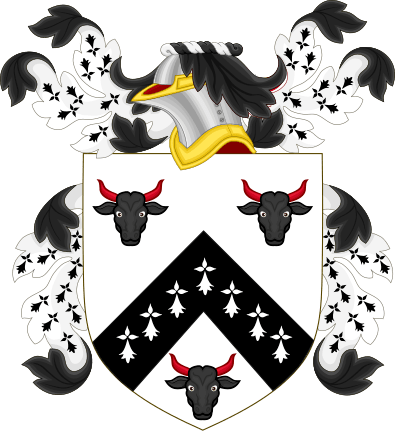
IllustrationCoat of Arms of Richard Waldron. Matthews’ American Armory and Blue Book, 1907.

Bibliography:

Baxter (1910) Documentary History of the State of Maine, Baxter Manuscripts, Vol. XXIV. Portland

Bilodeau, C. J. (2013) Creating an Indian Enemy in the Borderlands: King Philip’s War in Maine, 1675-1678. Maine History 47(1): 10-41.

Brooks, L. (2017a) Our beloved kin: Remapping a new history of King Philip’s War. A digital Awikhigan – Capture at Machias: William Waldron’s deceit.

Brooks, L. (2017b) Our Beloved Kin: Remapping a New History of King Philips War. A Digital Awikhigan – The Treaties at Pemaquid and Cascoak.

Siebert, F. T. (1983). The First Maine Indian War: Incident at Machias. Algonquian Papers – Archive14.

Euro-Wabanaki Wars (2): Metacomet’s (King Philip’s) War erupts in Maine

In the summer of 1675, a massive war broke out in southern New England between the English and the Algonquin-speaking Nipmuck, Narragansett, and Wampanoag. The outbreak was nominally led by Metacomet, whom the English called King Philip. This war would have enormous impacts on both Amerindian and English society in southern New England.

As Christopher Bilodeau describes (2013, pp. 10-11): “King Philips War has been called the most destructive war fought between Indians and Englishmen during the colonial period … Angry about English encroachment onto their lands by settlers, both Boxuss and Protestant missionaries, these Indian groups asserted their sovereignty against what they believed were unjustifiable pressures. Between one and five percent of the total English population of the area was killed. The war cost the English over £150,000 in damaged property and £100,000 for their defense—an enormous burden under which these colonial governments suffered for years. As for the Indians, Philip was killed in August 1676, and through casualties, the massive movement of refugees, and enslavement, the Indian presence in southern New England fell from one-fourth of the overall population to one-tenth. From that point onward, the English maintained a political stranglehold over the area.”

In the third quarter of the 17th century, the Wabanaki of  Maine had also reached a tipping point. They were fed up with the history of English trade abuses, land encroachments, rum dealing, and the destruction of their cornfields by livestock. Hostilities would erupt in Maine, leading  “to an unprecedented victory for the Wabanaki and an unmitigated disaster for the English” (Bitodeu, 2013, p. 13).

As the English colonists pushed deeper and deeper into Wabanaki territory, the atmosphere was ripe for a revolt. The Indigenous leaders were forced to accept the reality that the English considered their land sales to be deeds of ownership, not sharing relationships.  It was crystal clear that the English would never stop encroaching on their traditional hunting and fishing lands, periling their subsistence.

This tinderbox erupted into flames in the fall of 1674 when the Massachusetts Legislature decided to keep the Wabanaki at bay by banning all powder and shot sales to them. This action threatened the Wabanaki’s very livelihood, for by now, firearms were critical to their sustenance.

The flames of war were further fueled by the scalp bounty laws legislated by the Massachusetts Assembly during King Philip’s War. These laws offered substantial cash payments to any white colonists who murdered and brought in the scalps of Indigenous men, women, and children. The scalp hunters were not supposed to operate north of the Piscataway, but they moved into Maine anyway, not able to resist the lure of further profit.  

Between 1675 and 1765, 80 scalp bounty acts or laws were issued by the colonial governments of Massachusetts, Connecticut, New Hampshire, and Nova Scotia. At least 141 claims were recorded, with more than £9,000 in bounty payments made and hundreds of thousands of acres of land granted (Upstander Project).

The final tipping point came in Maine in the summer of 1675 when some drunk English fisherman accosted the wife and child of Squando, a Saco River sagamore, by overturning their canoe. The fisherman wanted to test the theory that Indian babies could swim from birth. The baby died, and Squando immediately sought revenge. He convinced several Wabanaki tribes in western Maine and eastern New Hampshire, to join him in an assault on English settlements along the frontier.  

In September, twenty Wabanaki looted the home of Thomas Purchase at Brunswick. No one was harmed, but “Purchase’s neighbors pursued the raiders up the New Meadows River, surprising and killing one; the resulting skirmish was the first battle of King Philip’s War in Maine” (Anonymous, 2010, n.p.).

Next, the home of Thomas Wakely in Falmouth was attacked, several family members were tomahawked, and a girl was taken captive. As the reverend William Hubbards described in his early account of the war in 1667: “The house was burned to ashes, the bodies of the old man and his wife half consumed by fire, the young women killed, and three of the grandchildren having their brains dashed out” ( Shults and Togias,  p. 304).

Various bands of Wabanaki continued to rampage throughout the fall. As Siebert (1983, p. 142) describes: “From September 9 to 12 at Falmouth and Casco Bay five houses were burned, two of them belonging to George Munjoy, and about 10 English killed, and three children taken into captivity.  On September 18, 1675, Saco was attacked and burned, and about 40 Abenakis killed 13 white men under Sagamore Squando  …  In September and October, there were assaults on Falmouth, Casco Bay, Blue Point, Kittery, Wells, Cape Porpoise (later Arundel, now Kennebunkport), and York, and on October  9, some 70 or 80 Wabanaki attacked Black Point and killed six men and a woman and burned 22 houses. Again, on October 19, they burned eleven or twelve houses and 500 bushels of corn in barns.  In the first two months, about 80 English were killed in Maine, and many others were taken into captivity.”

War was on!

Illustration: Amerindian attack on a homestead during King Phillips War. North Wind Picture Archives.

Bibliography:

Anonymous (2010). 1668-1774, Settlement and Strife. Maine History Network. The Maine Historical Society, Portland. 

Bilodeau, C. J. (2013) Creating an Indian Enemy in the Borderlands: King Philip’s War in Maine, 1675–1678. Maine History 47(1): 10–41.

Dekker, M. (2015) French & Indian Wars in Maine. The History Press. Charleston, South Carolina.

Shultz, E. B. and Tougias, M. (1999) King Phillips War: The history and Legacy of America’s forgotten conflict. Countryman Press, Woodstock, VT.

Euro-Wabanaki Wars (1): Settlements in Maine Before the Hostilities

In 1675, the English occupation of Maine was limited to a narrow coastal band, extending from the Piscataway to Penobscot Rivers, and along the riverine valleys. The English clung to what early historian William Hubbard called the “sea border” and considered the unfamiliar woods behind them “a great Chaos, the lair of wild beasts and wilder men” (Maine History Online, 2010).

The most significant concentrations of English settlers were located at Cape Porpoise and Saco, Falmouth, the Pemaquid Peninsula, and along the Kennebec and Penobscot Rivers. The English population in Maine consisted of approximately 3,500 hardy souls in 1675, while the rest of New England, mostly Massachusetts, contained around 50,000.  

As Siebert (1983, p.) describes Maine in 1675: “The largest and most important white community was Black Point, which included Prout’s Neck and Scarborough and extended from the Spurwink River west to the Nonesuch River. It counted more than 50 houses and had a population of about 650 people with a militia of 100 men. The Abenakis recognized Black Point as the strongest fortification in Maine and the most difficult to reduce since it had at least four strong garrison houses, those of William Sheldon, Joshua Scottow, Richard Foxwell, and Henry Jocelyn (Josselyn).  Next in size was Casco Bay or Falmouth, which included the scattered habitations along the Fore River, on Munjoy Hill, and about the Back Cove and Presumpscot River, with a total of about 40 houses and 400 people. There were about ten other settlements from Kittery to Pemaquid.

As English society grew in the seventeenth century, hamlets evolved into towns, and forests and open lands increasingly gave way to the axe and the plow. This increased contact with the Wabanaki led to conflict. “The proliferation of fur traders and settlers profoundly disturbed the Abenaki way of life” (Baker, 1985, p. 13). As increasing numbers of fishermen moved into the Riverine valleys, they pushed the Wabanaki further back into the backcountry, away from their traditional coastal fishing grounds that they had relied on seasonally for food. This made them more dependent upon hunting game for food and obtaining English food supplies. The arrival of European fur traders also tied the Indians even more strongly to hunting. By 1675, the Wabanaki people had come to depend on English guns and ammunition for survival, abandoning their traditional methods of huntingThe stage was now well set for the coming wars.

The economy

The economy of Anglo-Maine was centered around agriculture, fishing, and lumbering. The prominent settler at Black Point, John Josselyn, remarked (Churchill, 2011, p. 66);  “All these towns have stores of salt and fresh marsh [hay] with arable land. They are well-stocked with cattle.   Josselyn also found Saco and Winter Harbor “well stored with cattle, arable land, and marshes.” William Hubbard indicated that “upon the banks [of the Sheepscot] were many scattered planters … a thousand head of neat cattle … besides … Fields and Barns full of Corn.” Further east lay Pemaquid, “well accommodated with Pastureland about the Haven [harbor]   for feeding Cattle and some Fields also for tillage.” Fishing was also much in evidence.  However, there were some regional differences in economic emphasis. Wells, Saco, Falmouth, and Sheepscot were focused on farming, while Cape Porpoise, Winter Harbor, Richmond Island, Damariscove, and Monhegan were concentrated on fishing.

The lumber trade also substantially impacted most of the European settled coast. As Churchill (2011, p. 67) describes, “… nearly every community had at least one sawmill, and a number had several…” The first mill was built by John Mason in 1634 on the Little Newchawnnock River (near Berwick). Although short-lived, it was followed by at least six other mills between 1648 and 1660. By the mid-1670s, York supported at least ten mills, while Wells and Saco each had three. Further east, the Clark and Lake swills in the Sagadahoc area readied a hundred thousand feet of boards for shipment in 1675. The Piscataqua area also provided numerous white pine masts and spars, many of which were being shipped directly to England” (Churchill, 2011, p. 67).

As the towns matured, they acquired many artisans, including blacksmiths, carpenters, millwrights, coopers, shoemakers, and tailors.

The French

The French were in much smaller numbers than the English in Maine, located at trading outposts of varying duration at Pentagoet atthe mouth of the Penobscot River, St. Sauveur on Desert Island, Magies on the Machias River, and Port Royal in Nova Scotia. By far, the greatest concentration of Frenchmen was more south in the St. Lawrence Valley and Quebec, where about 10,000 lived.

Overall, the Wabanaki felt much friendlier toward the French than the English, as they did not view the French as harboring the same expansionistic designs as the English. The French were almost entirely focused on the fur trade, and the Wabanaki would form strong alliances with them for that purpose. The French learned to speak fluent Algonquian and worked diligently to establish trading relationships based on mutual respect.

Illustration:

William Hubbard’s first map of New England (1667). From his “A Narrative of the Troubles with Indians in New England, from the Planting Thereof to the Present Time.” Originally published in Boston.

Bibliography:

Baker, E. W. (1986) Trouble to the eastward: the failure of Anglo-Indian relations in early Maine. Dissertations, Theses, and Masters Projects. William & Mary. Paper 1539623765. https://dx.doi.org/doi:10.21220/s2-mh0r-hx28

Churchill, E. (2011). English beachheads in seventeenth-century Maine.  In: Judd, R.W., Churchill, E.A., and Eastman, J.W. (Eds.). Maine: The Pinetree State from Prehistory to the Present. University of Maine Press, Bangor. pp. 51–75.

Maine History Online (2010). 1668-1774, Settlement and Strife. Maine History Network. The Maine Historical Society, Portland.  https://www.mainememory.net/sitebuilder/site/897/page/1308/print

Siebert, F. T. (1983). The First Maine Indian War: Incident at Machias. Algonquian Papers – Archive14.  https://ojs.library.carleton.ca/index.php/ALGQP/article/view/837

Early Settlement Period (16): Governor Thomas Gorges’s Letter Home

In I640, Sir Ferdinando sent his young cousin Thomas Gorges, age 22,  as Deputy Governor to Bristol (Agamenticus) in the Province of Maine. Once settled in his new home, Thomas wrote letters periodically to his father which he copied into the blank pages of a commonplace book. Remarkably,  this book has survived, painstakingly transcribed and published by Professor Robert Moody of Boston University.

Thomas’s life in Maine, his frustrations, daily life, and his hopes for the future are wonderfully depicted in the following letter (Moody, 1972, pp. 47 – 50):  

“… I have now bin these three weeks at Accomenticus where I was a welcome guest to all sorts of people. I found Sr. Fard: house much like your Barne, only one pretty handsome roome & studdy without glasse windowes which I reserve for myself. For the household stuffe only one crocke, 2 Bedsteads and a table board. For his feild without fence, for his miles [mills]  without reparation and of cattle only 2 yearlinge and one calf. House­ hold stuffe I will shortly provide. In the meanwhile I have use of all the Tenants who with his wife are very godly people & I have a great comfort in there company.

I brew beer one day and ’tis good stale beer by the next day and we drinke it till we have mayde an end & then we drinke water till we can get more. This we must doe for there are but few vessels … In the meantime I am better contented than ever I was in England. Hither my diet is beef & pease, butter & cheese, fowl & fish. At winter I intend to get Bacon & poultery soe that I cannot see without good judgment the want of anythinge. Hitherto I have imployed my men about the house, now I intend to set them to mowing … And at winter they shall prepare pale to fence the feild which is 7 or 8 acres. For springe, Chris: Rogers  I intend to put into the grist mill as soone as I shall have it a little repaired, which mill & the saw mill with a little cost if they be well mended, as I hope they shall, will bringe in 200 li per an. to Sr. Fard: at the least. As yet he hath but halfe the profit.

Likewise the smiths mill will bringe in a good round sum, & in the interim he works it & will be every day cominge. Likewise the Rents of the Province will amount to a good round sum in time. Some now pay 10s per an., some 5s. some more, some lesse. At the next Court (4) we intend to confirm all theyr leases & have exact account of expences [?arrears?]. At my landinge in the Bay [torn] begun in the Province & at my arrival here [2] [torn] brought me all theyr proceedings, & I protest I admir’d to see so excellent way of orderinge all thinges. They doe it with grand & pety Juries & the officers of a court as they do in Ingland & all the fines goe to Sr. Fard:. About 8 weeks hence we have a 2d wherin my commission (5) is to be published & Mr. Champernoun & rnyselfe are to take our oaths, & then I intend to have my lease of 4000 acres (6) registered, which giuft of Sr. Fard: is not to be contemned for I know what benifit by Gods blessinge accrue of it. I could wish I had my law books I left in England, for I studdy Law & have more<need to use> of it then ever I had. I will direct you shortly some means for the conveyance of them to me. I pray Sr. intreat God to endow me with a wise heart that my actions may tend to his glory, to the advancement of the church and commonwealth, with a faythful heart towards Sr. Fard: & with a dutiful & obedient heart towards you & my mother, as I hope in God you shall finde …

The great Sagamour  hath bin with me to welcome me to his country. I find them very ingenious men only Ignorant of the true wisdome. I told him I pittied his case that he was soe Ignorant of God. He answered me he knew his great God Tanto, that he lives westward in a great city & feeds uppon pidgeons & they that doe well shall goe to him to the west country, & the naughty men shall go into the east cold country, & with those that dy they bury theyr bows & arrowes, money which they call wanpumpeage & theyr other thinges bee: they shall have need of it where they goe. Truly I take great delight to discourse with them … Thus with my duty remembered yourselfe, my ever lovinge mother, my brothers & sisters & all my friends in general, I rest.”

IllustrationA 17th-century colonial home (Craven, 2023).   

Bibliography:

Craven, J. (2023) Guide to Colonial American House Styles From 1600 to 1800. Ancient World History. https://www.thoughtco.com/guide-to-colonial-american-house-styles-178049

Moody, R. E. (1972) A letter from Thomas Gorges letter book. Maine History 12: 46–50.

Early Settlement Period (21): Maine in 1675

In 1675, the English occupation of Maine was limited to a narrow coastal band, extending from the Piscataway to Penobscot Rivers, and along the riverine valleys. The English clung to what early historian William Hubbard called the “sea border” and considered the unfamiliar woods behind them “a great Chaos, the lair of wild beasts and wilder men” (Maine History Online, 2010).

The most significant concentrations of English settlers were located at Cape Porpoise and Saco, Falmouth, the Pemaquid Peninsula, and along the Kennebec and Penobscot Rivers. The English population in Maine consisted of approximately 3,500 hardy souls in 1675, while the rest of New England, mostly Massachusetts, contained around 50,000.  

As Siebert (1983, p.) describes Maine in 1675: “The largest and most important white community was Black Point, which included Prout’s Neck and Scarborough and extended from the Spurwink River west to the Nonesuch River. It counted more than 50 houses and had a population of about 650 people with a militia of 100 men. The Abenakis recognized Black Point as the strongest fortification in Maine and the most difficult to reduce since it had at least four strong garrison houses, those of William Sheldon, Joshua Scottow, Richard Foxwell, and Henry Jocelyn (Josselyn).  Next in size was Casco Bay or Falmouth, which included the scattered habitations along the Fore River, on Munjoy Hill, and about the Back Cove and Presumpscot River, with a total of about 40 houses and 400 people. There were about ten other settlements from Kittery to Pemaquid.

As English society grew in the seventeenth century, hamlets evolved into towns, and forests and open lands increasingly gave way to the axe and the plow. This increased contact with the Wabanaki led to conflict. “The proliferation of fur traders and settlers profoundly disturbed the Abenaki way of life” (Baker, 1985, p. 13). As increasing numbers of fishermen moved into the Riverine valleys, they pushed the Wabanaki further back into the backcountry, away from their traditional coastal fishing grounds that they had relied on seasonally for food. This made them more dependent upon hunting game for food and obtaining English food supplies. The arrival of European fur traders also tied the Indians even more strongly to hunting. By 1675, the Wabanaki people had come to depend on English guns and ammunition for survival, abandoning their traditional methods of huntingThe stage was now well set for the coming wars.

The economy

The economy of Anglo-Maine was centered around agriculture, fishing, and lumbering. The prominent settler at Black Point, John Josselyn, remarked (Churchill, 2011, p. 66);  “All these towns have stores of salt and fresh marsh [hay] with arable land. They are well-stocked with cattle.   Josselyn also found Saco and Winter Harbor “well stored with cattle, arable land, and marshes.” William Hubbard indicated that “upon the banks [of the Sheepscot] were many scattered planters … a thousand head of neat cattle … besides … Fields and Barns full of Corn.” Further east lay Pemaquid, “well accommodated with Pastureland about the Haven [harbor]   for feeding Cattle and some Fields also for tillage.” Fishing was also much in evidence.  However, there were some regional differences in economic emphasis. Wells, Saco, Falmouth, and Sheepscot were focused on farming, while Cape Porpoise, Winter Harbor, Richmond Island, Damariscove, and Monhegan were concentrated on fishing.

The lumber trade also substantially impacted most of the European settled coast. As Churchill (2011, p. 67) describes, “… nearly every community had at least one sawmill, and a number had several…” The first mill was built by John Mason in 1634 on the Little Newchawnnock River (near Berwick). Although short-lived, it was followed by at least six other mills between 1648 and 1660. By the mid-1670s, York supported at least ten mills, while Wells and Saco each had three. Further east, the Clark and Lake swills in the Sagadahoc area readied a hundred thousand feet of boards for shipment in 1675. The Piscataqua area also provided numerous white pine masts and spars, many of which were being shipped directly to England” (Churchill, 2011, p. 67).

As the towns matured, they acquired many artisans, including blacksmiths, carpenters, millwrights, coopers, shoemakers, and tailors.

The French

The French were in much smaller numbers than the English in Maine, located at trading outposts of varying duration at Pentagoet atthe mouth of the Penobscot River, St. Sauveur on Desert Island, Magies on the Machias River, and Port Royal in Nova Scotia. By far, the greatest concentration of Frenchmen was more south in the St. Lawrence Valley and Quebec, where about 10,000 lived.

Overall, the Wabanaki felt much friendlier toward the French than the English, as they did not view the French as harboring the same expansionistic designs as the English. The French were almost entirely focused on the fur trade, and the Wabanaki would form strong alliances with them for that purpose. The French learned to speak fluent Algonquian and worked diligently to establish trading relationships based on mutual respect.

Illustration:

William Hubbard’s first map of New England (1667). From his “A Narrative of the Troubles with Indians in New England, from the Planting Thereof to the Present Time.” Originally published in Boston.

Bibliography:

Baker, E. W. (1986) Trouble to the eastward: the failure of Anglo-Indian relations in early Maine. Dissertations, Theses, and Masters Projects. William & Mary. Paper 1539623765. https://dx.doi.org/doi:10.21220/s2-mh0r-hx28

Churchill, E. (2011). English beachheads in seventeenth-century Maine.  In: Judd, R.W., Churchill, E.A., and Eastman, J.W. (Eds.). Maine: The Pinetree State from Prehistory to the Present. University of Maine Press, Bangor. pp. 51–75.

Maine History Online (2010). 1668-1774, Settlement and Strife. Maine History Network. The Maine Historical Society, Portland.  https://www.mainememory.net/sitebuilder/site/897/page/1308/print

Siebert, F. T. (1983). The First Maine Indian War: Incident at Machias. Algonquian Papers – Archive14.  https://ojs.library.carleton.ca/index.php/ALGQP/article/view/837