In the spring of 1693, James Converse was made Commander-in-Chief of the eastern forces, consisting of all the garrison soldiers and 350 new recruits. He began a campaign along the coast, hunting down and harassing groups of Wabanaki at Piscataqua, Wells, Sheepscot, Pemaquid, Teconnet, and Saco. This rampage brought many of the starving and exhausted Wabanaki to desire peace.
On August 11, thirteen Sagamores representing tribes from Saco, Androscoggin, Kennebec, and Penobscot, including Sagamores Madockawando and Moxus, came to the garrison at Pemaquid and asked to treat.
The English commissioners, John Wing, Nicholas Manning, and Benjamin Jackson demanded that “the Wabanaki pledge total subservience to the British Crown, confess to having caused the war, and admit that the French had instigated it. The treaty stipulated that the eastern tribes cease hostilities with the English, release all English captives without ransom, settle disputes in English courts rather than through armed conflict, and recognize English land claims”. (Dekker, 2015, pp. 41 – 42)
Despite the harsh stipulations, the thirteen sagamores felt compelled to sign the agreement. However, its signing provoked outrage among the Wabanaki sagamores, who were not present. They flatly rejected the treaty due to its blatant English bias.
“Acceptance of the treaty was further undermined when it was learned that Madockawando, despite questionable authority to do so, had sold a large parcel of land to Sir William Phips in the area now encompassing Thomaston, Warren, and Cushing” (Dekker, 2015, p. 42).
Dismayed by the breach within the Wabanaki Confederacy, the French also depicted the peacemakers as traitors. Under pressure, the thirteen signatories were forced to close ranks with the rest of the Wabanaki sagamores, and a reunified Wabanaki Confederation resumed its fight against the English.
On the 18th of July 1694, a force of 250 under Madockawando, Bomaseen, and Toxus, “again destroyed Dover in New Hampshire and, after plundering places further westward, returned to Piscataqua on August 20th, when a large party of them crossed over into Kittery with intent, manifestly, to complete the ruin of Maine. At Spruce Creek, they killed three, and at York, one, where they also took a lad prisoner. On the fifth day of their visit, they made a bold attack upon Kittery, and slew eight persons …” (Williamson, 1889, p. 640)
The bloody war would continue on for another two years. Periodic attempts by the Wabanaki for peace were consistently thwarted by English deceit. “In November 1694, four Wabanaki were killed under a flag of truce at Saco, and three others were taken prisoner a few weeks later in similar circumstances. When the Wabanaki released some of their captives during the following spring, the English refused to reciprocate. Then, in February 1696, several Indians were killed after they were lured into Fort William Henry to negotiate a settlement” (Ghere, 1995, p.127).
Last battle of King William’s War
In the late spring of 1696, in what turned out to be the final battle of King William’s War, Fort William Henry fell to a mixed force of 80 French and Canadian soldiers and several hundred Wabanaki, led by Pierre Le Moyne d’Iberville. Under siege by d’Iberville’s warships, the fort, which was considered so formidable, was found to be quite the opposite. The stone walls were built with poor-quality mortar and soon began to crumble under the concussive force of their own guns. Making matters even worse, the fort had no water source within its walls. Greatly outnumbered, the commander of the fort, Captain Pasco Chubb, was forced to surrender. He and his men were escorted to Boston and exchanged for French and Indians imprisoned there.
In 1697, Boston received news that England and France had signed the Treaty of Ryswick in the Netherlands, bringing an end to the Nine-Years’ War. However, it was not until the summer of 1698 that the French allies in the Wabanaki Confederation learned of the European peace and initiated their own negotiations with their enemies in New England. In January 1699, representatives of the Confederation (Penobscot, Kennebec, Androscoggin, and Saco) traveled to Mere Point in present-day Brunswick to make peace. On January 8, they signed a treaty that closely mirrored the one they had signed at Casco in 1693, which they had been furiously rejecting for the last six years. Now, so exhausted and desperate for peace and the resumption of trade, they were resigned once again to signing the humiliating document.
The only protest that they made was: They refused to accept the English king as “our common father,” pointing out that the King of France held that honor. However, now that the French and English Kings had made peace as “brothers,” the Wabanaki would be willing to call the English monarch “Uncle King William.” As such, they said they were thankful that their “uncle” had accepted them “into the league of friendship” (Prins, 2002, p. 364).
As the 18th century drew to a close, the boundaries between French and English claims in North America remained unresolved, and the coast east of Wells was nearly devoid of English settlers. The Wabanaki’s suffering would continue unabated, now with little aid from the French and an English trade embargo. An uneasy peace settled over Maine, but it would be very ephemeral, as the fighting would be renewed just four years later.
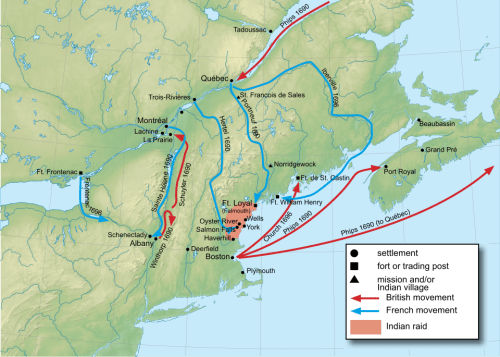
Illustration: Map of King William’s War. Wikimedia Commons.
Bibliography:
Dekker, M. (2015) French & Indian Wars in Maine. The History Press. Charleston, South Carolina.
Ghere, D. L. (2015) Diplomacy & War on the Maine frontier, 1678-1759. In: Judd, R.W., Churchill, E. A., and Eastman, J. W. (eds.). Maine: The Pinetree State from Prehistory to the present. University of Maine Press, Bangor. pp. 51–75.
Prins, H. E. L. (2002) The crooked path of Dummer’s treaty: Anglo-Wabanaki diplomacy & the quest for aboriginal rights. H. C. Wolfart (ed.). Papers of the Thirty-Third Algonquian Conference, University of Manitoba: Winnipeg. pp. 360 – 377.
Williamston, W. D. (1889) The history of the state of Maine: From its first discovery in A.D. 1602 to the separation, A.D. 1820, exclusive. Glazers, Masters, and Smith.
 Turmoil in Dawnland