In 1744, while the colonies were planning their assault on Louisbourg, settlers in the Kennebec River area were suffering growing hostilities from the Canadian Indians, including the destruction of homes, crops, and livestock. The local, non-confrontational Kennebec and Penobscot claimed they were not involved in these atrocities, but they continued to refuse the Massachusetts demand that they help fight the Canadians.
On July 19, 1745, a war party from Canada attacked the fort at Fort St. George, and a few days later, some confrontational Kennebec and Penobscot moved on Pemaquid, burning homes, killing livestock, and taking captives. When the non-confrontational tribes, once again, refused a demand from Massachusetts to ally with them, the English authorities declared war on all the Wabanaki of Maine, making no distinction between confrontational and non-confrontational groups.
The outbreak of this war prompted 300–400 Penobscot and Maliseet to migrate to the Quebec area in September, followed by another wave in November. These Wabanaki remained in Canada for the next two years, but continued to run raids into the heart of the Maine frontier. The confrontational Penobscots who stayed behind would also raise havoc throughout the Penobscot River Valley and into Nova Scotia.
Frontier Maine settled into another two years of violence and heightened anxiety. Several men harvesting corn in Sheepscot and Tompson were killed and scalped. Settlers in Gorham, Pemaquid, North Yarmouth, and Falmouth were ambushed, and their homes were destroyed. In the largest attack at Broad Bay (Waldoboro), isolated homesteads were burned to the ground, garrisons were assaulted, and a meeting house filled with German settler families was attacked, leaving many killed, scalped, and taken captive. Their church was also burned to the ground. “The communities from St. George to the Sheepscot River became shells of their former selves … Those who chose to remain did so in the region’s palisaded garrisons, leaving their homes and fields empty and untended” (Dekker, 2015, p. 93).
A state of near panic gripped Maine in June 1746, when a French fleet of seventy vessels carrying 3,000 men was sent to Acadia to reclaim Louisbourg and assault English settlements along the coast from Nova Scotia to Boston. They were to be joined by French Acadians and their Indigenous allies. However, during the three-month passage, the soldiers and crew were ravaged by disease; 1,270 men died at sea, and another 1,300 perished soon after arrival, effectively ending any campaign. The Cape Sable and St. John’s Indians who came to join the Frenchmen also succumbed to the deadly pathogens, with perhaps a third of their population dying over the next two years.
Having escaped the French assault, the Mid-Coast region still had to endure a series of more vicious Wabanaki raids throughout the spring of 1747. Communities at Damariscotta, Pemaquid, Newcastle, and Sheepscot suffered mightily. In some of the most brutal attacks, thirty men, women, and children were killed in raids along the Damariscotta River, and fourteen men fishing for alewives were murdered.
The atrocities continued unabated throughout the rest of 1747. A mixed Acadian force of French and Indians in September ambushed and killed ten soldiers outside the walls of Fort Frederick, but they were unable to overrun the fort. They then turned their attention to Fort St. George, which they also could not surmount, after digging a tunnel that collapsed in heavy rain. The group dispersed at this point into smaller bands, making many more isolated raids on civilian communities in the Mid-Coast region. As winter approached, the economy of the Mid-Coast region was in shambles due to the mass emigration, the slaughter of vast numbers of livestock, poor crop yields from inattention, and reduced timber exports due to wartime harassment.
Even though they had been the aggressors, the Wabanaki were also at the end of their rope, having little food and few material goods to face the winter after the persistent raiding, and very limited trade. Everyone in the Mid-Coast Region, Wabanaki and English, was hungry, exhausted, and anxious for peace.
Treaty of Aix-la-Chapelle
The Anglo-French conflict in Europe was resolved in October 1748 with the signing of the Treaty of Aix-la-Chapelle, which concluded the War of the Austrian Succession. To the horror of the people of New England, after their signal accomplishment of taking the fortress at Louisbourg, the treaty returned Cape Breton to the French. Britain had needed to bargain it away to extricate itself from the continental war, which was going poorly.
The English and Wabanaki skirmishes did not officially end until the Treaty of Falmouth on October 16, 1749, when conciliatory factions of the Penobscot and Kennebec finally sent ambassadors to Boston to request a peace conference. This agreement would essentially be a repeat of the one that ended Drummer’s War, and, like the former, it was mistranslated to more easily gain the Wabanaki’s acceptance.
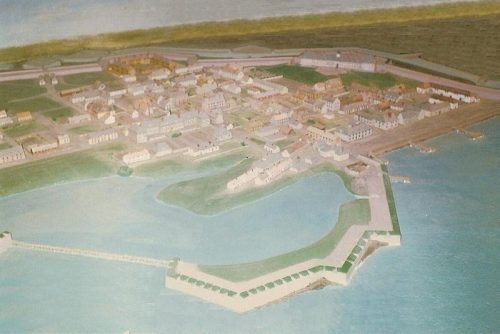
Illustration: Diorama of the Fortress of Louisbourg in 1758. Chamy
Bibliography
Dekker, M. (2015) French & Indian Wars in Maine. The History Press. Charleston, South Carolina.
Ghere, D. L. (1994) European diplomacy with the Eastern Abenaki, 1725-1750, Proceedings of the Meeting of the French Colonial Historical Society 19: 87 – 100, p. 92.
Williamson, W. D. (1889) The history of the state of Maine: From its first discovery in A.D. 1602 to the separation, A.D. 1820, exclusive. Glazers, Masters, and Smith, pp. 106-107.
Willis, W. (1833) The history of Portland from its first settlement with notices of the neighboring towns and of the changes of government in Maine. Part II – from 1700 to 1833.Charles Day & Co. Printers: Portland.
 Turmoil in Dawnland