When King William’s War ended in 1698, many of the settlers who had fled the bloodshed returned to their shattered settlements and homes. These early colonists were built of incredibly resilient stock.
As Williamston (1889, pp. 29 – 31) describes: “Destitute of homes, yet attached to the places of their birth, hundreds of freeholders, or the heirs of deserted realties, returned, during the season, and visited former abodes, or half wilderness lands; many repaired their dilapidated cottages, and more perhaps constructed habitations. Men with their families removed to the peninsula of Casco, Purpooduck, and Spurwink, in Falmouth; to Black Point and Blue Point in Scarborough, to Winter Harbor and the Falls in Saco; to Cape Porpoise; and to Cape Neddick; and during the present and succeeding summer, those places were repeopled with several abiding families.”
The returning settlers felt compelled to take up a quasi-military life: “Garrisons, usually under a militia command, provided nuclei for small settlements either just outside or within a stockade. During daylight, men and women worked in their fields under the protection of scouts and guards. For most of the period, English Maine lived in a state of virtual siege. Only the larger seaports – Boston, Salem, Portsmouth, Kittery – enjoyed sufficient security to benefit from the military expenditures from Great Britain (Anonymous, 2010).”
Postwar Wabanaki migrations
As the 18th century drew to a close, the Wabanaki were hungry, exhausted, and largely displaced from their traditional fishing and hunting grounds. Prins and McBride (2008, p. 189) suggest: “The surviving Wabanakis were desperate to return to their village gardens, and to hunt, fish, trap and trade as before. But the fur market had crashed. With the flow of furs from the Great Lakes no longer checked by Iroquois warfare, supplies rose just as the European demand dropped. For Wabanakis these market changes added to their problems.
Under the watchful care of Jesuit missionaries, many Wabanaki relocated to the Missions of Bécancour, and St. Francis. “Although they created new lives for themselves in French Canada, many exiles never gave up the hope of retaining their lands in Maine from the English. While life in the mission villages provided residents with a safe haven and ready access to food, firearms, and other trade goods, physical and material security came at a cost. Although the native people of the mission villages could come and go as they pleased and maintain their own political structure, they remained fundamentally dependent on French aid and hospitality. Seeing the native people as ready allies in their war with the English, the French routinely used the flow of trade goods to exert Influence over the native peoples’ collective and individual choices of war and peace. … As the frontier wars progressed over the first half of the eighteenth century, native war parties striking the communities of coastal Maine increasingly originated from French Canada rather than the resident native populations.” (Dekker, 2015, p. 4)
Sébastien Rale builds a mission at Norridgewock (Nanrantsouak)
In 1694, Jesuit Sébastien Rale arrived at Norridgewock on the Kennebec River and built a mission at the site where Father Druillettes had toiled almost a half-century earlier. The faith had been kept alive at Norridgewock by occasional visits of missionaries, but no permanent pastors had been in residence until Father Rale arrived.
Father Rale soon became an expert on the Wabanaki dialect and gave his catechetical instructions in their native tongue. He wrote a detailed Wabanaki dictionary, which was later stolen in an English raid. Rale would become a powerful opponent of the English, but in his early years at Norridgewock, he toiled quietly among the Wabanaki.
Not much is known about his early activities, but Rale’s arrival during King William’s War certainly placed him in a precarious position. As described by Schuyler (1915, pp. 167-168): “The English colonists greatly outnumbered the French, but the Indians were mostly allied with the latter. At the very beginning of his career at Norridgewock, Father Rale must have realized how difficult and how dangerous his position was. His was the most western of the Acadian Missions. The New England colonists were uncomfortably near him, and many were the anxieties and sorrows caused by this proximity. He became almost at once the object of English suspicion and accusation and later of armed attack. Every foray of New England colonists was attributed to him as the prime cause.
Rale became known as the “Apostle of the Abnakis” and was one of the most prominent names in the history of missionary activity on Maine’s frontier. He would be a central player in the French and Indian Wars for thirty years.
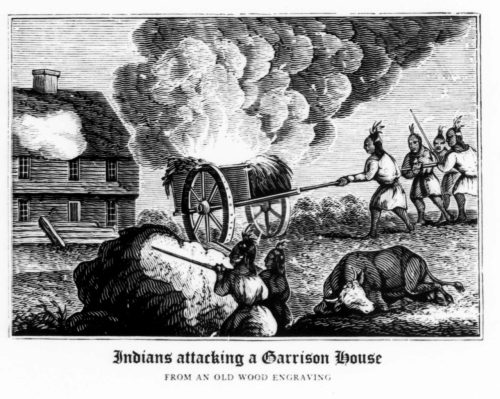
Illustration: Indians Attacking a Garrison House, from an Old Wood Engraving. Collection of the Dover Public Library, New Hampshire
Bibliography:
Anonymous (2010). 1668-1774, Settlement and Strife. Maine History Network. The Maine Historical Society, Portland. https://www.mainememory.net/sitebuilder/site/897/page/1308/print
Dekker, M. (2015) French & Indian Wars in Maine. The History Press. Charleston, South Carolina.
Prins, H. E. L., & McBride, B. (2007). Asticou’s Island Domain: Wabanaki Peoples at Mount Desert Island 1500-2000. Acadia National Park. Ethnography Program. National Park Service.
Schuler, H. C. (1915) The Apostle of the Abnakis: Father Sebastian Rale, S. J. (1657-1724). Catholic Historical Review 1(2): 164-174.
Williamston, W. D. (1889) The history of the state of Maine: From its first discovery in A.D. 1602 to the separation, A.D. 1820, exclusive. Glazers, Masters, and Smith.
 Turmoil in Dawnland