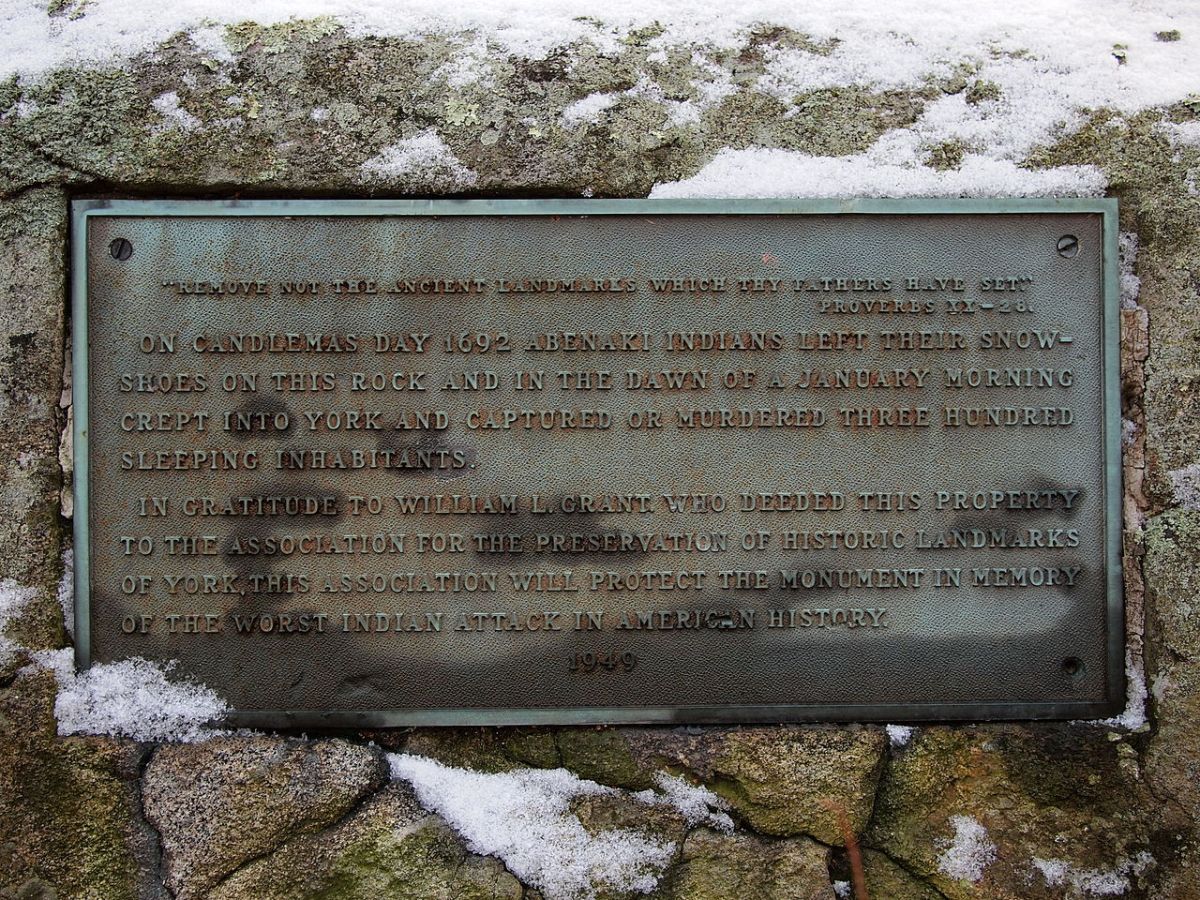
In King Philip’s War, raids on English settlements were rare during the winter months, when the Wabanaki disappeared into the forest on their yearly hunts. This all changed dramatically in the winter of 1692, when Madockawando and Father Thury led 200-300 Wabanaki on snowshoes in a bloody raid on York during King William’s War.
As Drake (1910, p. 73) tells the story, “On the morning of February 5, 1692, the village of York lay locked in the arms of winter. Since daybreak, it had been snowing heavily, so few of the inhabitants were stirring. At this hour, nothing could be heard but the muffled roar of the waves beating against the ice-bound coast or the moaning of the wind as it swept through the naked forest. All else wore its usual quiet.
Suddenly, a gunshot broke the stillness. At that sound, the village awoke. The startled settlers ran to their doors and windows. Out in the darkness and gloom, they saw a body of armed men fronting them on every side. Some tried to escape by their front doors. A storm of bullets drove them back. They next made for the back doors. Death met them at the threshold. They saw themselves surrounded, entrapped. On every side, the rattle of musketry, mingled with the loud yells of the assailants, drowned the voices of nature—moaning sea and rising storm. The village was surrounded, and retreat cut off, and a carnival of murder was to join its horrid uproar to that of the elements.
… The savages quickly burst open the doors with their axes, killing and scalping all whom they met. As soon as one house was carried and its inmates butchered, it was first ransacked and then set on fire; the assailants then rushed off in pursuit of new victims. In a short time, the village was blazing in twenty places.”
Accounts differed on the number slain, but the death toll was substantial, with 50 to 100 being slaughtered. Dozens of others were taken captive, and all but four garrison homes were burned to the ground.
To the east of York, the small, struggling village of Wells was initially spared. However, in June, it was assaulted by a formidable body of warriors led by Madockawando and Moxus, supported this time by a small group of Acadian French led by Portneuf and St. Castin. The battle started with the assailants swooping out of the surrounding forest, “screeching, brandishing their weapons aloft, and hurling shouts of defiance at the garrison as if they expected to frighten it into surrender by a show of numbers and noise” (Drake, 1910, p. 78).
The stockade was defended by twenty-nine soldiers commanded by Captain James Converse. Fourteen had just arrived a few days earlier in two sloops. In a bitter firefight, the soldiers held fast in their garrison, their guns reloaded by several stout-hearted women. Failing to breach the walls, the assailants then tried to capture the sloops, with several losing their lives in the attempt, including a Frenchman. ” When night put an end to the fighting, Storer’s men had everywhere more than held their own.” (Drake, 1910, p. 79).
Throughout the night, the warriors shot flaming arrows into the fort to keep the besieged on alert and to wear them out. The combatants lay so close together that the firing was interspersed with boastful bantering on both sides.
In the morning, the assailants made another frontal assault on the stockade, but a rapid discharge of musketry again repulsed them.
Exasperated by repeated failures, the savages next made another dangerous attempt upon the sloops, now lying lashed together for mutual protection out in the stream. A fire raft was hurriedly put together, the combustibles lit, and the raft shoved off from the shore and left to drift down upon the vessels with the tide. The same fatality attended this effort as the others. A puff of wind drove the blazing mass against the bank, where it burned harmlessly out.
Force having failed, the discouraged besiegers resorted to stratagem. A flag was sent to demand a surrender. Ensign Hill went out to meet it. When the message was brought to Converse, he returned for an answer “that he wanted nothing but men to come and fight him.” The wrathful envoys retorted the threat to cut the English “as small as tobacco” before morning. Converse then broke off the conference with a brusque invitation to make haste, for he wanted work. “The savage, who held the flag, then dashed it to the ground in a rage and ran off one way, while Ensign Hill ran off in another, each one eager to get under cover as quickly as possible. It was well for Hill that he took the alarm when he did for a number of shots were fired at him from an ambush, treacherously contrived by the savages, in case their demand was refused. Thanks to fleetness of foot, Hill got into the garrison unhurt.
After putting their one captive, John Diamond, to death with excruciating torture, the discomfited crew of white and red savages slunk silently away between dark and daylight, leaving some of their unburied dead behind them.” (Drake 1910, pp. 80 – 81).
Illustration: Memorial plaque in York, Maine.
Bibliography:
Drake, S. A. (1887). The Border Wars of New England, commonly called King Williams and Queen Anne’s Wars. Charles Scribner’s Sons: New York.
 Turmoil in Dawnland