The Euro-Wabanaki Wars (17): Beginning of Queen Anne’s War

In 1701, the War of the Spanish Succession (1701-1714) broke out in Europe. It was triggered by the death of childless Charles II of Spain, leading the French Bourbons and the Austrian Habsburgs to begin fighting over the Spanish Empire.

The War of the Spanish Succession spilled over into North America, where it was known as Queen Anne’s War, and involved the colonial empires of Great Britain, France, and Spain.  It was battled with Indigenous allies on three fronts: 1) Spanish Florida and the English Province of Carolina, 2) English St. John’s and Newfoundland, and the French at present-day Placentia, and 3) French Acadia with English New England on the Maine frontier.   

On August 6, 1703, the War began in Maine when the Royal Governor of New France, Philippe de Rigaud Vaudreuil, sent an expedition force of 500 French and Mi’kmaq from the St. Lawrence River Valley to make a massive assault on all the English coastal towns and forts stretching from Wells to Falmouth.

This expedition force laid coastal Maine to waste once again. As described by Willis (1833, pp. 7-8): “The inhabitants of Purpooduck [near Cape Elizabeth] were the most severe sufferers in this sudden onset. There were nine families then settled upon and near the point who were not protected by any garrison. The Indians came suddenly upon the defenseless hamlet when the men were absent, killed 25 persons, and took several prisoners. Among the killed were Thomas Lovitt and his family, Joel Madeford or Madiver, and the wives of Josiah and Benjamin Wallis and Michael Webber. The wife of Joseph Wallis was taken captive; Josiah Wallis made his escape to Black Point with his son John, then 7 years old, part of the way upon his back.

Spurwink, principally occupied by the Jordan family, was attacked at the same time, and twenty-two persons by the name of Jordan were killed and taken prisoners. Dominicus Jordan, the third son of the Rev. Robert, was among the killed, and his family, consisting of six children, was carried to Canada. His brother Jeremiah was among the prisoners, who was subsequently called French Jeremy, from the circumstance of his having been carried to France.

The whole country, from Purpooduck Point to Spurwink, was covered with woods, except the few spots which the inhabitants had cleared. This afforded facilities to the Indians for concealment and protection. From these coverts, they made their sudden and cruel visits, then returned to mingle again with the other wild tenants of the forest, beyond the reach of pursuit.”

At this point, only the fort and settlement at Falmouth remained. “This was the most considerable fort on the eastern coast and was the central point of defense for all the settlements upon Casco Bay; under its protection, several persons had collected to revive the fortunes of the town” (Willis, 1833, p. 8). The veteran Major John March was in command of the fort.

The assault began by deception and treachery (Drake, 1910, pp. 159-160):  “While the main body of assailants was kept out of sight, three chiefs boldly advanced to the gate with a flag of truce. At first, March paid no attention to the flag bearers but finally went out to meet it, taking with him two others, all three being unarmed. His men were, however, warned to be watchful against treachery. Only a few words had been exchanged when the Indians drew their hatchets from under their blankets and fell with fury upon March and his companions. Being a man of great physical strength, March wrested a hatchet from one of his assailants, with which he kept them at bay until a file of men came to his rescue. Luckily, he escaped with a few slight wounds …

Having failed to gain the fort by treachery, the savages next fell upon the scattered cabins outside, which were soon blazing on all sides. After this was done, they returned to attack the fort. For six days, the weak garrison defended itself unflinchingly. During this time, the besiegers were joined by the confederate bands, Falmouth holds, who had been destroying all before them out at the west. Beaubassin, the French leader, now pressed the siege with greater vigor and skill. Covered by the bank on which the fort stood, the savages set to work undermining it on the waterside. For two days and nights, they steadily wormed their way under the bank toward the palisade without any hindrance from the garrison and were in a fair way to have carried the fort by assault when the arrival of the provincial galley compelled them to give over their purpose in a hurry, as that vessel’s guns raked their working party. On the following night, they decamped. Two hundred canoes were destroyed, and an  English shallop retaken by the relieving galley.”

One hundred and thirty persons were either killed or taken captive during this bloody conquest. Fear and dismay now filled the hearts of the settlers, for Maine had come very close to receiving a death blow. Only the strongest-willed remained, hunkered down in their garrisons, performing only the most necessary outside labor under armed guard.

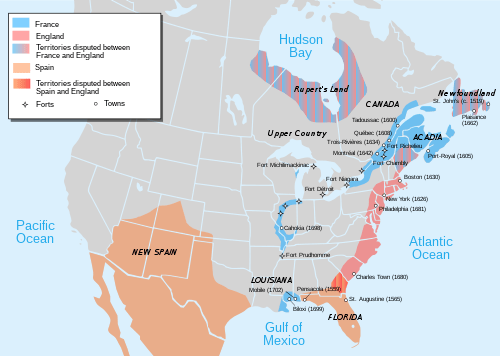
Illustration: European occupation of North America at the start of Queen Anne’s War. Wikimedia

Bibliography

Drake, S. A. (1887). The Border Wars of New England, commonly called King Williams and Queen Anne’s Wars. Charles Scribner’s Sons: New York.

Willis, W. (1865) The history of Portland from 1632 to 1864. Bailey and Noyes: Portland.
Early Contact Period (1): The first French settlement in Maine

In 1603, King Henry of France granted Pierre Degua (c. 1558–1628, a monopoly on the fur trade in the New World and asked him to colonize l’Acadie, covering eastern Canada and the northeastern United States.  The goal was to set up a settlement, from which furs could be obtained from the Indigenous peoples of New England. 

Degua put together an expedition force of hundred and twenty men and two vessels, one captained by Sieur de Pont Grave, and another, which he captained himself. On board were also French noble Jean de Biencourt de Poutrincourt et de Saint-Justand Samuel de Champlain as the cartographer and historian. It would be Champlain’s first visit to New France.

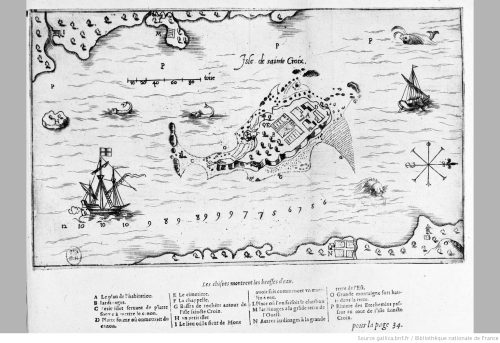
The expedition set sail from Le Havre in April 1603 and arrived at the coast of Nova Scotia in May, in a very rapid crossing. The Sieur de Mons and Champagne then made a careful examination of the coast of Acadia for potential settlement sites. After exploring for a bit, they decided to build their settlement on a small island (now Muttoneguis Island)  in the St. Croix River, which divides what is now Maine and New Brunswick. It caught their eye as a handsome island that would be easy to fortify. Champlain wrote: “This place we considered the best we had seen, both on account of its situation, the fine country, and for the intercourse we were expecting with the Indians of these coasts and the interior, since we should be in their midst…” (Grant, 1907: 40)

On the development of their fort, Champlain continues: “Each worked so efficiently that in a very short time it was put in a state of defense, though the mosquitoes (which are little flies) gave us great annoyance while at work, and several of our men had their faces so swollen by their bites that they could scarcely see … all set to work to clear the island, to fetch wood, to cut timber, to carry earth, and other things necessary for the construction of the buildings” (Grant, 1907: 42).

By the end of September, snow began to fall and the settlers’ preparations for winter were cut short. The river became impassable with treacherous ice flows, and they could no longer cross to the mainland. This left them with a shortage of drinking water and firewood. As the winter progressed. the men began to fall prey to scurvy. Champlain’s descriptions of this disease are quite graphic: “There was engendered in the mouths of those who had it large pieces of superfluous fungus flesh (which caused a great putrification), and this increased to such a degree that they could scarcely take anything except in very liquid form. Their teeth barely held in their places and could be drawn out with the fingers without causing pain.” (Grant, 1907: 53)

Spring came at last in May, and to the settler’s great relief and joy, relief arrived on June 15, 1605 in a ship loaded with supplies. Of the 79 men who wintered at St. Croix, 35 died, and 20 more were severely debilitated when spring came. The selection of St. Croix Island for a settlement turned out to be a great mistake, as it was too exposed to the extreme winter weather. Champlain wrote: “It was difficult to know this country without having wintered there; for on arriving in summer everything is very pleasant on account of the woods, the beautiful landscapes, and the fine fishing for the many kinds of fish we found there …There are six months of winter in that country.” (Grant, 1907: 55)

Bibliography

Grant,  W. L. (ed.) (1907) Voyages of Samuel de Champlain 1604 – 1618. Charles Scribner’s Sons, New York.

McManamon F.P. (2022) The French along the Northeast Coast—1604-1607, Saint Croix Island International Historic Site. National Park Service, Boston, MA.

Otis, C. P. (1880) Voyages of Samuel de Champlain: Translated from the French. Prince Society, Boston

Early Contact Period (2): Champlain’s first explorations of coastal Maine

While the artisans were busy building the settlement at St. Croix, Pierre Dugua sent Champlain with 12 sailors and 2 local guides on the first voyage along the coast of what is now Maine.  They set out on September 2, 1604, and within a few days sighted Mount Desert Island, which Champlain named for the stone mountain peaks, that were bare of trees. Champlain described Mt. Desert Island as: “about four or five leagues in length, of which we were almost lost on a little rock, level with the surface of the water, which made a hole in our pinnace close to the keel. The distance from this island to the mainland on the north is not a hundred paces. It is very high and cleft in places, giving it the appearance of the sea of seven or eight mountains one alongside the other. The tops of them are bare of trees because there is nothing there but rocks. The woods consist only of pines, firs, and birches. I named it Mount Desert Island ” (Grant, 1907 – pg. 45).

Champlain also wrote about interactions with the Indigenous people along the shorelines. They came across two local Etechemin rowing a canoe and, after some initial discourse and an exchange of trade items for fish, they led them further south to the mouth of the Penobscot River and up the river about 20 miles to the fall line at present-day Bangor, Maine.

Champlain reported that along the riverbank were: “…neither town nor village, nor any traces that there ever had been any, but only one or two empty Indian wigwams…” He was told by his guides that ”they come there [to the river] and to the islands only for a few months in summer during the fishing and hunting season when the game is plentiful. They are a people of no fixed abode, from what I have discovered and learned from themselves; for they pass the winter sometimes in one place and sometimes in another, wheresoever they perceive the hunting of wild animals is the best” (Grant, 1907 – pg. 48). The Etechemin’s and other Eastern Wabanakis groups followed a migratory foraging subsistence way of life (Prins and McBride 2007:1-3). 

Near Bangor, Champaign and his party met on shore with another group of Etchemins and two of their leaders, Bessabez and Cabhis. Each was accompanied by at least 30 followers. As Champagne describes the encounter: “I ordered the crew of our pinnace to draw near the Indians and to hold their weapons in readiness to do their duty in case they perceived any movement of these people against us. Bessabez, seeing us on shore, bade us sit down, and began with his companions to smoke, as they usually do before beginning their speeches. They made a present of venison and waterfowl “(Grant, 1907 – pg. 49).

The meeting went smoothly and strong interests were expressed for cooperation and alliance.  Champlain conveyed: “that the Sieur de Monts had sent me to them, and also their country; that he wished to remain friends with them, and reconcile them with their enemies, the Souriquois and Canadians; moreover, that he desired to settle in their country and show them how to cultivate it, in order that they might no longer lead so miserable an existence as they were doing; and several other remarks on the same subject…I made them presents of hatchets, rosaries, caps, knives, and other little knick-knacks; then we separated. The rest of this day and the following night they did nothing but dance, sing, and make merry, awaiting the dawn when we bartered a certain number of beaver skins.” (Grant, 1907 – pg. 50)

Thus, the two cultures made their first tentative steps to seek an arrangement that would reward them both. The meeting concluded; Champlain and his men sailed down the river the next day. They explored Penobscot Bay and the mid-coast region a bit more, and then returned to the St. Croix settlement, arriving there on 2 October.