One of the dominant figures in the French and Indian Wars in Maine was Jean-Vincent D’Abbadie de Saint-Castin. He would build a trading station at Pentagoet (Castine), become a Wabanaki leader, and then lead at least a dozen bloody raids on English settlements along the Gulf of Maine from 1688 to 1690.
How St. Castine wound up at Pentagoet is a remarkable story. He was born in France in 1652, the second son of a French baron. His mother was a direct descendant of Louis VIII. Little is known of his early life other than his mother died of the plague in his infancy, and his father died when he was a young boy. He arrived in 1665 in Quebec, only 13 years old, as an ensign in the company of Hector Andigne de Grandfontaine, an officer of the Carignan-Salieres Regiment. This unit was brought to New France to fight the Iroquois.
Five years later, Saint Castin was selected as one of the two officers to accompany Grandfontaine, the new Governor of Acadia, to Pentagoet, where he would establish the capital of French L’Acadie. Pentagoet was chosen for its commanding position at the mouth of the Penobscot River Estuary, an area rich in furs and timber. It was also near where the great Penobscot sagamore, Madokawando, and his family spent their summers fishing and hunting.
Saint-Castin found the wilderness of Maine very much to his liking. He became fluent in the Algonquian language and adopted many of the Wabanaki’s ways. However, the rest of his little group of 30 soldiers at Fort Pentagoet struggled. The government of New France paid little attention to them, and to survive, Grandfontaine was forced to trade with the English, which was forbidden by France. Grandfontaine was subsequently replaced in 1673 by another army officer named Jacques de Chambly, who made Saint-Castin his liaison officer with the Wabanaki.
On August 10, 1674, a Dutch expedition led by Capt. Jurriaen Aernoutsz attacked Pentagoet with 125 men. They easily overpowered the small garrison and took the officers to Boston as prisoners. With the help of some Amerindians, Saint-Castin escaped and traveled to Québec, where he reported the incident to New France’s governor, Frontenac, who ransomed Chambly from prison. However, Chambly refused to return to Acadia.
Frontenac decided to send Saint-Castin back to Pentagoet and ask him to enjoin the Wabanaki to serve the King of France. “Frontenac thus launched an obscure army officer into a career that would win him fame and a place in history, for Saint-Castin was destined to become a leader of men and to hold the destinies of Acadia in his own hands” (Chassé, 1985, p. 65.)
Saint-Castin returned to the ruined fort at Pentagoet, but instead of rebuilding the fortress, he constructed a house and a lead-shot factory in a Wabanaki village of 30 wigwams. He completely accepted the lifeways of the Wabanaki, accompanying them to their winter homes upriver. “He enjoyed the company of Indian women – perhaps too much, according to gossip that made its way to the Jesuit missionaries and the leaders of New France. But he remained a staunch Catholic” (New England Historical Society, 2024, n.p.).
Saint-Castin also became a great friend and advisor of Madokawando and married at least one of his daughters, Pidianske. Saint-Castin married her both in the Amerindian way and a Catholic ceremony. Before marrying, she converted to Catholicism and took the name Marie-Mathilde, also known as Molly Mathilde.
Saint-Castin served as a military advisor to Madokwando during numerous confrontations with the English. The historian Geor Cerbelaud suggests “… Madokawando was the sole great chief of the Penobscots; he had his lieutenants who were in command of the warriors, led expeditions, and parleyed with them when truces were made, but it was known everywhere that nothing was done without his son-in-law’s advice, and that the latter had only to express a wish for it to be instantly complied with.” (New England Historical Society, 2024, n.p.).
Saint-Castin was a shrewd businessman, and his trading station made him a wealthy man. In 1840, a farmer named Stephen Grindle unearthed treasure six miles north of Saint-Castin’s home, which his daughter had buried. It included between 500 and 2,000 coins originating from France, Spain, England, Massachusetts, Portugal, and Holland.
In 1675, his older brother died childless in France, making him Baron Saint-Castin at the age of 22. However, he stayed in Acadia, prospering greatly and becoming one of the most notorious Frenchmen in the frontier of Maine.
Saint-Castin did not return to France until 1701, when he was forced to answer accusations of treason for trading with the English, and fight an attempt by his sister’s lawyer husband to obtain the family castle in Bearn and his title of baron. He eventually won on both counts, but never returned to Acadia; he died in 1707.
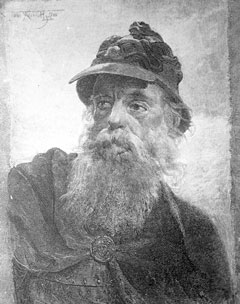
Illustration: Baron Saint-Castin 1881 by Will H. Lowe, Wilson Museum Archives.
Bibliography:
Chassé, P. (1985) The D’Abbaddie de Saint-Castins and the Abnakis of Maine in the Seventeenth Century. Proceedings of the Meeting of the French Colonial Historical Society 10: 59-73.
March, K. (2019) Castine’s Imperial Moment: Baron de Saint-Castine, Governor Edmund Andros, and the Boston Revolution of 1689. The Castine Visitor 29(3): 1-12.
New England Historical Society (2024) Saint-Castin, the French Baron Who Drove the English from Maine. https://newenglandhistoricalsociety.com/saint-castin-french-baron-drove-english-from-maine/
 Turmoil in Dawnland