At the end of King Philip’s War in Maine, many English returned to their coastal and riverine settlements, joined by a new cadre of migrants, mainly from Massachusetts. Tensions remained high with the local Wabanaki as the English settlers’ insatiable desire for land led to additional acquisitions. They continued to push deeper and deeper into Wabanaki territory. The settlers free-ranging livestock wreaked havoc in Wabanaki agricultural fields, and their fish seines and damns obstructed their fishing. The Wabanaki repeatedly complained to English magistrates about the encroachment of English settlers on their land, but to no avail.
The tensions would boil up in 1688 into what has been dubbed King William’s War. In this War, instead of going alone against the English, the Wabanaki received the active support of the French. The French would enter the conflict as part of the broader European dynastic struggle known as the War of the Grand Alliance, also referred to as the Nine Years War or the War of the League of Augsburg. This war would drag on for a decade in Maine, and at its end, the French and their Wabanaki allies were very close to driving the English completely out of Maine.
Roots of King William’s War
The War of the Grand Alliance began when King William replaced James II as ruler of England. James escaped to France and teamed up with Louis XIV in a failed attempt to reclaim the English throne and reinstate Catholic rule. The greater war began in late 1688 when the French invaded the Rhineland (Today’s Germany and the Netherlands). In response, England, the Dutch Republic, and the Holy Roman Emperor Leopold formed the anti-French coalition, known as the League of Augsburg, to combat the French.
The war that spilled over into North America was fought along the border between French Acadia and the English Province of Maine. The French felt they had dominance as far west as the Kennebec, while the English believed the border was much further east at the St. Croix River. The English Fort Charles at Pemaquid stood in the center of the disputed territory in 1689, a bulwark against French aspirations.
During King William’s War, the Wabanaki would partner with the French as the lesser of two evils. The English were actively encroaching on their traditional lands, while the French were content to establish small trading posts with less imprint. The French Jesuit missions had also become important sanctuaries for many Wabanaki. The English were not only encroaching on Wabanaki land but also actively supporting their bitter enemies to the northwest, the Iroquois, with guns and ammunition, to take the fur trade away from the French. It simply made sense for the Wabanaki to join the French in their battles with the English, particularly when the French were happy to provide them with guns and ammunition. King Williams War would become a murderous orgy where Englishmen, Frenchmen, and Wabanaki would all participate in brutal massacres of outposts and whole settlements.
The Wabanaki form a tighter bond
The English would battle a more organized group of Wabanaki in King William’s War than King Philip’s. Early in the final quarter of the 17th century, the exact date is not known, a loosely affiliated group of northeastern Algonquian tribal communities in the borderlands between New England, French Acadia, and Canada formed a pan-tribal alliance known as the Wabanaki Confederacy. As described by Prins (2002, p. 362): “Threatened by the growing numbers of English settlers invading their lands and increasingly brazen raids by their ancient Iroquois enemies, these Algonquians understood that their very survival was at stake and committed themselves to a bond of peace with each other. Emerging in the complex political landscape increasingly dominated by Anglo-French colonial disputes, their alliance remained a potent force for over 150 years. Although its composition could fluctuate somewhat according to time and circumstances, the core of this pan-tribal alliance originally consisted of a group of neighboring Abenaki communities and extended to similar clusters of Maliseet and Passamaquoddy. Later, it widened even more and included the more numerous Mi’kmaq.”
The members of the Wabanaki Confederation were not always aligned in war and peace, but there was now a vehicle for unified action. During several major raids in King William’s War, Mi’kmaq from the Gulf of St. Lawrence and Maliseet from St. John fought with Wabanaki warriors from as far south as the Saco River (Prins, 2002).
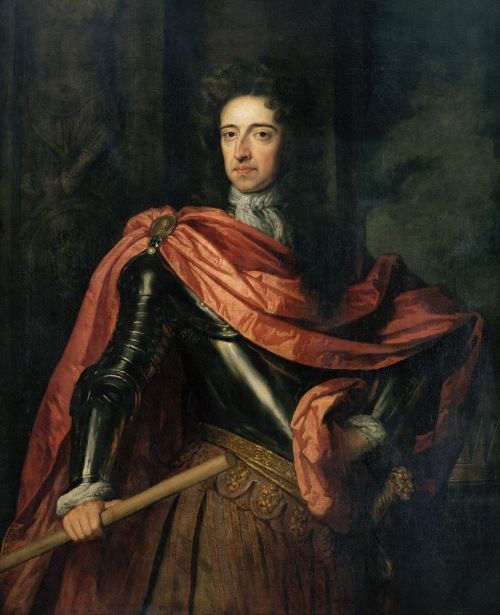
Illustration:Portrait of King William III by Godfrey Kneller (1650-1702). Scottish National Gallery.
Bibliography:
Prins, H. E. L. (2002) The crooked path of Dummer’s treaty: Anglo-Wabanaki diplomacy & the quest for aboriginal rights. H. C. Wolfart (ed.). Papers of the Thirty-Third Algonquian Conference, University of Manitoba: Winnipeg. pp. 360 – 377.
Prins, H. E. L. (2015) The Wabanaki Frontier, 1524-1678. In: Judd, R.W., Churchill, E. A., and Eastman, J. W. (eds.). Maine: The Pinetree State from Prehistory to the Present. University of Maine Press, Bangor. pp. 97-119.
 Turmoil in Dawnland