As the year 1677 closed, the Wabanaki had destroyed most of the settlements along the coast of Maine. The only ones remaining were located at the far western corner of Maine’s frontier, at Wells, York, and Kittery.
After three years of fighting, most of the Wabanaki battle objectives had been met. Now exhausted and desperate for the resumption of trade, the eastern groups located around Pemaquid began to disown any allegiance to Squando and placed the blame for the bloodshed on him. In this mood, they started making peace overtures. Soon, many other eastern tribes, also sick of war, joined them. Several Kennebec chieftains, including Moxus and Madockawando, were prepared to lay down their arms and surrender their hostages.
In 1678, the representatives of the provincial government of New York and the Wabanaki met at Pemaquid. Many Wabanaki diplomats attended the conference, arriving in thirteen large canoes.
No copy of the treaty survives, but Williamson (1889, p. 552-553) reports that the articles of peace were: “1. the captives present were to be surrendered, and those absent released without ransom; 2. all the inhabitants, on returning to their homes, were to enjoy their habitations and possessions unmolested; but 3. they were to pay for their lands to the Indians, year by year, a quit-rent of a peck of corn for every English family, and for Major Phillips of Saco, who was a great proprietor, a bushel of corn.”
Williamson also reports that: “Though the close of king Philip’s war in Maine was the cause of universal joy, the terms of peace were generally considered by the English, to be of a disgraceful character,—nevertheless, preferable to a predatory warfare and its consequent deprivations and calamities. Nor were the exactions of the Sagamores unjust. The Aborigines, it was acknowledged, had a possessory right to the country … and their remarkable successes through the late war, might very properly embolden them to dictate these hard conditions of peace.”
This would be the last peace treaty the English would sign acknowledging the Wabanaki’s sovereign rights. The settlers were allowed to reoccupy their homesteads, but the Wabanaki retained their sovereignty. All future treaties would deny this right and demand their loyalty to the King of England.
The human cost of King Philip’s War in Maine
From a Wabanaki perspective, even though they had won King Philip’s War, the English’s appearance on Dawnland’s shores less than a century before had brought about an “unimaginable change in fortunes.” As described by Harald Prins (2015, p. 118): “Relations that had begun with mutually beneficial trade deteriorated over the first three-quarters of the seventeenth century into bitter war, and conflict would continue for another century. Wabanaki’s history between 1600 and 1678 reveals the tragic paradox of European migration to the New World: the European quest for a better life in the Americas transformed native American existence into a nightmarish reflection of their former existence. Although the Wabanaki peoples endured, somehow, the dramatic upheavals of the seventeenth century, their struggle for cultural survival had only just begun.”
Father Jean Morain, a French Jesuit missionary at Rivière du Loup between the upper St. John and St. Lawrence Rivers, wrote to his superiors in Quebec that the Etchemin after Metacom’s War were reduced to only about 400-500 people, a decline of almost 90 percent since the European Invasion (Prins & McBride, 2008).
The losses sustained by the English in Maine during King Philip’s War were also huge. As told by Willamson (1889, p. 553), “About 260 were known to have been killed or carried into captivity, from which they never returned. There were probably many others, the accounts of whose deaths have never been noticed or transmitted to posterity. Numbers were severely wounded who survived, and a hundred and fifty or more, at different times, were made captives who were released. The dwelling houses at Cape-Neddock, Scarborough, Casco, Arrowsick, Pemaquid, and several other places were reduced to ashes. Possessions were laid waste, domestic animals killed, and a great amount of property plundered or destroyed. The cost of the war in Maine to the colony government was £8,000, besides incidental losses.
A very uneasy peace
The uneasy peace following the Treaty of Casco would prove to be short-lived. Festering tensions would erupt again in the summer of 1688, only ten years later, in what came to be known as King William’s War. In this War, the Wabanaki would participate in a much broader conflict against the English, often allied with the French. The French wanted to limit the expansion of the English in the Maine frontier, and they entered into the fray in Maine as part of the larger Seven Years War in Europe.
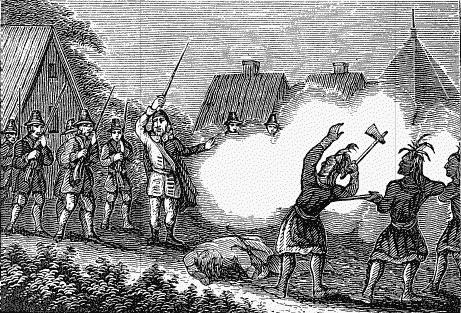
Illustration: Early colonists defending their home. Artist and date unknown.
Bibliography
Brooks, L. (2017) Our Beloved Kin: Remapping a New History of King Philips War. A Digital Awikhigan – The Treaties at Pemaquid and Cascoak.
Prins, H. E. L. (2015) The Wabanaki Frontier, 1524-1678. In: Judd, R.W., Churchill, E. A., and Eastman, J. W. (eds.). Maine: The Pinetree State from Prehistory to the present. University of Maine Press, Bangor. pp. 97-119.
Prins, H. E. L., & McBride, B. (2007). Asticou’s Island Domain: Wabanaki Peoples at Mount Desert Island 1500-2000. Acadia National Park. Ethnography Program. National Park Service.
Williamston, W. D. (1889) The history of the state of Maine: From its first discovery in A.D. 1602 to the separation, A.D. 1820, exclusive. Glazers, Masters, and Smith.
 Turmoil in Dawnland