In early 1677, while Mogg Heigan was still in Boston, a militia led by Lieutenant Bartholomew Tippen was transported to Black Point and found the fortress to be unharmed and empty. All English had fled from the area after Mogg’s attack, but he had left the structures intact. The militia quickly took residence and were followed almost immediately by thirty resilient families that had been displaced earlier (Hunnewell, 2017).
All appeared well until Mogg returned on May 13, 1677, and attacked the Black Point garrison again. This time, however, the militia was ready for him. The onslaught went on for three days. “Day and night, they heard the wild cries of savage defiance; the war whoops, fierce and revengeful, grew more and more fierce as each desperate assault was repulsed, and the number of their dead multiplied. Surging backward and forward with their forces in front and rear, as the waves of old ocean sweep and surge around the half-hidden rock in the sea, so from all sides came the wild, fierce charge of the determined foe.” (Hight, 1894, pp. 262-263)
In the meager reports available on the details of the fighting, we know that three of the defenders of the garrison were killed, and one was captured and barbarously tortured outside its walls in full view of the occupants. All we know about the Wabanaki invaders is that Lieutenant Tippin made a successful shot on the third day of the fight and killed their leader, Mogg.
After Mogg’s death, the warriors withdrew, but the war was far from over.
In June 1677, the General Council in Boston decided to deploy more troops to Maine to secure the frontier more fully. To entice recruitment, the soldiers were offered a reward of twenty shillings for each scalp they brought back and twice that for each prisoner they took (Hunnewell, 2003). One group of soldiers was transported by sea to Scarborough in two sloops, commanded by Major Thomas Clark and Benjamin Swett, while another group, under James Richardson, marched by land through the Merrimack and Piscataway valleys.
Soon after the two militias’ arrival, an alarm was received at the garrison that a small group of Wabanaki had been spotted approximately a mile east of the ferry servicing Black Point and Blue Point. In response, about one hundred men marched off to meet them, led by Major Clarke and Lieutenant Tippen. After the group had traveled for about two miles, they were ambushed in a horrific slaughter by Squando and a large group of his warriors.
As Hunnewell (2003) relates: “Lieutenant James Richardson was cut down soon after the first volley along with others of his men. English and friendly Indians fell wounded or dead; others tried to carry the wounded to safety, but shelter was two miles away, and they were facing an enemy that knew the territory well. Some badly wounded English found ways to hide. Some men, many of those who served with Swett before, must have held their ground. There is no doubt that some of the men, inexperienced soldiers “shifting for themselves,” left their comrades to bear the brunt of the attack. There is good reason to believe that the friendly Indians stood their ground, and there is no record that shows any treachery or perfidy on their part. The townsmen had shown their lack of resolve earlier in their encounter with Mogg the preceding year, but how they reacted now is unknown. Soon, the English and friendly Indian ranks were thrown into disarray.
Swett, showing great courage, rallied what men he could again and again and made a torturous retreat towards the garrison on the neck. The rout had turned into a tremendous defeat, and by the time Swett was within sight of the garrison, he had suffered many wounds and was taken bodily by the Indians and hewn to death. Of the nearly one hundred men who left the garrison, less than half a dozen came back without a scratch. Nineteen out of twenty of Major Clarke’s men were cut down. A doctor treated those who returned wounded. Fifty to sixty of the New England forces were dead or mortally wounded, including eight friendly Indians.”
The Indians made quick work of the wounded men left on the field. Those who were wounded and hiding were quickly dispatched, and there are no records of any captives being taken. The victorious Wabanaki then left the area, after once again culling many English. Squando is thought to have gone to Canada and did not participate in any further engagements.
Illustration:
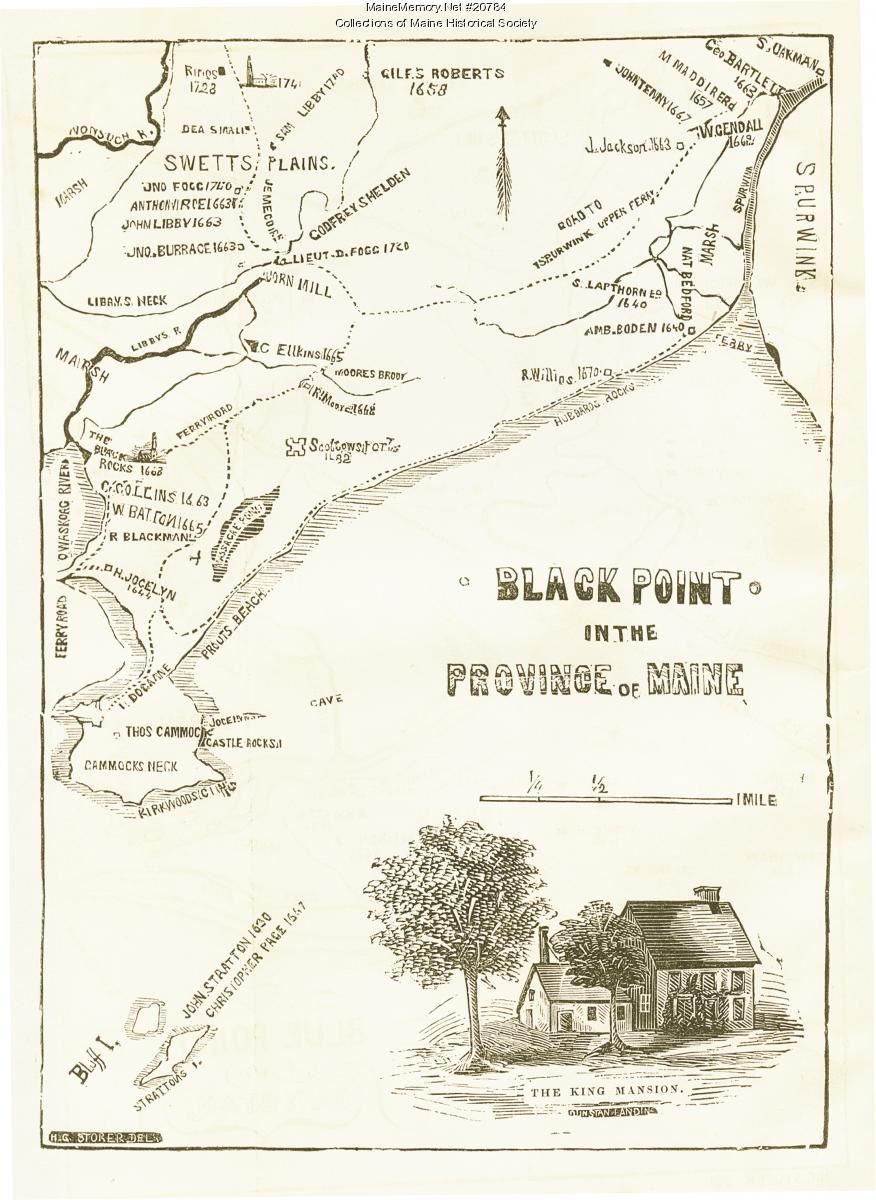
Map showing the supposed locations of early settlements in the Black Point area of Scarborough. Visible are Scottow’s Fort, Strattons Island and landowners’ names as well as an engraving of the King Homestead at Dunstan Landing. This map was published in 1853 to accompany William S. Southgate’s “The History of Scarborough from 1633 to 1783. From Maine Memory Network.
Bibliography:
Hight, H. (1894) Mogg Heigon- His life, his death, and its sequel. Part 1. Maine Historical Society. Vol.5: 345-360
Hunnewell, S.G. (2003) A doleful slaughter. The Maine Genealogist. 25: 51-72, 99-120.
 Turmoil in Dawnland