On October 12, 1676, 100 Wabanaki warriors, led by Saco sagamore Mogg Hagen, surrounded the garrison at Black Point, demanding its surrender. Aged John Jocelyn, the village’s founder, was overseeing the garrison while its commander was away. Trying to avoid bloodshed, Jocelyn went outside the walls to talk peace with Mogg, who had long been his friend.
Mogg, showing great courtesy, told him that he would allow everyone to go free if the garrison surrendered. However, when Jocelyn went back inside, to his chagrin, he found the garrison empty except for his family members. All the others had fled to a vessel lying off the Neck. Jocelyn and his family had no recourse but to surrender, and Black Point was now wholly under Mogg’s control.
Later that day, leaving the garrison intact, Mogg captured a 30-ton vessel on Richmond Island that local settler Walter Gendal and eleven others were loading to escape the hostilities. They were unaware that the garrison had been taken and were caught completely by surprise, and quickly surrendered.
In a single day, Mogg had captured, without shedding a single drop of blood, the most substantial garrison remaining in Maine, along with eleven prisoners and a schooner—a remarkable accomplishment.
At this point, the warring party separated into two groups and divided the captives between them. One group headed back eastward to Penobscot in the schooner, while Mogg and his tribesman traveled by land to Wells, where a few lingering settlers manned another garrison. Here, Mogg’s warriors attacked and killed two men and wounded another three outside the garrison walls, but were not able to take the fort. Considering this garrison of trifling importance, Mogg now made the epic decision to travel to Boston to seek a treaty with Governor John Leverett. He believed that with the English now largely purged from Maine, they would be ready to sue for peace and restore trade.
The scenes in Boston must have been quite an experience for Mogg. As Horacio Hight (1887, pp. 357-358) suggested: “It is fair to presume that no pains were spared to impress upon this half-civilized savage the greatness of the metropolis of New England. Boston was then a town of five thousand inhabitants. Some of the streets were paved; many of the buildings stood close together on both sides of the streets. The city contained three meeting houses and a townhouse. Besides these, there was the governor’s residence and two constant fairs for daily traffic thereunto. Undoubtedly, he was shown the stores of great artillery and heard much concerning the powerful army then making war on the Narragansetts”.
Alone and without counsel, Mogg forged ahead with Leverett to make a treaty. However, the still arrogant Governor presented Mogg with terms that heavily favored the English, completely ignoring the fact that the English had been overwhelmingly defeated. Levett demanded that Mogg go back to Maine and get the Penobscot superchief Madockawando to 1) stop all hostilities against the English and declare war on any Indians that continued them, and 2) return all English captives, ships, and goods, including arms and artillery, that they took from the English, and compensate them for all injuries, losses, damages to houses, cattle, and estates, either immediately or in yearly fees paid to the government of Massachusetts Bay. If this were all done, the English agreed to supply the Wabanaki with powder, firearms, ammunition, and other necessary supplies, but only from traders approved by the governor and council.
Incredulously, Mogg signed the treaty, undoubtedly fearing for his life if he did not. It is very hard to believe that he intended to adhere to its stipulations.
On November 21, the Governor sent Mogg under guard to the Penobscot to seek Madockawando’s signature on the peace accord and secure the release of the remaining captives under his control. Madockawando agreed to sign the treaty but, at present, had only two of the captives with him, as other sagamores had taken the rest further east. Mogg was set free by the English authorities to find and bring back these prisoners for release. Of course, once given his freedom, Mogg defied the authorities and fled directly home.
Upon his return, Mogg found that his people were far from ready for peace. As Hight (1896, p. 258) describes: “Mogg found, upon returning among his people, that he had incurred the displeasure of those who were only too happy in the enjoyment of the spoils gathered from the various English settlements. The large quantity of goods captured by them at Arrowsick Island and other places, with English captives, to make garments for them, the grain and corn harvested after their fashion, with cattle and horses that supplied the place of moose meat, came nearer to giving them a comfortable living than any other turn of affairs in all their savage lives. These were affording them too comfortable maintenance for them to think of a treaty that required restitution.”
In no way was the first Wabanaki-Anglo War about to end! The spoils of war had made the Wabanaki way too comfortable.
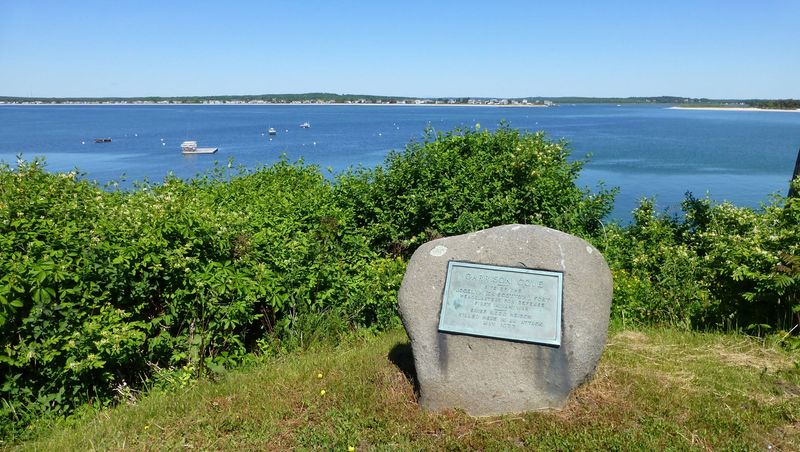
Illustration: Black Point Forts Garrison Cove Marker, photo by John Stanton 5 Jun 2013.
Bibliography:
Dekker, M. (2015) French & Indian Wars in Maine. The History Press. Charleston, South Carolina.
Ghere, D. L. (2015) Diplomacy & War on the Maine frontier, 1678-1759. In: Judd, R.W., Churchill, E. A., and Eastman, J. W. (eds.). Maine: The Pinetree State from Prehistory to the present. University of Maine Press, Bangor. pp. 51-75.
Higgins, P. (2000) Mogg Hegon & Henry Jocelyn come to an agreement. The Maine Story. https://mainestory.info/maine-stories/mogg-hegon–henry-jocelyn.html
Hight, H. (1889) Mogg Heigon- His life, his death, and its sequel. Part 1. Maine Historical Society. Vol.5: 345-360
Hight, H. (1896) Mogg Heigon- His life, his death, and its sequel. Part 2. Maine Historical Society. Vol.6: 256-279
 Turmoil in Dawnland