Waldron’s taking of slaves at Machias galvanized Wabanaki opposition throughout Maine, and the tribes began making bloody lightning raids. Their actions were not coordinated, but they nonetheless presented a united front; Pigwackets, Sacos, Androscoggins, Kennebecs, and Penobscots all participated in the violence. They would fight the English via small raiding parties of rarely more than twenty warriors, falling upon outlying farms and poorly defended villages.
The entire frontier was lit up with these raids, but the English had no way to counter them without a center of operations to attack. They had no defense “against these numerous, tiny, highly mobile groups of extremely skilled Wabanaki warriors who attacked in uncoordinated, minimally planned, and minimally strategized yet relatively spontaneous raids” (Bilodeau, 2013, p. 26).
In the summer of 1676, Falmouth and several other locations around Casco Bay were subject to brutal raids, and a total of 34 English were slaughtered or taken captive. From their farm on the Back Cove, Anthony Brackett, his wife, five children, and a slave were taken prisoners, and Mrs. Brackett’s brother was killed and scalped. Along the mouth of the Kennebec, more than a dozen settlements were destroyed.
Also, that summer, a series of Sagadahoc settlements came under murderous attack (Dekker, 2015). The first was Richard Hamilton’s trading post at Days Ferry, located in today’s Woolwich. Hammond was butchered along with two other men, and 16 were taken captive. The fortified trading post of the Clarke and Lake Company at Arrowsic was also taken in bloody hand-to-hand combat. Thirty-five people were slain, and the fort, mills, mansion houses, and outbuildings were burned to the ground.
In a panic, the residents of Sheepscot fled to Cape Newagan on the tip of Southport Island, leaving everything behind, including hundreds of cattle. They watched in horror as “the whole circle of the horizon landward was darkened and illuminated by the columns of smoke and fire rising from the burning houses of the neighboring Main … From there, they fled to Damariscove Island near what is now Boothbay. By the end of August, the island was home to an estimated 300 English war refugees. Unable to adequately support and defend themselves on the Island, the English exiles from mid-coast Maine soon made their way westward to Massachusetts and the Piscataqua River” (Dekker, 2015, p. 31).
In only five weeks, 60 miles of the coast east of Casco Bay had been “wiped clean of English settlements” (Anonymous, 2010). The mid-coast region of Maine would remain devoid of any English settlers for the next 25 years!
To the fleeing colonists, it was clear why they had been attacked. In a petition to the Council from trader Thomas Gardner and several others, they suggested the assaults were due to a combination of outside instigation, anger at Waldron’s abductions, and the ban on gun sales.
The petition read: “The Cause of the Indianes Riseing Apeares to us to be threfold the first & Cheefest being the Coming of diners Indianes from the westwards who by ther perswation & Asistance have set these Indianes on this vngodly Enterprise. The Second Cause being the perfidious & unjust dealing of som English as we Supose who haue Stouen Eight or Nine persones from the Indianes About Micheas River & Caried them Away. the Indianes being Incensed for their lose we desier that Enquiry may be made of one Lawton that went in A Cach of Mr Simon Lines one John Lauerdore being of Company About it. The Third Reason which thay likewise Render : the last winter for want of Powder died in the Conntry haue in of nothing to kill food & thay say that After their present Crop ot Corne be spent this winter thay must Starve or go to Cannade” (Baxter, 1900, pp. 118-119).
King Philip’s War was now a full-blown, bloody confrontation.
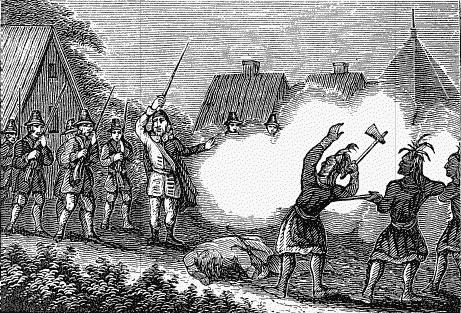
Illustration: Colonists defending their settlement. circa 1800s, unknown illustrator
Bibliography:
Anonymous (2010). 1668-1774, Settlement and Strife. Maine History Network. The Maine Historical Society, Portland.
Baxter (1910) Documentary History of the State of Maine, Baxter Manuscripts. Vol.14. Maine Historical Society, Portland.
Bilodeau, C. J. (2013) Creating an Indian Enemy in the Borderlands: King Philip’s War in Maine, 1675-1678. Maine History 47(1): 10-41.
Dekker, M. (2015) French & Indian Wars in Maine. The History Press. Charleston, South Carolina.
Siebert, F. T. (1983). The First Maine Indian War: Incident at Machias. Algonquian Papers – Archive, 14. https://ojs.library.carleton.ca/index.php/ALGQP/article/view/837
 Turmoil in Dawnland