In the summer of 1675, a massive war broke out in southern New England between the English and the Algonquin-speaking Nipmuck, Narragansett, and Wampanoag. The outbreak was nominally led by Metacomet, whom the English called King Philip. This war would have enormous impacts on both Amerindian and English society in southern New England.
As Christopher Bilodeau describes (2013, pp. 10-11): “King Philips War has been called the most destructive war fought between Indians and Englishmen during the colonial period … Angry about English encroachment onto their lands by settlers, both Boxuss and Protestant missionaries, these Indian groups asserted their sovereignty against what they believed were unjustifiable pressures. Between one and five percent of the total English population of the area was killed. The war cost the English over £150,000 in damaged property and £100,000 for their defense—an enormous burden under which these colonial governments suffered for years. As for the Indians, Philip was killed in August 1676, and through casualties, the massive movement of refugees, and enslavement, the Indian presence in southern New England fell from one-fourth of the overall population to one-tenth. From that point onward, the English maintained a political stranglehold over the area.”
In the third quarter of the 17th century, the Wabanaki of Maine had also reached a tipping point. They were fed up with the history of English trade abuses, land encroachments, rum dealing, and the destruction of their cornfields by livestock. Hostilities would erupt in Maine, leading “to an unprecedented victory for the Wabanaki and an unmitigated disaster for the English” (Bitodeu, 2013, p. 13).
As the English colonists pushed deeper and deeper into Wabanaki territory, the atmosphere was ripe for a revolt. The Indigenous leaders were forced to accept the reality that the English considered their land sales to be deeds of ownership, not sharing relationships. It was crystal clear that the English would never stop encroaching on their traditional hunting and fishing lands, periling their subsistence.
This tinderbox erupted into flames in the fall of 1674 when the Massachusetts Legislature decided to keep the Wabanaki at bay by banning all powder and shot sales to them. This action threatened the Wabanaki’s very livelihood, for by now, firearms were critical to their sustenance.
The flames of war were further fueled by the scalp bounty laws legislated by the Massachusetts Assembly during King Philip’s War. These laws offered substantial cash payments to any white colonists who murdered and brought in the scalps of Indigenous men, women, and children. The scalp hunters were not supposed to operate north of the Piscataway, but they moved into Maine anyway, not able to resist the lure of further profit.
Between 1675 and 1765, 80 scalp bounty acts or laws were issued by the colonial governments of Massachusetts, Connecticut, New Hampshire, and Nova Scotia. At least 141 claims were recorded, with more than £9,000 in bounty payments made and hundreds of thousands of acres of land granted (Upstander Project).
The final tipping point came in Maine in the summer of 1675 when some drunk English fisherman accosted the wife and child of Squando, a Saco River sagamore, by overturning their canoe. The fisherman wanted to test the theory that Indian babies could swim from birth. The baby died, and Squando immediately sought revenge. He convinced several Wabanaki tribes in western Maine and eastern New Hampshire, to join him in an assault on English settlements along the frontier.
In September, twenty Wabanaki looted the home of Thomas Purchase at Brunswick. No one was harmed, but “Purchase’s neighbors pursued the raiders up the New Meadows River, surprising and killing one; the resulting skirmish was the first battle of King Philip’s War in Maine” (Anonymous, 2010, n.p.).
Next, the home of Thomas Wakely in Falmouth was attacked, several family members were tomahawked, and a girl was taken captive. As the reverend William Hubbards described in his early account of the war in 1667: “The house was burned to ashes, the bodies of the old man and his wife half consumed by fire, the young women killed, and three of the grandchildren having their brains dashed out” ( Shults and Togias, p. 304).
Various bands of Wabanaki continued to rampage throughout the fall. As Siebert (1983, p. 142) describes: “From September 9 to 12 at Falmouth and Casco Bay five houses were burned, two of them belonging to George Munjoy, and about 10 English killed, and three children taken into captivity. On September 18, 1675, Saco was attacked and burned, and about 40 Abenakis killed 13 white men under Sagamore Squando … In September and October, there were assaults on Falmouth, Casco Bay, Blue Point, Kittery, Wells, Cape Porpoise (later Arundel, now Kennebunkport), and York, and on October 9, some 70 or 80 Wabanaki attacked Black Point and killed six men and a woman and burned 22 houses. Again, on October 19, they burned eleven or twelve houses and 500 bushels of corn in barns. In the first two months, about 80 English were killed in Maine, and many others were taken into captivity.”
War was on!
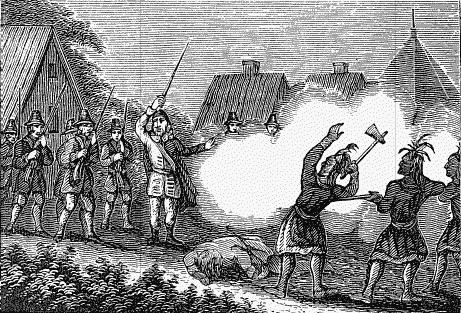
Illustration: Amerindian attack on a homestead during King Phillips War. North Wind Picture Archives.
Bibliography:
Anonymous (2010). 1668-1774, Settlement and Strife. Maine History Network. The Maine Historical Society, Portland.
Bilodeau, C. J. (2013) Creating an Indian Enemy in the Borderlands: King Philip’s War in Maine, 1675–1678. Maine History 47(1): 10–41.
Dekker, M. (2015) French & Indian Wars in Maine. The History Press. Charleston, South Carolina.
Shultz, E. B. and Tougias, M. (1999) King Phillips War: The history and Legacy of America’s forgotten conflict. Countryman Press, Woodstock, VT.
 Turmoil in Dawnland