In 1690, Benjamin Church was sent to Maine by the Massachusetts authorities to wage a major offensive against the Wabanaki. He was ordered to root out and destroy their permanent villages upstream that had been harassing the coastal English settlements.
As Drake (1887, pp. 66-67) describes, “At safe distances up these rivers, varying from sixty to a hundred miles, the tribes who usually acted together against the English had permanent villages, whence war parties could easily slip down unperceived to the coast, join their forces at some point mutually agreed upon, and fall upon such settlements as had been marked for destruction. Small and insufficient garrisons posted at the mouths of these rivers had utterly failed to put a stop to these inroads. Scouting the border could not do it. To destroy the enemy’s villages was the only alternative. Root out the nests, and the vultures would fly away.”
Church, leading 300 men, arrived in Casco Bay on September 11th. Landing at Maquoit Bay, he marched directly to Fort Andros, which he found abandoned. Then he continued for another forty miles to the principal Penobscot village at Great Falls (in today’s Lewiston). As he approached, they were spotted, and most of the warriors fled, leaving the women and children to their fate. Three or four men were shot in the river while trying to escape. Once inside the village, Church discovered five gaunt and starving English captives, and in retaliation, butchered seven random villagers.
From the captives, Church learned that the warriors had gone to Saco, and he resolved to chase after them. After burning the village to the ground and destroying the Indian’s store of corn, Church and his men clambered aboard his ships, taking as hostages nine family members of the sachems Kancamagus and Worumbo (Dow, 2025). The rest of the women and children of the village were then brutally slaughtered, except for a few old women, left to tell the tale.
As Williamston (1889, p. 66) related, “The wives of the two Sagamores and their children were saved and sent on board his vessels in consideration of a solemn promise made by the women that eighty English prisoners should be restored. But it is painful to relate, and nowise creditable to the usual humanity of Major Church, that the rest of the females, except two or three old squaws, also the unoffending children, were put to the tomahawk or sword.—The old women, he left with some necessaries and this errand – tell the Sagamores, they may find their wives and children at Wells.”
Just before sailing, the group was joined by Anthony Brackett, who had escaped his captivity at Falmouth. He would serve as a valuable guide.
Church then sailed to the mouth of the Saco River, where he surprised some Wabanaki who were fishing. He killed two of them in a brief skirmish and freed from them a captive, Thomas Baker, who told him that the Indians had hidden beaver pelts at Pejepscot (Brunswick). Backtracking, Church found the pelts but no more Wabanaki to harass. At this point, some of his weary men demanded that it was time to return home, and when his full council agreed, Church accepted, and the group loaded up and headed across Casco Bay to Cape Elizabeth.
After spending the night, his group was viciously attacked by some of the warriors he had been pursuing but had not yet found. Seven of his soldiers were killed and twenty-four wounded before the Wabanaki evaporated into the woods again. Church searched high and low for them to re-engage, but to no avail. He finally gave up and returned to Portsmouth on September 26 to an icy cold reception from the local authorities.
Meanwhile, as he had hoped, his capture of the Indian women at Androscoggin yielded for him a positive result. In October, several chief sagamores came to Wells, hoping to retrieve their women and children. Under a flag of truce, they told Captain Elisha Andros “with real or pretended sincerity- it is hard to say which – they declared that the French had made fools of them, that they would not fight against the English anymore, and that they were ready to make a treaty whenever the English were” (Drake, 1887, p. 69).
It seems likely that the Wabanaki’s statement was disingenuous. By now, they must have known of Phips’ defeat at Ontario and likely had no intention of giving up anything more than the minimum to regain their women and children. They had brought with them only ten captives, and after a drawn-out negotiation that took six days, they promised to deliver more captives the following May and remain peaceful until then.
When the English commissioners returned in May for those captives, no one came to meet them, and the local Wabanaki claimed they knew nothing of the expected rendezvous. This, as told by Drake (1887, p. 70), “was a sinister omen and forewarned another outbreak. Breathing time, however, had been gained, which was much to people who were worn down and dispirited by last year’s reverses. It proved, however, a mere lull inthe storm.”
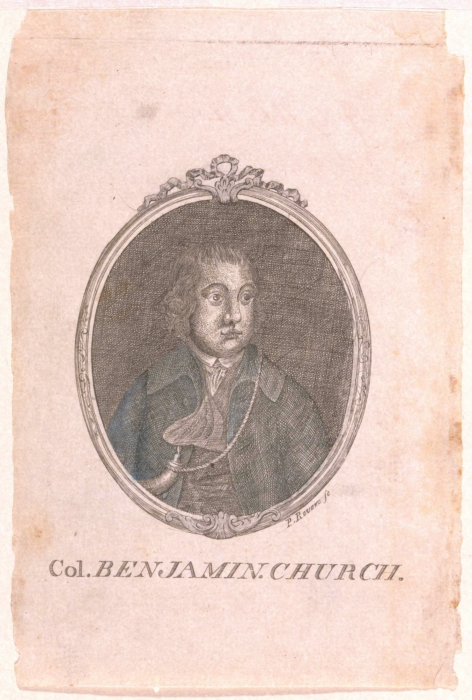
Illustration: Engraved portrait by Paul Revere that was believed to be of Benjamin Church. Yale University Art Gallery.
Bibliography:
Dow, C. (2024) Adaptation and resistance, Indigenous history of the Pejepscot region. Virtual Exhibit at the Bowdoin College Museum.
Drake, S. A. (1887) The Border Wars of New England, commonly called King William’s and Queen Anne’s Wars. Charles Scribner’s Sons: New York.
Williamston, W. D. (1889) The history of the state of Maine: From its first discovery in A.D. 1602 to the separation, A.D. 1820, exclusive. Glazers, Masters, and Smith.
 Turmoil in Dawnland