As the Nine Years’ War began to reach a fevered pitch in Europe in 1690, the French authorities decided to extend the war to the frontier of Maine. In that year, Comte de Frontenac, the governor-general of New France, began directly supporting groups of Canadian Indians led by Frenchmen (soldiers and priests) against the English settlements. He hoped to annihilate the frontier communities by murdering as many inhabitants as possible and burning their buildings to the ground. He would deploy three significant missions to Schenectady, New York, Salmon Falls near Dover, New Hampshire, and Falmouth (Casco), Maine.
Frontenac sent a group led by Sieur de Portneuf, to attack Falmouth, now the most easternmost surviving settlement of the English. The force consisted of fifty French soldiers and fifty Wabanaki from the mission of St. Francis.
The force left Quebec in January 1690, traveling slowly but steadily through the wilderness and mountain ranges that separate the waters of the St. Lawrence and those of the Kennebec. They sustained themselves by hunting and fishing.
“They rested at the Indian villages as they proceeded and added to their numbers from the Indian recruits who offered. Previous to the departure of this party. Count Frontenac, during the winter previous, had sent messengers to the Baron de Castine on the Penobscot,” stating his intention to attack the white settlements in Maine in the spring, and requesting his assistance with a force of the Penobscot tribe. Castine readily complied … During the winter months, he selected the best of the Tarnitine [Tarrentine] warriors, gathered ammunition and stores, and with his father-in-law Madockawando, the chief of the Penobscots, accompanied by at least one hundred of the warlike men of that tribe, they started to meet the expedition from Quebec, in April, 1690.
They, carrying their canoes, traversed the short distance between the waters of the Penobscot and the river Sebasticook, and floated down the stream to its junction with the Kennebec in the present town of Winslow … When on the waters of the Kennebec they were in communication with the Indians in that vicinity, and they were soon joined by the party from Quebec under the command of Portneuf. Soon, A party of Hertel [Francois], who had destroyed Salmon Falls, came up with them, and an agreement was made respecting the expedition against Casco. The different parties rendezvoused at Merrymeeting Bay, and they comprised a force of between four and five hundred.“ (Hull, 1885, pp. 63-64)
The battle
The forces that had gathered to attack Falmouth came into Casco Bay from the Kennebec via the New Meadows River. “It was but a short carry for them to transport their canoes across the neck of land which separates the two waters. No white settlements were on their track, as the whole country was deserted by the inhabitants, who had retired to the protection of Fort Loyall. After reaching Casco Bay, they made their rendezvous on some of the Islands.” (Hull, 1885, p. 69).
“The battle began on May 25, 1690, when a settler happened upon an Algonquian scout and shot him. The shot alerted about 30 men who rushed to the scene only to receive a murderous volley, almost at the muzzles of the enemy’s guns, which brought thirteen to the ground and put the rest in disorder. The enemy then sprang from their coverts, behind the fences, and fell with swords and hatchets upon the survivors, only four of whom succeeded in regaining the fort, and they were wounded … Elated by this success, the invaders then rushed into the village. The undefended houses were easily carried, but the assailants met with such a rough reception at the garrisons that they were obliged to draw off at nightfall, and Portneuf even began to doubt his ability to take the fort.” (Drake, 1910, p. 51).
That night, those still in the garrisons quietly withdrew to the fort. Finding the village deserted the following day, the enemy plundered and burned it and then turned their attention to the fort. A deep gully was found to run within fifty yards of the stockade, from which the assailants could fire freely at the garrison but not successfully assault it.
“Hertel had his men, French and Indian, dig a trench to the palisade with a pick and shovel taken from the village and, on the third day, when the besiegers were at the base of the palisade, demanded that Davis surrender. Expecting the return of his detachment, Davis asked for a six-day truce, which was denied, and the besiegers began hurling hand grenades over the stockade into the fort while they fired upon it under cover of the trenches. A barrel of tar and other combustibles was pushed up against the stockade wall, and made ready to light, forcing Davis to hoist a white flag. Davis tried to negotiate directly with the French to allow the English survivors safe passage to another village. However, instead of finding the promised protection, the survivors were abandoned to the fury of the Indians, who wreaked their vengeance unchecked. Davis’s indignant remonstrances were treated with derision. He was told that he was a rebel and traitor to his king, as if that fact, were it true, absolved his captors from all pledges. After plundering the fort, the invaders set it on fire, and it was soon burned to the ground, leaving Casco untenanted, save for the unburied bodies of the slain.” (Drake, 1910, p.51)
About 200 English lost their lives that day and were left piled in a grisly mound outside the fort. Only ten or twelve survived and were taken into captivity.
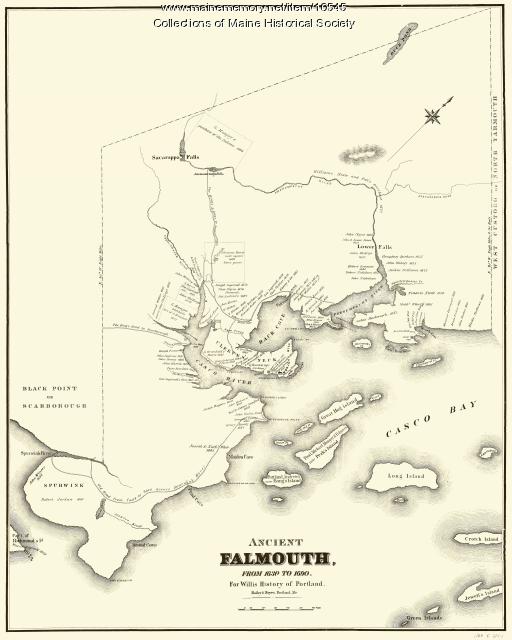
Illustration: Falmouth in 1690 (Willis, 1865)
Bibliography:
Drake, S. A. (1897). The border wars of New England, commonly called King William’s and Queen Ann’s Wars. Charles Scribner’s Sons, New York.
Hull, J. T. (1885) The siege and capture of Fort Loyall, Destruction of Falmouth, May 20, 1690. (O.S.). Maine Genealogical Society. Owen, Strout & Co., Printers, Portland, Maine.
Willis, W. (1865) The history of Portland from 1632 to 1864. Bailey and Noyes: Portland.
 Turmoil in Dawnland