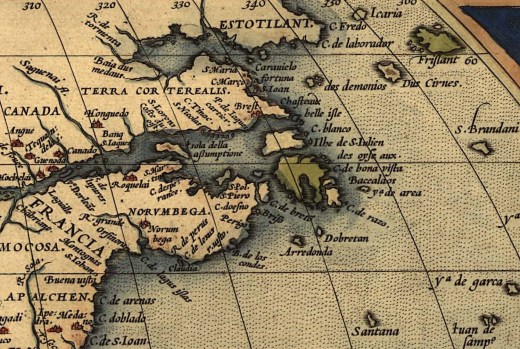
In November 1675, Dover trader and slaver Richard Waldron decided to use the ongoing Wabanaki raids along the eastern coast of Maine as a justification for profit. He commissioned his nephew, Willian Waldron, to travel up the Maine coast to seek out and capture Wabanaki for sale as slaves.
The full commission read (Brooks, 2017a): “The Insolency of ye Indian enemy being such as that in ye Eastern parts they have Made sundry Assaults upon us to ye great prejudice of ye people there both in ye loss of ye lives and Estates of many of them & as yet no considerable damage done them by ye soldiers or Inhabitants[.] that yourself being bound into those parts these are to Im[power] and commission you with what company shall [g]o along with you as the opportunity presents to pursue kill & destroy & by all ways & means to Annoy ye said Indian Enemy[.] Attending such further order as you shall receive from myself or other superior authority.”
Richard Waldron was a major in the militia, a deputy in the Massachusetts General Court, and a prominent sawmill owner and trader in Dover. He had a particularly odious reputation among the Algonquians as an unscrupulous dealer. He turned to slavery as a more lucrative alternative to fur trading when beaver pelts became less plentiful.
Waldron was most notorious for taking four hundred Algonquians into captivity in 1674. The Algonquians, fleeing the militia, were invited by him to participate in a mock battle. When they all fired their first round, he took them prisoner. He sent their leaders to Boston for execution, while the rest were sold into slavery, mostly in Barbados.
The depth of Waldron’s animosity towards the Algonquians seems unconscionable today but was very typical among the English of his time. As Siebert (1983, 151) relates: “the majority of the English regarded the Indians with ill-concealed contempt as inferior beings who were to be tolerated until they could be either acculturated or driven away.” However, not all English felt this way. A particularly notable exception was trader Thomas Gardner of Pemaquid, who wrote a letter to Waldron in 1676 begging him “not to take any Indians east side of Kenibek River because we had made peace with them” (Brooke, 2017a).
William Waldron sailed on the Endeavor, chartered by Henry Lawton, up the Wabanaki coast to Machias, where he managed to take 32 Penobscot prisoners, approximately half of a village’s population, including its Sagamore and his wife (Siebert, 1983). He then sold his captives in Fayal (modern Faial Island), which was then at the crossroads of the slave trade in the Azores.
The reaction of Boston authorities
Despite the general hatred of Algonquians, Waldron’s abductions did not go down well with the Boston authorities. On August 23, 1676, Edward Rawson, the Secretary of the colony, issued a warrant for the arrest of Lawton and Waldron “for seizing and carrying away 30 Indians where one Sagamore & his squaw to ye Eastward” (Baxter, 1900, p. 120).
Siebert (1983, p. 140) suggests that “Leverett’s motives were probably threefold: partly humanity and justice; the desire to avoid any more trouble with the Indians of which he already had plenty; and partly to circumvent any protest from the French.” Machias was within the bounds of French Acadia as determined by the Treaty of Breda.
The Governor of the colony, John Leverett, also requested that the English sea captain, Bernard Trott, attempt to rescue the Amerindians. Trott was able to recover the chief and his wife but not the others, for they “had disappeared into the cruel oblivion of slavery” (Siebert, 1983, p. 140).
The warrant for Waldron’s arrest on August 23, 1676, was for the “apprehending” and imprisonment of William Waldron, charging him with “Seazing and Carrying away 30 Indians” from “ye Eastward,” including “a sagamore” and his wife. The indictment of William Waldron, which came later, stated that he “did unlawfully surprise & steal away seventeen Indians men women & children & in your vessel called the endeavor of Boston Carrjed & sent them to fall & there made the sale of them. Henry Lawton, who chartered the ship, was also charged but “broke prison,” while the ship’s master, John Haughton, was “fined.” Waldron, the merchant, was eventually tried and discharged (Brooks, 2017a).
Waldron likely escaped punishment due to the widespread hostility towards the Amerindians, his family connections, and particularly his uncle’s prominent role in King Philip’s War. In dealing with Indian affairs, the English courts rarely ruled against perpetrators of violence against the Algonquians and made little effort to understand their side of the story. As Bilodeau (2013, p. 22) tells it: “Many Bostonians, and even settlers and traders along the coast of Maine, minimized their interaction with the Wabanakis. Although some traders, such as Thomas Gardiner, understood keenly the differences between Wabanaki groups and befriended many Indians, these men were often ignored when discussions about Indian policy occurred in Boston. Policymakers in Massachusetts Bay lacked nuance in their views toward the Indians and failed to recognize the importance of diplomacy … Boston officials rarely deviated from certain goals: regulate all trade with the Indians, keep them away from the French, and, after 1693, demand their subjection under the English crown. “
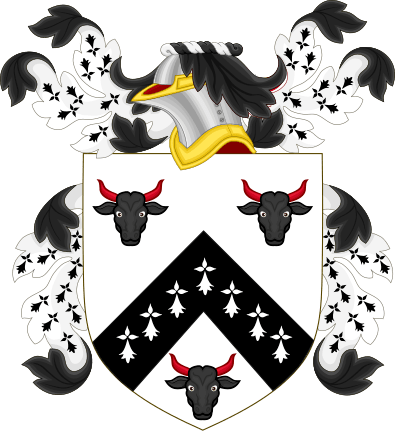
Illustration: Coat of Arms of Richard Waldron. Matthews’ American Armory and Blue Book, 1907.
Bibliography:
Baxter (1910) Documentary History of the State of Maine, Baxter Manuscripts, Vol. XXIV. Portland
Bilodeau, C. J. (2013) Creating an Indian Enemy in the Borderlands: King Philip’s War in Maine, 1675-1678. Maine History 47(1): 10-41.
Brooks, L. (2017a) Our beloved kin: Remapping a new history of King Philip’s War. A digital Awikhigan – Capture at Machias: William Waldron’s deceit.
Brooks, L. (2017b) Our Beloved Kin: Remapping a New History of King Philips War. A Digital Awikhigan – The Treaties at Pemaquid and Cascoak.
Siebert, F. T. (1983). The First Maine Indian War: Incident at Machias. Algonquian Papers – Archive, 14.
 Turmoil in Dawnland