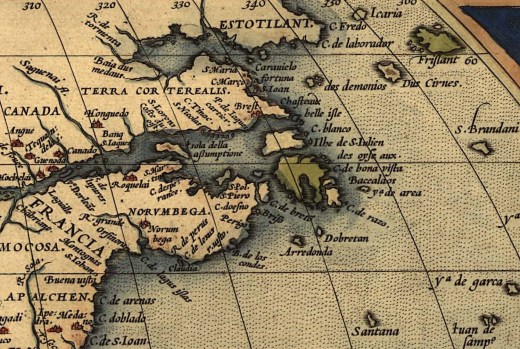
The first Europeans to fish in the Gulf of Maine did not come from the West of England, as is often portrayed, but rather from Jamestown, Virginia. Virginian fishing crews likely began visiting the coast of Maine soon after the colony’s 1607 establishment. By 1613, French priest and observer Father Biard noted that the Virginians were sailing north “every summer” to the offshore islands in the vicinity of Pemaquid. He was undoubtedly referring to the islands of Monhegan and Damariscove. The Virginians likely dominated fishing in the area from 1608 to 1614 and continued until around 1625. Their ships brought back a vital source of food for the winter months.
It wasn’t until the mid-1610s that the fishermen from the West of England began to arrive, along with a few French vessels. The fisherman from the West of England came for purely commercial reasons. The cod they caught were destined for the markets of France, Spain, Portugal, and Italy. Their numbers grew as word spread within England’s fishing and merchant communities of the productivity of New England coastal waters. In 1614, English merchants sent four fishing vessels to New England. Six years later, that number had grown to six or seven. The majority of the vessels congregated in and around the waters of the Isles of Shoals, Monhegan, Damariscove, and Copenhagen.
The number of fishermen in the Gulf of Maine fell far short of the numbers traveling to Newfoundland, but the New England Industry steady grew. By 1622, thirty-seven English fishing boats made the journey across the ocean to the coast of Maine. They were joined by the first inhabitants of the Plymouth plantation beginning in 1621, who sent one or two boats a year. During the early 1620s, Plymouth suffered many food shortages due to poor harvests, and these resources proved critical to their survival.
The actual settlement of Maine began mainly as an offshoot of fishing, with the formation of permanent fishing stations. In 1623, Sir Ferdinando Gorges established the first year-round English fishing communities on the Damariscove and Monhegan Islands. Another was soon established at Odiorne Point, New Hampshire, and others at Cape Newagan and Richmond Island, Maine
One of the most active early year-round fishing communities was founded by John Brown at New Harbor on the eastern shore of the Pemaquid Peninsula. Pemaquid had been “granted” to Brown, on June 1, 1621, by the Plymouth Council, “allowing him the privilege of settling at any place he and his associates might choose, not however within ten miles of any other settlement”( Williamston, 1883, p. 66 ). He obtained the first deed of a tract of land from the Wabanaki of Maine in July 1623.
Burrage (1914, p. 200) suggested that: “The proclamation of the king, calling attention to England’s interests on this side of the sea, gave an added impulse to English settlements on the Maine coast. Pemaquid began to develop into a prosperous community. By 1630, no less than eighty-four families had located there, on the St. George’ River and at Sheepscot. The first fort at Pemaquid, was likely erected about this time, probably not so much as a defense against Wabanaki assaults as against outlaws and plunderers of French descent.
Resident fisheries began to pop up east and west of Cape Ann between 1620 and 1640. In the east early fisheries were established at Monhegan, Damariscove, Pemaquid, Glouchester, Odiorne Point, Cape Newagen and Richmond Island. These fishermen were mainly from the West Country of England, and they were not particularly religious men; they came to fish (Leavenworth, 2008). The exceptions were at Pemaquid and Glouchester, which the Puritans had established themselves from Plymouth. Southwest of Cape Ann, Puritans from the Massachusetts Bay Charter at Salem established fishing settlements all down the northwestern shore of Massachusetts Bay from Salem to Hull, south of Boston.
These New England fisheries had an enormous advantage over those in Newfoundland, as the milder New England climate could support European modes of agriculture. “Fishermen who arrived for a resident fishery as company employees soon discovered they could walk away from the operation and not only survive but prosper. They could acquire land for a house and garden simply by squatting or by arranging a lease under one of the Proprietor’s local agents. Year-round squatters could farm when not fishing, making themselves relatively independent of European food supplies”. (Leavenworth, 2008, p. 37).
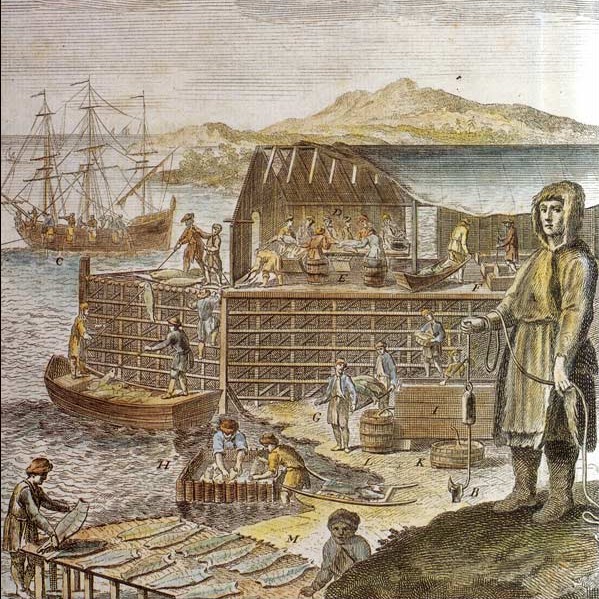
Illustration: Processing cod for transport. Original picture source unknown.
Bibliography:
Burrage, H. S. (1914). The beginnings of colonial Maine 1602-1658. Marks Printing House.
De Paoli, N. (2001) Life on the edge: Community and trade on the Anglo-American periphery, Pemaquid, Maine, 1610—1689. Doctoral Dissertations. University of New Hampshire Scholars Repository. https://scholars.unh.edu/dissertation/11
Harrington, F. (1995) Wee Tooke Great Store of Codfish, In: Baker, E. (Ed.) American Beginnings: Exploration, Culture, and Cartography in the Land of Norumbega.University of Nebraska Press, pp. 198–201.
Leavenworth, W. (2008) The changing landscape of maritime resources in seventeenth-century New England. International Journal of Maritime History 20: 33-62.
Smith, J. (1865) [1615] A Description of New England or Observations and Discoveries in the North of America in the Year of our Lord, 1615. William Veazie.
Williamston (1889) The history of the state of Maine: From its first discovery in A. D. 1602 to the separation, A. D. 1820, exclusive. Glazers, Masters, and Smith.
 Turmoil in Dawnland