Monhegan Island, a unique landmass nestled twelve nautical miles into the Gulf of Maine, may appear diminutive at 4.5 square miles, 1.75 miles long, and 0.75 miles wide. However, its historical significance is far from small. This unassuming island played a surprisingly pivotal role in the European discovery of New England.
Bartholomew Goswald, a true pioneer, was the first European explorer to venture into the Gulf of Maine, landing on the coast at Cape Elizabeth or nearby in 1602. The first explorer to step foot on Monhegan was likely Martin Pring in 1603, on his way to the Pamet River on Cape Cod to harvest what was believed to be a wonder drug – sassafras. Regrettably, he left no specific record of his stay on Monhegan.
The second explorer to land on Monhegan, was George Waymouth, in the Archangel, on May 17, 1605. As his chronicler, James Rosier vividly describes: “… at about sixe a clocke at night we descried the land, which bare from vs North-North-East; but because it blew a great gale of winde, the sea very high and neere night, not fit to come upon an unknowen coast, we stood off till two a clocke in the morning, being Saturday; then standing in with it againe, we descried it by eight a clocke in the morning bearing North-East from us. It appeared a meane high land, as we after found it, being but an Iland of some six miles in compasse, but I hope the most fortunate euer yet discoured. About twelve a clocke that day, we came to an anker on the North side of this Iland, about a legue from the shore. About two a clocke our Captaine with twelue men rowed in his ship boat to the shore, where we made no long stay, but laded our boat with dry wood of olde trees upon the shore-side and returned to our ship, where we rode that night.”
Rosier further describes: “This Iland is woody, grouen with Firre, Birch, Oke, and Beech, as farre as we saw along the shore; and so likely to be within. On the verge grow Gooseberries, Strawberries, Wild pease, and Wild rose bushes. The water issued forth down the Rocky cliffes in many places: and much fowl of divers kinds breed upon the shore and rocks. While we were at shore, our men aboord with a few hooks got aboue thirty great Cods and Hadocks, which gaue us a taste of the great plenty of fish which we found afterward wheresoeuer we went vpon the coast.” (Winship, 1905, p. 106)
Rosier recognized they had come upon a cod fishery superior to Newfoundland’s well-known coast. He reported that “in a short voyage [a] few good fishers [could] . . . make a more profitable returne from hence than from Newfoundland: the fishing being so much greater, better fed, and abundant with traine [train-oil]; of which some they desired and did bring into England to bestow among their friends, and to testifie the true report.”
This discovery of a great cod fishery would turn Monhegan into a beehive of activity, making it one of New England’s most important stops for about 30 years. Captain John Smith, of Jamestown fame, was sent to Monhegan in 1614 by Ferdinando Gorges, Governor of the port of Plymouth in England. He was told to hunt whales for oil and search for gold and copper mines, but fish and furs would be the backup if these endeavors failed. It was the backup that proved most profitable. As Smith related in his 1616 book, A Description of New England: “We found this Whalefishing a costly conclusion – we saw many, and spent much time in chasing them; but could not kill any … For our gold, it was rather the Master’s device to get a voyage that projected it, than any knowledge he had at all of such a matter. Fish and Furs was now our guard ….”
Smith described Monhegan Island as a “round, high Ile, and close by it [is] Monanis betwixt, which is a small harbor where we ride.” He stated, “I made a garden upon the top of a Rockie Ile in 43 ½, 4 leagues from the Main, in May, that grew so well, as it served us for sallets in June and July. From Monhegan, Smith made an exploring trip along the coast of what he coined “New England,” leaving his companions to fish.
By the time of Smith’s arrival, Monhegan’s harbor must have been a busy place. He wrote in his Description that in 1615, “foure good shippes” came and in 1616, four more ships sailed from London, and four from Plymouth. Smith also describes that in 1620, “six or seuen sayle from the west Countrey onely to fish.” In Smith’s “New England’s Trials,” published in 1622, he declares “the successe of 80 Ships employed thither within these eight years”.
In the mid-1620s, year-round fishing stations spread out from Monhegan all along the coast of New England. The first was at Damariscove, followed by Cape Newagen, Piscataqua, Pemaquid, and Richmond Island.
Cod fishing, which began at Monhegan, was New England’s first major economic activity.
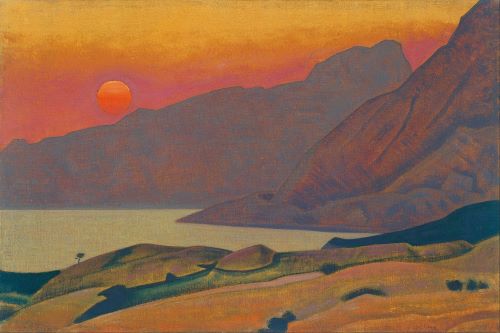
Illustration: Monhegan, Maine (1922) by Nicholas Roerich (Google Art Project)
Bibliography
Arber, E. (Ed.) (1910) Travels and works of Captain John Smith. John Grant, Edinburgh.
Churchill, E. A. (1978) The Founding of Maine, 1600-1640: A Revisionist Interpretation. Maine History 18 (1): 21-54
Jenny, C. F. (1921) The fortunate island of Monhegan: A historical monograph. Proceedings of the American Antiquarian Society (pp. 299 – 357).
Smith, J. (1865) [1615] A Description of New England or Observations and Discoveries in the North of America in the Year of our Lord, 1615. William Veazie.
Winship, G. P. (1905) Sailors Narratives of Voyages Along the New England Coast, 1524-1624. Houghton-Mifflin & Co., Boston
 Turmoil in Dawnland