In 1622, Ferdinando Gorges, a naval commander and governor of the important port of Plymouth in England, sought and received a grant for a massive piece of New England from King James I, called the “Province of Maine.” For the next 25 years, Gorges spent much of his time and money trying to develop this English colony. He would gain the title of the “Father of English Colonization in North America,” but his success in settling Maine would greatly pale compared to that of the Puritans in Massachusetts.
Gorges would try to settle Maine using a model distinctively different from the other English colonies at Jamestown and Plymouth. As Burrage (1919, p. 175) described: “There was no organization like that which planted the colony at Jamestown in Virginia, or … even as it was with the Pilgrims at Plymouth – a body of men and women who, not finding in the old world those conditions of civil and religious liberty under which they desired to live, sought such conditions in the new world, and associated themselves together for this purpose. Here, even formal association preliminary to such beginnings was lacking, and only individual enterprise, pure and simple, is discoverable.
The colonies settled west of Cape Ann, such as Plymouth and Massachusetts Bay, were set up as communities of families with representative governments and individual rights. Gorges’ model envisioned colonies with a more or less feudal owner under an appointed governor loyal to the English King. The settlements east of Cape Ann were owned by investors who expected an annual profit; the settlements to the west of Cape Ann were supported by loans from investors that were to be paid back. This dichotomy in settlement strategies is unsurprising, as Gorges was a royalist supported by the King, while Massachusetts was settled by Puritans seeking liberty.
To govern his territory, Gorges planned a complex structure fit for an empire. It would be comprised of eight bailiwicks divided into sixteen “several hundreds.” The colony would be administered by officers such as a chancellor, a treasurer, a marshal, an admiral, a master of the ordnance, and a secretary for the public service.
“This grand scheme never came to fruition, for while Gorges theoretically controlled English access to who did what and where in Maine, His authority faced significant challenges. Independent English hunters and fishermen had been harvesting the area for decades, and they constantly engaged in the “promiscuous trading” Gorges and other organized interests found so objectionable. Moreover, members of Plymouth Colony, which had been founded with fewer than sixty inhabitants but had rapidly become more successful than any of Gorges’ own attempts at settlement, had begun to encroach on the territory that Gorges and Mason had claimed. By 1625 Plymouth settlers were sailing many miles up the Kennebec River-Plymouth’s eastern border, which divided it from Maine, -to trade their com with Indians in exchange for furs that were almost certainly procured within Maine’s borders.” (Farber, 2009, p.492)
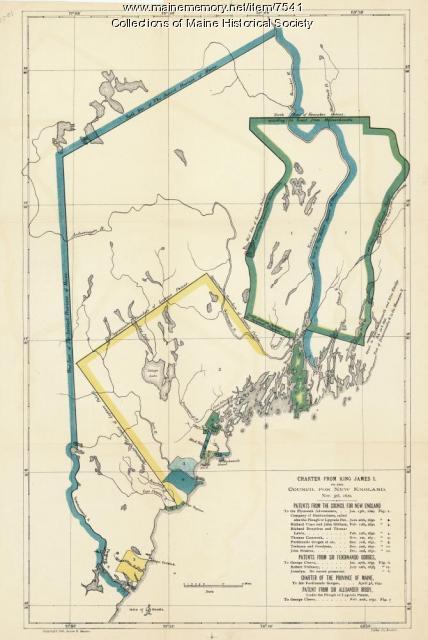
Sir Ferdinando’s grand scheme also suffered from the Council of New England issuing a haphazard array of patents that defied order. During the 1630s and 1640s, various individuals, companies, and political factions struggled to gain control of the territory of New England, but their efforts lacked coordination. English rulers granted land patents with vaguely defined or overlapping borders. Colonies competed for natural resources with one another and with independent settlers, fishermen, and traders who engaged, as the speculator Sir Ferdinando Gorges wrote, in “promiscuous trading without order and in a disjointed manner.” Plantations were chartered and abandoned; patents were granted and canceled; and provinces the size of kingdoms rose and vanished within a matter of years. (Farber, 2009, pg. 409)
The Puritan model of colonization was far more successful than that of Gorges. By 1640, migration had swelled the English population of Massachusetts to over 20,000, while Maine’s had stagnated at a few thousand. In the 1650s, Massachusetts Bay absorbed most of Gorges’s colonies in western Maine, and in 1677, Sir Ferdinando’s heir sold the remainder of his empire to the state of Massachusetts for £1,250.
Illustration: The charters in Maine awarded by Sir Ferdinando Gorges and the Council of New England.
Bibliography:
Burrage, H. S. (1914). The beginnings of colonial Maine 1602-1658. Marks Printing House.
Farber, H. (2009) The rise and fall of the Province of Lygonia, 1643-1658. The New England Quarterly 82: 490-513
 Turmoil in Dawnland