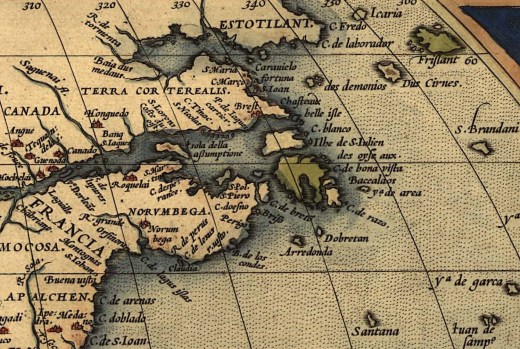
In 1620, Sir Ferdinando Gorges convinced James I to establish a charter, Laconia, to settle New England between the 40th and 48th parallels. The charter was awarded to a group of 40 mostly gentry investors from Plymouth, Exeter, and Bristol, who called themselves “The Council of New England in America.”
The patent bestowed upon them not only the authority to establish, rule, and govern the vast territory but also gave them an extensive array of additional rights and privileges. “They were granted ownership of the firm lands, soils, grounds, havens, ports, rivers, waters, fishings, mines and minerals, as well as royal mines of gold and silver, or other mine and minerals, precious stones, quarries and all, and singular other commodities, jurisdictions, royalties, privileges, franchises and pre-eminencies, both within the same tract of land upon the main and also within the said islands and seas adjoining.” (Farnham, 1901, p. 33).
The patent also stipulated that no other of the king’s subjects could enter and visit any of the ports of New England in America, or trade or traffic therein, without a license from the council for New England, under the penalty of the forfeiture of both ships and goods.
Remarkably, the document justified the colonization of New England by suggesting that God had recently emptied the region of Indigenous people by plague and warfare – the Wabanaki, who had lived on the land for more than 12,000 years.
As stated in the patent: “We have been further given certainly to knowe, that within these late Yeares there hath by God’s Visitation reigned a wonderfull Plague, together with many horrible Slaugthers, and Murthers, committed amoungst the Sauages and brutish People here, heertofore inhabiting, in a Manner to the utter Destruction, Devastation, and Depopulation of that whole Territorye, so that there is not left for many Leagues together in a Manner, any that doe claime or challenge any Kind of Interests therein, nor any other Superiour Lord or Souveraigne to make Claime “hereunto, whereby We in our Judgment are persuaded and satisfied that the appointed Time is come in which Almighty God in his great Goodness and Bountie towards Us and our People, hath thought fitt and determined, that those large and goodly Territoryes, deserted s it were by their naturall Inhabitants, should be possessed and enjoyed by such of our Subjects and People as heertofore have and hereafter shall by his Mercie and Favour, and by his Powerfull Arme, be directed and conducted thither. (Farnham, 1901)
Plymouth is settled in the wrong place
On 11 November 1620, a group of Pilgrims landed and settled smack dab in the center of the Council’s newly awarded territory. The Pilgrims had a charter from the Virginia Company, allowing them to settle south of Cape Cod, but weather conditions and a difficult tide had forced them to anchor at Provincetown Harbor in Massachusetts, well north of their intended destination. Knowing full well that they were in a region outside the jurisdiction of the Virginia Company, the Pilgrims formed the Mayflower Compact to provide a semblance of law and order in the new colony until a new patent could be obtained from the Council of New England.
When the first news from the colonists got back to England, the stockholders in the Plymouth Plantation led by John Peirce went to the Council of New England to get the Pilgrims the rights to live and establish a government where they had landed (Baker, 2007). Most of the records of the Council before 1622 are lost, but the text of what became known as the Peirce Patent survived. Like their first patent, the Peirce Patent gave the Pilgrims seven years to establish a settlement successfully. If the settlement was successful at the end of seven years, a new “permanent” patent would be issued; if the settlement was unsuccessful, then all rights would revert to the Council. The patent further stipulated that the settlement would initially receive a total of 1500 acres and 100 acres for every person who moved there and stayed for three years or died in the attempt. The settlers were made responsible for developing their own local government, making laws, and governing themselves.
Other early Council Decisions
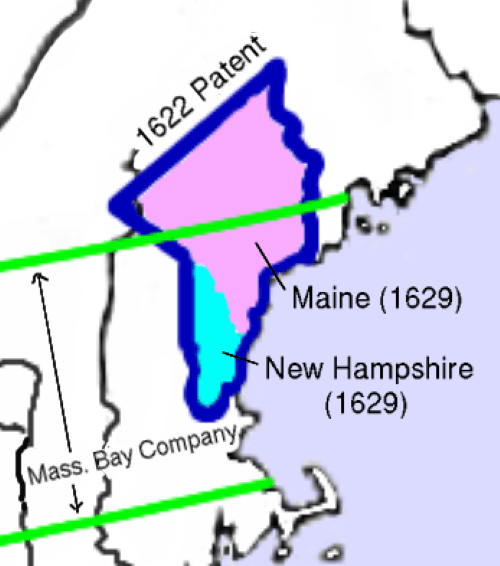
In its first years, the Council of New England struggled mightily to make decisions on the division of its land. Several proposals were made but never consummated, except for the Plymouth colony request. Finally, on August 10, 1622, the Council decided to play large and grant all of today’s Maine and New Hampshire to Sir Ferdinando Gorges and Captain John Mason. They were awarded “all that part of the mainland in New England lying upon the sea coast betwixt the rivers of Merimack and Sagadahock and to the furthermost heads of the said rivers and so forward up into the new land westward until three score miles be finished from the first entrance of the aforesaid rivers and half way over, that is to say to the midst of the said two rivers . . . . . . said portions of lands with the appurtenances the said Sir Ferdinando Gorges and Captain John Mason, with the consent of the resident and council, intend to name the Province of Maine.” (Burrage, 1914, p. 167)
This is the first use of the designation Province of Maine in any printed document. It was later divided into the Provinces of Maine and New Hampshire in 1629 by Mason and Gorges.
Illustration: The 1622 grant of the Province of Maine. The later division into the Province of New Hampshire and the Province of Maine is shown by shading. © 2004 Matthew Trump.
Literature cited:
Baker, P. M. (2007) The Plymouth Colony patent: Setting the stage. Pilgrim Hall Museum. https://pilgrimhall.org/pdf/The_Plymouth_Colony_Patent.pdf
Burrage, H. S. (1914). The beginnings of colonial Maine 1602-1658. Marks Printing House.
Farnham, M. S. (1901) History of the state of Maine. Vol. VII. The Farnham Papers, 1603 – 1688. The Thurston Print, Portland.
Williamston (1889) The history of the state of Maine: From its first discovery in A. D. 1602 to the separation, A. D. 1820, exclusive. Glazers, Masters, and Smith.
 Turmoil in Dawnland