In 1628, about when the Pilgrims established their Kennebec trading post, Thomas Purchase settled at Pejepscot (now Brunswick) and established a salmon fishery and trading post. Purchase had first landed in Maine at Saco with Richard Vines in 1626.
Burrage (1914, p. 242) suggests that “Doubtless after his arrival in the province, Purchase spent some time in seeking a favorable location for a settlement. From the eastern part of Casco Bay there was an Indian thoroughfare that led to the falls of the Pejepscot in what is now the town of Brunswick. Skirting the shores of Casco bay and journeying by this well-known route, Purchase probably reached the falls; or he may have made his way thither by the Sagadahoc to Merrymeeting Bay, and thence by the waters of the Pejepscot River. However this may be, by one route or the other, he discovered a very favorable location for trade with the Indians as they descended the river in passing from their villages to the mouth of the Sagadahoc or the pleasant camping grounds on the shores or islands of Casco Bay.”
On June 16, 1632 he and George Way received a formal patent to the land from the Council of New England. Wheeler and Wheeler (1878, pp. 789-790) suggest it encompassed “certain lands in New England called the river Bishopscotte [Pejepscot] and all that bounds and limits the mainland adjoining the river to the extent of two miles, from the said river northward four miles, and from the house there to the ocean sea with all other Profitts and Commodities whatsoever, paying to the King one fifth part of gold and silver oare, and another fifth part to the President and Council, also paying twelve pence to the said President and Councill for every hundred Acres of Ground in use, to the rent-gatherer for the time being, as by the same Grant may appeare.
There is no record of George Way coming to New England, although it is known that his widow and sons ultimately resided in Hartford, Connecticut.
Purchase would make his living in a myriad of ways. “During his residence at Pejepscot he was probably engaged in different pursuits at different times. He is mentioned as a hunter and trader with the Indians, as being engaged in the salmon fishery, and as a planter. The causes that led to his emigration can never be known, but there is every reason for supposing that he came to Pejepscot in pursuit of furs and peltry,’ which he acquired partly by his own exertions in the chase and partly by traffic with the natives. He was also engaged for the whole period of his residence in obtaining salmon and sturgeon and packing them for exportation to London and probably collected a number of settlers near him. He also cultivated the soil, and at the time of the attack upon his house by the Indians in 1676, he was possessed of stock and probably had what in those days would be considered a respectable farm.” (Wheeler and Wheeler, 1878, p. 793).
Purchase’s diverse enterprises required the services of many helpers, and many of the new emigrants now making their way to Maine came to work for him. Purchase came to support a bustling little community. He became well-known and was considered one of Maine’s most prominent men.
In 1639, Purchase contacted John Winthrop, governor of Massachusetts Bay, and asked to be placed under the jurisdiction of that colony. He deemed this prudent, even though he had his patent from Gorges, as there was no effective government in the part of Maine he had settled. Burrage (1914, p. 304) suggested that “Purchase deemed it imperative to make an effort in some direction, and he made his appeal to the governor of the colony of Massachusetts Bay. Winthrop evidently listened sympathetically to a description of conditions among the settlers along the Androscoggin River, and as a result of the interview, by an indenture executed August 22, 1639, Purchase conveyed “to John Winthrop and his successors, the governor and company of the Massachusetts forever, all that tract of land at Pejepscot upon both sides of the river of Androscoggin, being four miles square towards the sea, with all liberties and privileges thereunto belonging”. The right to plant there “an English colony” was included in the rights conveyed, as also “full power forever to exercise jurisdiction there as they have in the Massachusetts” ; while Purchase, his heirs and assignees, together with all other inhabitants within the limits of the Pejepscot grant, were to be given that “due protection of the said governor and company” as was enjoyed by the inhabitants of the Bay colony.
Purchase lived long and well in Maine. When he first arrived at Pejepscot, he was 53 years old. He died in 1678 at the age of 101.
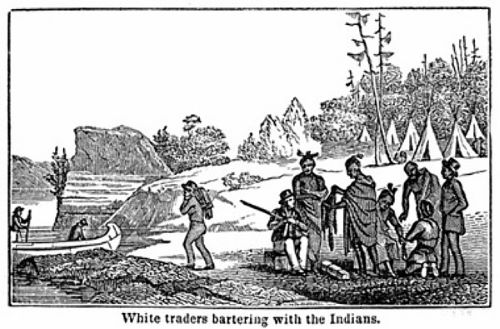
Illustration: Woodcut, Unknown Artist, White Traders bartering with Indians. Originally from: Graphic Arts Collection, National Museum of American History, Smithsonian Institution, Nr: 2003-33644
Bibliography:
Burrage, H. S. (1914). The beginnings of colonial Maine 1602-1658. Marks Printing House.
Wheeler, G. A. and Wheeler, H. W. (1878) History of Brunswick, Topsham, and Harpswell, Maine, including the ancient territory known as Pejepscot. Alfred Mudge & Son, Printers.
 Turmoil in Dawnland