In 1632, New England’s first pirate, Dixey Bull, attacked and pillaged Pemaquid. Sailing audaciously into the harbor with three ships, he opened fire on the stockade and sacked the town. The booty was worth about £55, or today’s $2,500. While the plundering was going on, he was little resisted, but just as he weighed anchor, his second in command was shot to death from shore.
Born in Huntington, England, in about 1611, Dixey was trained as a skinner and apprenticed to his elder brother Seth for nine years. Skinners traded animal skins and furs. Dixey found his way to Boston in 1632 after being granted a land patent with his brother and a group of investors. He began his career in New England, sailing up and down the Maine coast in a small vessel, trading with the Wabanaki for furs, especially beaver. Before his rouge assault, Dixey had operated as a legitimate trader focusing mainly on Penobscot Bay. He was well-known to the Pilgram traders as an unwanted competitor.
Bull became a pirate after being attacked by a roving band of French thieves in Penobscot Bay, perhaps as part of a French force that had fallen upon the Pilgrim’s trading post in Castine Bay. Dixie’s ship was taken over, and all his trade goods and provisions were confiscated. He went to the Plymouth Company to plead for compensation but was spurned. Filled with rage, he returned to Boston, put together a crew of around 25 men, and began his career of piracy to recoup his losses. Ironically, he focused on English ships and settlements rather than French ones, even though the French attacked him. Perhaps English trading posts were wealthier.
After Bull’s raid on Pemaquid, the Pilgrim leader Winthrop dithered for a while but eventually sent out all the forces he could muster, four shallops and 40 men, to hunt down Dixie in what is considered America’s first armed naval expedition. Unfortunately, after two months of searching, the squadron returned empty-handed. Dixie got away, leaving a letter signifying his intent not to do any more harm to his countrymen and stating he and his crew were resolved to sink themselves rather than be taken.
Bull’s final fate is unknown. Some stories say he joined the French, others say he returned to England and took up work as a skinner, and still others suggest he was captured by government authorities and hanged in Tyburn, like other notorious pirates. There are also tales of his booty being buried on islands off the coast of Maine that were never recovered.
Dixie Bull’s legend was ultimately enshrined in ballads—the most famous being “The Slaying of Dixie Bull”:
“Dixey Bull was a pirate bold,
He swept our coast in search of gold.
One hundred years have passed away
Since he cast anchor in Bristol Bay.
Under the lea of Beaver’s shore
He laid his craft three days or more;
He flaunted his flag and shot his lead,
Which kept the people out of bed.
Until the folks of old Jamestown
Had passed the word to all around,
That Dixey Bull, the pirate bold,
Would not leave without their gold.
Into the fort the people came
To fight this man of bloody fame;
But well they knew the fort would fall
When stormed by powder and by ball.
Their gold was gathered in a pile
To send to him at Beaver’s Isle,
So the pirate would go his way
And leave the waters of Bristol Bay.
But Daniel Curtis, a fisherman,
Feared not the flag from which they ran,
But took his skiff; bent to his oar,
And rowed alone to Beaver’s shore.
‘I, Dan Curtis, my boat will pull
Down to the craft of Dixey Bull
And man to man, we’ll meet tonight,
To settle for all in a good, fair fight.
“And he who wins shall have the say
Of whether the riches go or stay;
If he kills me they’re his by right,
If I kill him we win the fight
The women wept, the children cried,
As he went off to the pirate’s side,
He gave a roar and waved his hand,
And said, ‘I want to see the man ”
The poem ends with Dixie being slain and saving the town.
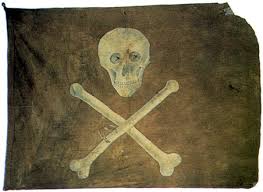
Illustration: A pirate flag
Bibliography
Eckstrorm, F.H. and Smyth, M. W. (1927)Minstrelsy of Maine: Folk-songs and Ballads of the Woods and the Coast. Boston: Houghton Mifflin.
Lagerbom, C. (2021) ‘Shiver me timbers?’ Maines first pirate. Midcoast Villager. https://knox.villiagesoup.com/opinion/shiver-me-timbers-maine-s-first pirate/article_9905e393-6681-5a3d-bebb-6214a00e82f8.html
Parker, A. D. (1925) A history of Pemaquid with sketches of Monhegan, Popham and Castine. MacDonald & Evans: Boston
 Turmoil in Dawnland