The first Wabanaki-Euro Wars began in 1676, and the brutal warfare would continue off and on for another 100 years. On at least three occasions, almost all Englishmen were purged from Maine. However, after every war, many returned to their original settlements, and others pushed further into Wabanaki territory. They justified their return by citing land deeds previously awarded by Wabanaki Sagamores.
The Wabanaki land sales were massive, covering a large portion of Maine.
- Capt. John Somerset and Unongoit – Awarded a tract of land on the tip of Pemaquid extending eight miles deep by twenty-five wide, including Muscongus Island. Sold to John Brown of New Harbor in 1624.
- Rawandagon (Robinhaud or Robin Hood)– Awarded seventeen land grants and witnessed two others between 1639 and 1675. These contracts covered the territory from the west side of the Kennebec River to Casco Bay, the area just east of the Kennebec, and lands north of Georgetown and Boothbay along the Sheepscot River.
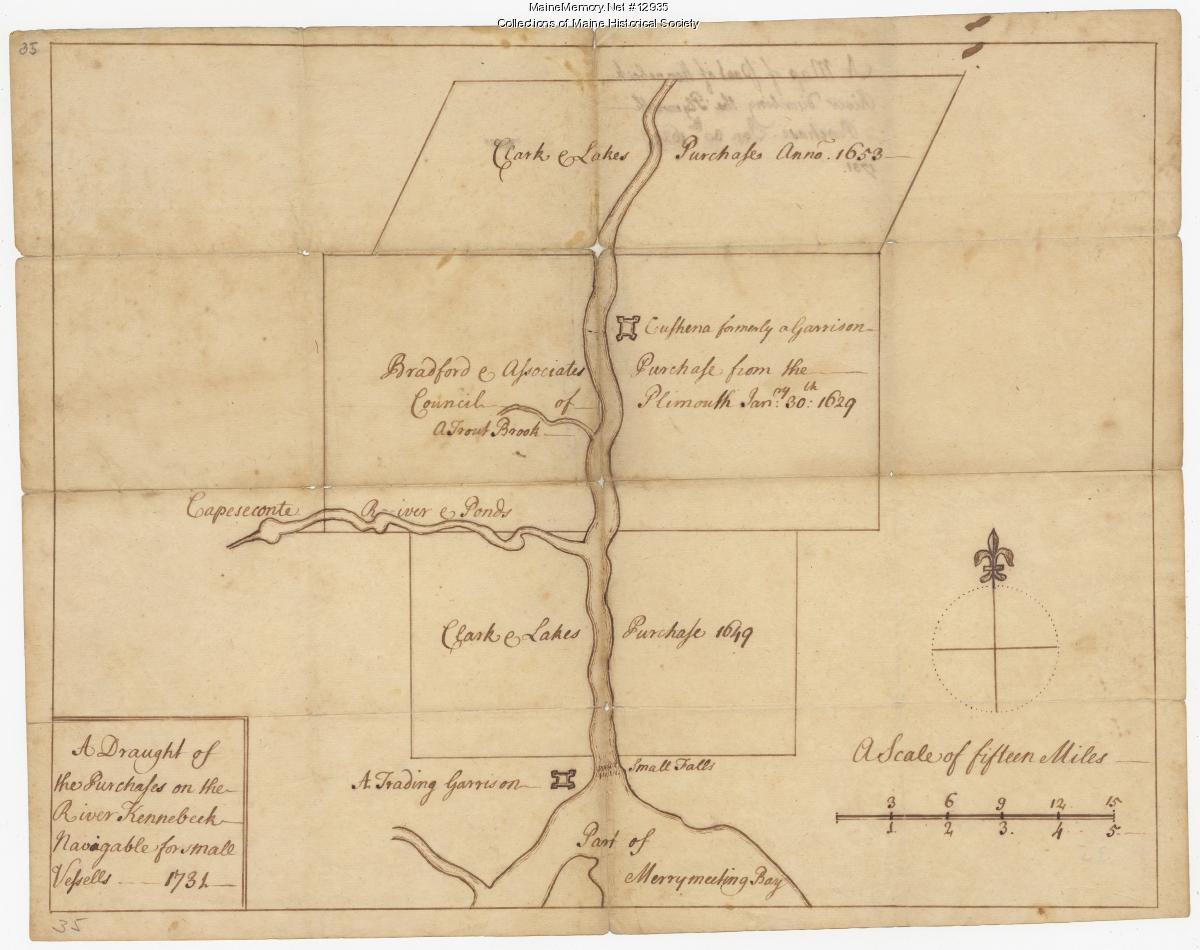
- Monquine (or Natahanada) – Awarded land on both sides of the Kennebec from Cushnoc to Wesserunset (Skowhegan) to William Bradford, governor of Plymouth Colony in 1648.
- Abagadusset (Bagadusset) – Sold a tract of land along the lower Kennebec River to Thomas Lake, Roger Spencer, and Christopher Lawson in 1649. This sale overlapped that of Monquine, leading to a lengthy legal battle.
- Warumbee, Darumkine, Wihikermet, Wedon, Domhegon, Neonongasset, and Numbauewet – Deeded lands along Merrymeeting Bay, Androscoggin River, and Kennebec River regions to Richard Wharton in 1684.
- Uphanum (Indian Jane) – Sold land around Dunstan to Andrew and Arthur Alger in 1659, along with her mother Nagaasqua, and her brother Ugagoguskitt. She would be the last Wabanaki resident of Scarbough.
- Madockawando – Awarded William Phips the land on both sides of the St. George River in 1692, during negotiations for the Treaty of Casco.
Why did the Wabanaki sell their land?
An obvious question is: Why did they do this? Did they understand what they were signing? The payment they received was usually a pittance, some booze, a coat, or an annual stipend of a peck or bushel of corn.
One reason may have been that they thought they had land to spare. Their numbers had become so diminished after the epidemics and the Tarrentine wars that they simply did not need so much land to support themselves. From the 1616-18 pandemic to the 1675 outbreak of King Philip’s War, Northern New England was only sparsely populated by the Wabanaki.
In fact, by the 1630s, the English greatly outnumbered the Wabanaki along the coast of Maine. “Excluding the hundreds of seasonal fishermen, the Maine coast soon counted well over 1,500 permanent settlers, most concentrated in the area from the Kennebec to Pemaquid. By this time, having reached manhood during the century’s turbulent first decades, Rawandagon must have realized fully that his people were powerless to resist the encroachment of foreigners … Sharply reduced in number, many of their cornfields deserted because of Mi’kmaq raids, their spirits shaken by strange diseases, coastal Ahenakis were essentially cornered into becoming Pawns in the burgeoning fur trade. Beaver, otter, marten, and other furs had become greatly valued as profitable exports” (Prins, 1996, p. 100).
It is also possible that the Wabanaki thought they were granting the English the right to use the land, but not to possess it. Beliefs about what land ownership meant were very different. In fact, the Wabanaki generally did not vacate the land they sold. As Baker (1986, p. 161) describes:
Until the outbreak of King Philip’s War, the Wabanaki were allowed to use and inhabit lands they had sold to the English. Although almost all the lands on the lower reaches of the Kennebec and Androscoggin rivers were sold to Englishmen between I639 and 1660, the natives occupied several parcels long afterward. As late as 1676, Kennebec Indians maintained a village, known as “Abagadusset’s fort,” on the north side of Merrymeeting Bay, despite having sold this property in the 1650s. The English must have allowed this in part because it ultimately benefited them. Having a large Indian village within the bounds of the Clarke and Lake tract at Taconic was a major reason for the success of the company’s trading post there. Likewise, as the English did little or no trapping, they would have been foolhardy to deny the Indians the right to trap on their land, or else they would never have received any pelts in trade. The English probably did not mind the Indians’ continued use of the lands as hunting territory, for the English settlers of Maine preferred their traditional sources of subsistence, particularly husbandry and fishing.”
Finally, the Wabanaki may have accommodated the English to build a buffer zone between them and their other enemies. “Having earlier been raided by seafaring Mi’kmaqs, the Abenakis were now threatened by Iroquois aggression from the opposite direction. Made up of five nations, including the formidable Mohawks, these Iroquois could field about 2,200 warriors. From the late 1630s onwards, they began spreading mayhem, soon reaching all of the Algonquian-speaking peoples from the Great Lakes to the Gulf of St Lawrence” (Prins, 1996, p. 107).
Regardless of the reason, the Wabanaki ultimately sold the bulk of Maine to the English. They would come to regret these sales, as the English continued to push relentlessly deeper and deeper into Maine.
Illustration: Clark & Lake’s land purchases and those of the Plymouth Colony (1731, Plymouth Company). Maine History Network. https://www.mainememory.net/record/12935
Bibliography:
Baker, E. W. (1986) Trouble to the eastward: the failure of Anglo-Indian relations in early Maine. Dissertations, Theses, and Masters Projects. William & Mary. Paper 1539623765. https://dx.doi.org/doi:10.21220/s2-mh0r-hx28
Baker, E. W. (1989) “A Scratch with a Bear’s Paw”: Anglo-Indian Land Deeds in Early Maine Ethnohistory 36 (3): 235-256
Prins, H. C. L. (1996) Chief Rawandagon alias Robin Hood: Native ‘Lord of Misrule’ in the Maine Wilderness. In: Grumet, R. S. (ed.) Northeastern Indian lives, 1632-1816. University of Massachusetts Press
 Turmoil in Dawnland