By the early 1630s, the sight of Wabanaki traders arriving in Pemaquid with their stocks of beaver, moose, and otter furs, pelts, skins, and hides was a common occurrence. Their periodic trading visits remained a part of local routine through the 1680s. Upon arrival, the traders did business with the several truck masters who operated trading posts or truck houses in the Pemaquid area.
Reconstructing the size of the Indian trading groups and the length of their stays is hampered by the usual dearth of historical documentation. The existing evidence suggests the Wabanaki typically traveled in small bands, consisting either of several adult males or small family units. They probably remained in the Pemaquid area for anywhere from several days to several weeks.
“During their visits, the Indian trading parties probably stayed in several locations. One popular site appears to have been on the grounds of today’s Bristol Town Beach … The beach area has added significance in that scholars believe it was the location of the Etchemin village visited by George Popham in 1607. A second possible Indian trading encampment may have also existed at the mouth of the Pemaquid River, but on its western banks, in a small cove just above the river’s Inner Harbor.20 While it has not been documented, some of the Indian visitors to Pemaquid likely spent time in the homes of local residents whom they had befriended or did business. Such a practice was not unusual in 17th-century New England. Period accounts contain numerous references to New Englanders taking in Indians for meals and overnight stays. Others probably established short-term trading camps on the more sparsely settled periphery of the Pemaquid plantation.” (De Paoli, 2001, pp. 228-229)
By the 1630s, Maine traders had shifted from offering nicknacks such as mirrors, rings, and bells, to practical goods that supported the Amerindian’s changing needs, such as English cloth, foodstuffs, clay smoking pipes and tobacco, shot, powder, kettles, axes, liquor, and beads (DePaoli,1994).
In their transactions, the Amerindians were given credit to obtain materials ahead of time, and their debts were met when they brought furs back to the station. The amount of credit they were given depended on their reliability. The most successful traders dealt in quality goods, and if they cheated the Amerindians, they risked being killed. The longevity of Abraham Shurt’s twenty-five-year trading career at Pemaquid was a testament to his good reputation for being fair and honest.
“Shurt’s trading network included the Pilgrim’s bitter French rivals Charles D’Aulney at Pentagoet and Charles de la Tour at the mouth of the St.John River, the preeminent Acadian traders. He provided them with all kinds of provisions including powder and shot. His furs were shipped directly to England or Massachusetts Bay on the ocean-going vessels owned by Aldworth and Giles. These ships regularly shuttled between Bristol, Massachusetts Bay, and the mid-coast of Maine.
Boston’s John Winthrop was Pemaquid’s primary client. Pemaquid’s furs, hides, fish, wood products, and agricultural produce would have found a ready market in the region’s primary entrepot. With their sale, Shurt could clear old debts and replenish stocks of consumables for Pemaquid’s planters and Indian clients. Much the same was undoubtedly done, but on a smaller scale, with the merchants and traders from Massachusetts South and North shores, New Hampshire, and Maine who did business with the Pemaquid manager.” (DePaoli, 1994, pp. 178-179)
Samoset
From 1616 to 1653, the Sagamore of Pemaquid was Samoset, headquartered on Muscongus or Louds Island. He became a great friend of Shurt and aided the English settlers in many ways.
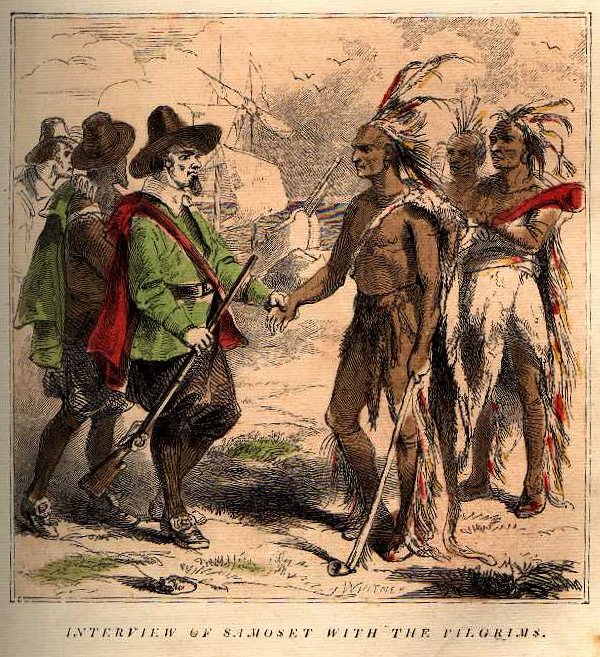
As a young man, Samoset interacted with English fishermen on Monhegan and learned to speak credible English. It was he who, in 1621, startled the Pilgrims by walking amongst them and talking to them in broken English, then later introducing them to Squanto and the great Wampanoag Sagamore, Massasoit. He explained that he was from Pemaquid, five days away by land and one day by water and rattled off the names of many captains and ships that had visited Monhegan.
Samoset would have a long, rich history of engagement with the English. He met and regaled Christopher Levett when he visited the region in 1623-1624. Levett described him as “a Sagamore, one that hath ben found very faithful to the English, and hath saved the lives of many, of our nation, some from starving, others from killing” (Baxter, 1893, p. 102). He was one of the Sagamores who deeded land to John Brown in 1625, and he would make several other smaller land grants to settlers in the 1630s and 40s. He cooperated fully with Abraham Shurt and was integral to his many Anglo-Indian negotiations.
Illustration: The cover of the 1853 book, Interview of Samoset with the Pilgrims, depicting Samoset meeting the Pilgrims.
Bibliography:
Baxter, J. P. (1893) Christopher Levett of York, pioneer of Casco Bay. Gorges Society, Portland.
DePaoli, N. (1994) Beaver, blankets, liquor, and politics. Pemaquid’s Fur Trade, 1614-1760. Maine History 33 (3): 166-201. https://digitalcommons.library.umaine.edu/mainehistoryjournal/vol33/iss3/2
 Turmoil in Dawnland