On 22 September 1648, Rev. Robert Jordan was elected president of Lygonia by the Assembly, with Cleeve as his deputy. Robert Jordan was the brother-in-law of Winter at Richmond Island and had taken over his affairs at his death. He had originally come to the Island as an Episcopalian Priest. Cleeve, Jordan, and Henry Josselyn were made judges of the province.
At this point, Cleeve’s hold on the affairs of Lygonia was beginning to crumble. As the local infrastructure grew and his peer landholders became more powerful, his being the agent of the high-ranking Englishman Rigby, diminished in importance. Desperate to keep power, Cleeve traveled to England in 1652 to confer with Rigby. He returned with a new thousand-acre patent, along with an order that the locals desist from making decisions until they heard from Rigby. However, the Lygonians chose to ignore this order, and Rigby became distracted with other affairs and didn’t try to enforce it.
An even greater factor in the decline of Cleeve’s hold on Lygonia was the tremendous rise of the Massachusetts Bay Colony. “By the mid-1650s, the Massachusetts Bay Colony’s government was far larger and better organized than the governments of its northern neighbors. Its citizens enjoyed the rights of trial by jury and the freehold tenure of land; members of each individual town elected councils to write bylaws as well as selected deputies to attend sessions of the General Court. The population of Massachusetts had grown to approximately 14,000 by 1650, and it was expanding rapidly … By contrast, Lygonia’s settlements remained small, scattered, and impoverished. In 1650 only about twelve hundred English lived in Maine year round. Although the region’s abundant fish and lumber had enriched individual merchants, Lygonia had not profited as a whole, and its economy was languishing. Even the fur trade was failing.” (Farber, 2009, p. 510).
Over the following decade, the Massachusetts Bay Colony would gobble up Lygonia and all of western Maine. Their original patent had conveyed to them “all that part of New England which lies and extends between Merrimac and Charles rivers,” and also “three miles north of the former, and every part thereof, and the same distance south of the latter”.
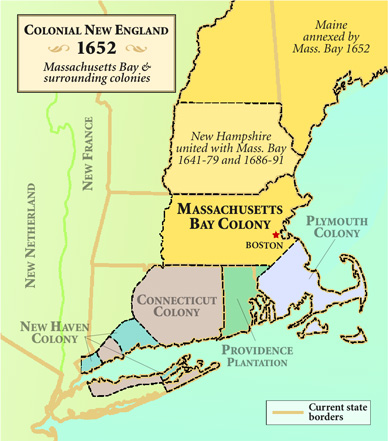
When this grant was made, it was thought that the course of the Merrimac was only east, parallel to that of the Charles; however, its head was discovered by the Massachusetts patentees to be much farther north at an outlet of Lake Winnipiseogee. In 1652, a committee of the General Court of Massachusetts, determined that the northeastern limit of their patent would strike Clapboard Island in Casco Bay, a few miles east of the town of Casco (Folsome, 1830). This definition of the charter brought within their jurisdiction nearly all the settlements in Maine.
Folsome (1830, pp. 84-85) relates that “Commissioners were sent “to treat with the gentlemen of the eastward,” in the summer of that year, who repaired to Kittery for the purpose of conferring with the officers chosen by the Combination. Gov. Godfrey, with his council, resolutely denied the right of Mass. to any portion of the Province of Maine. Thereupon the commissioners published a protest against the authority of Godfrey, declaring the province to be within ‘the limits of the patent of Mass. and invited the inhabitants to submit to the jurisdiction of its government. This document is dated at Kittery,
Under howls of protest from the leaders of Lygonia and eastern Maine, the Bay’s commissioners, began traveling from town to town, suggesting that the settlers in Maine would be more prosperous by joining Massachusetts Bay (Farber, 2009). Those settlers living just north of Massachusetts soon capitulated, and then gradually – town by town – most of the residents of the old Province of Maine … voted to become part of the government of Massachusetts Bay.
In August, 1656, seventy-one persons, inhabitants of Saco, Cape Porpus, Wells, York, and Kittery, addressed a petition to Cromwell, praying to be continued under the government of Masssachusetts, alleging that they were “a people few in number, and those not competent to manage weighty affairs, our weakness occasioning distraction, our paucity division, our meanness contempt.(Willis, 1865, p. 88)
The only holdouts would be the settlers of the Kennebec Patent, awarded initially to the Plymouth Colony, who established a government in that quarter in 1654. The Lygonian towns held out the longest, but on 13 July 1658, Cleeve, Jordan, and Jocelyn formally agreed that Lygonia would become a part of Massachusetts Bay. In the agreement, those places formerly called Spurwink and Casco became Falmouth, and Black Point, Blue Point, Cape Elizabeth, and Prout’s Neck were joined into Scarborough.
Cleeve became Falmouth’s commissioner as a consolation prize, falling from deputy president of a major New England province “to a small-claims judge with a two-town jurisdiction” (Farber, 2009, p. 512).
Illustration: Colonial New England, 1652. https://gerard-tondu.blogspot.com/2015/12/1652-massachusetts-takes-over-maine.html
Bibliography
Farber, H. (2009) The rise and fall of the Province of Lygonia, 1643-1658. The New England Quarterly 82: 490-513
Folson, G. (1830) History of Saco and Biddeford, with notices of other early settlements and of the proprietary governments, in Maine, including the provinces of New Somersetshire and Lygonia. Alex G. Putnam.
Willis, W. (1865) History of Portland, from 1632 to 1864: With a notice of previous settlements and changes of government in Maine. Bailey and Noyes: Portland.
 Turmoil in Dawnland