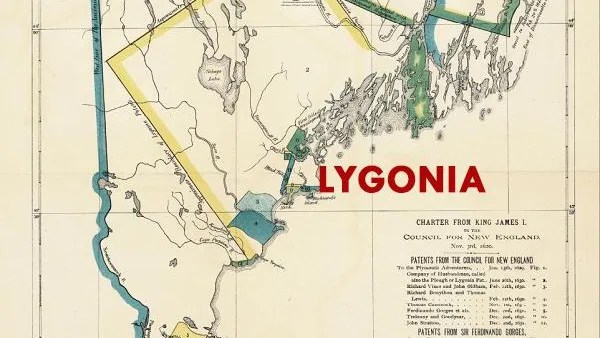
Among the flurry of patents issued by the Council of New England between 1629 and 1630 was the Lygonia or Plough Patent, which was awarded to a group of moderately prosperous artisans who called themselves husbandmen. Some of these belonged to a small sect of Puritans known as Familists. The patent awarded them “the tract containing forty miles in length and forty miles in breadth upon the south side of the river Sagadahock with all bays, rivers, ports, inlets, creeks, etc. ” (Burrage, 1916, p. x). In the patent, they were also authorized to form their own government.
The parcel of land was immense and cut right through the middle of Sir Ferdinando’s Province of Maine. Most astonishing, as pointed out by Burrage (1914, pp. 204 – 205): “It was made with a singular disregard for the fact that in 1622, the Council for New England. had granted all the land between the Sagadahoc and the Merrimac to Gorges and Mason, and that in 1629, in confirming the division of the land, the council had granted to Mason the territory between the Merrimac and the Piscataqua, leaving to Gorges the territory between the Piscataqua and the Sagadahoc, the council now took from Gorges’ territory a tract forty miles square and bestowed it upon this company of Husbandmen. Oddly, this action could not have been without Gorges’ knowledge, as he was still an influential council member. Moreover, the name given in the patent to the territory thus granted was derived from the maiden name of his mother, a daughter of William Lygon, and it may be supposed to have been suggested at least by Gorges himself.”
The Husbandmen left England in 1631 on the ship Plough and briefly landed at Sagadahoc. However, they apparently did not favor the site for colonization and soon left, not examining any other location within the limits of their patent.
Cleeve steals Lygonia
The Lygonia patent then lay fallow for over a decade. Typically, an unutilized patent would have been considered a broken title when its owners made no effort to retain or sell it. However, the political climate changed dramatically for Sir Ferdinando in England.
“During the rule of James I, such a petition would have almost certainly been rejected out of hand. Ferdinando Gorges supported his monarch faithfully, and when the king first gave him authority over New England, the legality of his holdings would have been considered secure. But Gorges’ standing in court had gradually waned after James I, died in 1625. Gorges had spent his own fortune on the colonization of New England as well as that of the three wives he had outlived, but he had found no precious metals and had been unable to monopolize the trades of fish, fur, or lumber. His several agents had established themselves more or less successfully as local leaders but had raised scant taxes from Maine’s fishermen, itinerant traders, and impoverished settlers. And now, England’s political climate was shifting dramatically. King Charles I was locked in fierce battles over taxation and religion with the increasingly rebellious Parliament.” (Farber, 2009, pp. 502 – 503).
Sir Ferdinando’s former friend and associate, George Cleeves, would discover the Lygonia patent and turn against him. Somehow, in 1641, Cleeve learned about the moribund patent and realized that if he could find a way to resuscitate it, he could take over virtually all of western Maine’s fur trade and its access to the sea (Farber, 2009). To make this happen, he would have to convince the Parliament that Sir Ferdinando was not fit to rule Maine and then identify a peer who would take over ownership of Lygonia and put him in charge.
On 4 June 1642, Cleeve sailed to England and appeared before Parliament, presenting a petition containing several trumped-up accusations against Sir Ferdinando and his agent Richard Vines, the London merchant Robert Trelawny and his agent John Winter, and the government of Massachusetts Bay.
Not surprisingly, the new parliament favored the petition of the Puritan Cleeve against his royalist protagonists. Then, on April 3, 1643, he gathered the remaining owners of the 1630 Lygonia petition and oversaw its sale to Parliamentarian Alexander Rigby. Rigby made Cleeve his representative and named him the “Deputy-President of Lygonia.”
With his commission in hand, Cleeve sailed for New England to assume control of his government, smack in the middle of Gorges’s Province of Maine. Upon returning, Cleeve immediately began organizing the province’s government. He instituted a Lygonian circuit court to rotate sessions among Casco, Black Point, and Saco. He nominated Commissioners, a Coronell General, Provost Marshall, and other officers to support the court. He then began selling parcels of Lygonian land to new settlers.
For at least a few years, Cleeve would control the bulk of English Maine.
Illustration: Screenshot of Lygonia from the 1620 Charter to King James. Maine Memory Network.
Literature cited:
Burrage, H. S. (1914). The beginnings of colonial Maine 1602-1658. Marks Printing House.
Farber, H. (2009) The rise and fall of the Province of Lygonia, 1643-1658. The New England Quarterly 82: 490-513
 Turmoil in Dawnland