In 1635, Sir Ferdinando sent his nephew, Captain William Gorges, and a group of craftsmen to the Province of Maine to form a government, build houses for future settlers (including a Manor for Gorges), and erect sawmills. William was Sir Ferdinando’s lieutenant at the Fort of Plymouth.
While the workman got busy in Agamenticus, William Gorges took up residence in Saco, where he established a court of commissioners composed of himself, Captain Richard Bonython of Saco, Edward Godfrey of Agamenticus, and several other early settlers in Maine—Captain Thomas Cammock and Henry Josselyn of Black Point, Thomas Purchase of Pejepscot, and Thomas Lewis of Winter Harbor. This court first met at Saco on March 21, 1636.
William Gorges’s court proved to be ephemeral, as in early 1637, he returned to England. “In all probability, like Robert Gorges, who came over in 1623 as governor and lieutenant-general of New England, William Gorges did not find the position he was to occupy in any way congenial to him and so sought an early release from the task to which he had been assigned” (Burrage, 1914, p. 234).
Another attempt at government
I639, Sir Ferdinando made another attempt to establish a government in the Province of Maine. By this time, the Saco Bay region was filled with many unruly settlers in addition to those sponsored by the Council of New England. Sir Ferdinando reserved the supreme power in the province for himself but appointed a deputy governor and a permanent council with seven members to rule in his absence. He named his young cousin Thomas Gorges as his Deputy Governor and as commissioners: Richard Vines and Richard Bonython of Saco; Henry Josselyn of Black Point; Edward Godfrey and Francis Champernount of Piscataqua and William Hook of Agamenticus. The first general court was held at Saco on June 25, 1640.
Thomas Gorges, at 22, was a remarkable choice for lieutenant governor. He had just completed two years at the Inns of Court. He was headed towards a lucrative future in the law in London, particularly because his great uncle, Lawrence Hyde, was the King’s attorney-general. His cousin Edward Hyde (later Earl of Clarendon and grandfather of Queen Mary and Queen Ann) was moving up in the English court. How Sir Ferdinando captured him for New England is unstated, but Thomas Gorges had strong Puritan leanings, and he could have chosen a career in New England to be with other Puritans in New England.
Thomas Gorges headed to New England in 1640, stopping first to meet with John Winthrop of the Massachusetts Bay colony to get his advice on setting up an effective government. Upon his arrival at Bristol, the name which had supplanted that of Agamenticus, Gorges was immediately disappointed. As Baxler (1902, p. 14) relates: “A mansion, large and imposing for the time and place, had been erected for him on the bank of the Organug and furnished in a style befitting the dignity of the expected governor, but, owing to the prevalent lawlessness, had been nearly despoiled of its belongings so that he found himself on his arrival with little to conduce to his comfort. The political affairs of the settlement he found controlled by a dissolute man, who, under the garb of a preacher, was exercising a baneful authority over the people. He was promptly arrested and, obtaining an execution against him, succeeded in driving him from the country.”
Sir Ferdinando makes Bristol/Agamenticus a city
On March 1, 1641, Sir Ferdinando decided to elevate Bristol/Agamenticus from a borough into a city. At this time, its population was about 200.
He executed a new charter: “by which he incorporated a territory of twenty-one square miles, and the inhabitants upon it, into a body politic, conferring upon it the dignity of his own name, ” Gorgeana.” The territory of the city ” lay, in the form of a parallelogram, on the northern side of the river Agamenticus, extending up seven miles from its mouth, and a league upon the seashore.” The government consisted of a mayor, twelve aldermen, twenty-four common councilmen, and a recorder, elected annually on March 25th by the freeholders. The mayor and aldermen were ex-officio justices and had the appointment of four sergeants, whose insignia of office was a white rod and whose duty it was to serve all judicial processes. The first city mayor was Edward Godfrey; the aldermen were probably those under the former charter” (Baxter, 1914, pp. 319 – 320).
Thomas Gorges returns home
Thomas Gorges made excellent initial inroads at governing with his council, which was kept busy with much early litigation. Even people like John Winthrop wrote that he had considerable talents. However, the outbreak of the English Civil War essentially ended English migration to New England, preventing further growth of the colony.
In 1643, Thomas Gorges himself returned to England to fight. He entrusted the colony to a committee headed by Edward Godfrey, who had been made mayor of Gorgeanna. Godfrey had little authority, leaving the colony effectively ungoverned, and Sir Ferdinando did nothing about it as his attention was now focused on the wars.
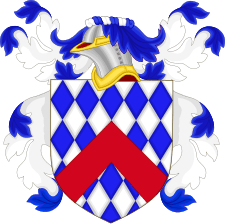
Illustration: Coat of arms of Thomas Gorges
Bibliography:
Baxter, J. P. (1889) Sir Ferdinando Gorges’s Province of Maine. John Wilson and Son, Boston.
Baxter, J. P. (1902) Two hundredth anniversary, Georgiana – York, 1652 – 1902. Old York Historical and Improvement Society, York, Maine.
Burrage, H. S. (1914). The beginnings of colonial Maine 1602-1658. Marks Printing House.
Moody, R. E. (1972) A letter from Thomas Gorges letter book. Maine History 12: 46–50.
 Turmoil in Dawnland