In 1630, Sir Ferdinando Gorges recruited George Cleeve to settle in his Province of Maine. If he immigrated there, he was given the title to two thousand acres of land at a place of his choice.
Cleeve was born about 1586 in Stogursey, Somersetshire, England, and was a native of Plymouth, England, when he met Sir Ferdinando. As described by Burrage (1914, p. 210): “[Cleeve] was not only acquainted with Gorges, who for so many years was in command of the fort at Plymouth, but he had doubtless talked with him many times with reference to the opportunities for settlement that were opening for Englishmen in the Province of Maine. In Cleeve, Gorges evidently found a man of energy and decision, and he was ready to give him information and encouragement. The enthusiasm of Sir Ferdinando with reference to the brightening prospects here was evidently contagious, and in 1630, with his wife and daughter, Cleeve made his way to the Maine Coast.”
Cleeve settled at the mouth of the Spurwink River at Cape Elizabeth with his family, one servant, and his business partner, Richard Tucker. They built a homestead there and started fishing and trading furs. Cape Elizabeth is on the mainland across from Richmond Island. One wonders if Cleeve had any interactions with Bagnell before he was murdered.
The Spurwink area was a beautiful, bounteous location, As described By Baxter (1885, pp. 30 -32): “Far and near, all was an unbroken wilderness, save tracts of land here and there which had been burnt over by the Indians, and had grown up to grass, presenting charming openings in the summer time, bright and fragrant with wild flowers, and musical with the songs of countless birds. The streams abounded with trout and salmon, which the gentle angler could lure to his basket with a scrap of red cloth, if he possessed no more succulent morsel to offer them. The woods, too, were full of game of every sort, from the wild pigeons, which at sunset settled down upon the great pines ebbing tide. Nor was the sea less populous than the forest. Herring, mackerel, cod, and the much-prized bass crowded the waters adjacent to Richmond Island and the Spurwink, and along the margin of the sea hovered numberless wildfowl, acceptable for food. Never had the newcomers from the Old World, where game, protected with jealous care, was the peculiar privilege of the rich, beheld such abundance, and they wrote home extolling the country as a newfound Paradise.”
Cleeve was not able to stay at Cape Elizabeth for very long. In 1633, John Winter, manager of Robert Trelawny’s fishing station on Richmond Island, took umbrage at the proximity of Cleeve’s claim at Spurwink and, “backed by some thirty brawny fishermen of the new fish-drying operation, compelled Cleeve and Tucker to abandon their homesteads and move a few miles north to Casco Bay.”
In 1636, Cleeve sailed back to England, where he met with Gorges and officially garnered fifteen hundred acres along Casco Bay. In addition, Gorges gave Cleeve the right to govern the portion of Maine between Casco Bay and Sagadahoc and “withal to oversee [Gorges’] servants and private affairs.” Finally, Gorges issued Cleeve three “protection[s] under the privy signet”: “For searching out the great lake of Iracoyse [Lake Champlain], and for the sole trade of beaver, and [for] the planting of Long Island. (Farber, 2009, p. 497)
Notably, this grant to Cleeve and Tucker did not come from the Council for New England but from Gorges himself. “The council for New England was [now] in a moribund condition … In a word, the council was ill constituted for conditions then existing in England. Its members stood with the king in his struggle to maintain the prerogatives to which Charles so tenaciously clung; while in the country at large the sympathies of the people in increasing numbers were with those who had arrayed themselves in opposition to the king. It was not yet civil war, but the country in its opposition to a king ruling without a Parliament, levying taxes illegally, raising money by the sale of monopolies and in such other ways as ingenuity and government distress could invent, was fast drifting toward it” (Burrage, 1914, pp. 228-229).
Cleeves and Tucker selected for their home an area called Machigonne (“Great Neck”) by the Wabanaki, which is now Portland. The two men continued as partners for many years, with Cleeves managing the land and Tucker carrying on the trade. Cleeve’s new lands proved to be a much more successful base for fur trading than Trelawny’s, being situated deeper into the heart of beaver land and possessing a large river for easy transport of goods.
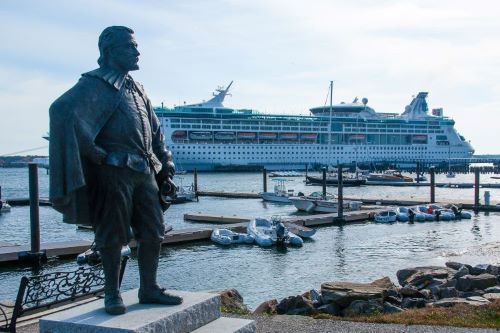
Illustration: A statue of George Cleave on the Portland, Maine waterfront. Paul Van Der Wert, Brunswick, Maine.
Bibliography:
Baxter, J. P. (1844) Documentary History of The State of Maine. Vol. III. Containing the Trelawny Papers. Hoyt, Fogg, and Donham: Portland.
Burrage, H. S. (1914). The beginnings of colonial Maine 1602-1658. Marks Printing House.
Farber, H. (2009) The rise and fall of the Province of Lygonia, 1643-1658. The New England 82: 490-513
Willis, W. (1865) The history of Portland from 1632 to 1864. Bailey and Noyes: Portland.
 Turmoil in Dawnland