Some of the earliest English settlers in Maine made their homes on small islands in Casco Bay. These included Walter Bagnall on Richmond, John Stratton on Stratton, and Arthur Mackworth on Mackworth.
The first English settler in Casco Bay was Walter Bagnall, who migrated to Richmond Island on the coast of Cape Elizabeth in about 1627. Bagnall moved there from Thomas Morton’s Merrymount Colony in Massachusetts when it was disbanded. Known as “Great Walt,” Bagnall would make his living as a trader with a very dubious reputation.
In 1631, after squatting on the Island for several years, Bagnell had Morton, who was back in England, apply for a proper patent from the Council of New England. Morton was successful, but the Great Walt was dead when the deed was awarded.
It seems, as Baxter tells it, he had “practiced fraudulently on the ignorant natives, selling them the deadly fire water which they so loved and stripping them of their Beaver and Wampompeage when under its influence …. on the evening of October 3d, 1631. a company of Indians, under the lead of a well-known Sagamore, Squidrayset, visited the island upon pretense of trade and revenged their many wrongs by slaying him and his family, plundering his house, and burning it over the bodies of its murdered inmates. (1885, pp. 27, 33-34).
Bagnall’s murder was avenged two years later by a group of English sailors that were passing by Richmond Island after chasing the first Maine pirate, Dixy Bull. The Indian they snatched was likely innocent and taken by chance, while the real culprit was never apprehended.
Before he died, the Great Walt buried some of his wealth in a stoneware rum jug. It lay hidden for over 100 years until, on May 11, 1855, a farmer and his son plowed it up. It contained twenty-one gold and thirty-one silver that, in today’s money, probably exceeded $5,000 in value.
Richmond Island would not stay unoccupied for long after Bagnall’s death. On December 1, 1631, the Council of New England deeded to the English merchants Robert Trelawny and Moses Goodyear the same tract of land awarded to Bagnall’s between the Spurwink and Presumpscot Rivers along Casco Bay “with liberty to erect and maintain stages and places for preserving fish in and upon and near the islands commonly called Richmond.”
Trelawny and Goodyear were only given the use of the land and not ownership since the Council had just a few months earlier given Richmond Island to Bagnall. However, when he was conveniently killed, “his title, therefore, lapsed, and Trelawny and Goodyear were left in undisputed possession of a most desirable location for developing large business plans and purposes. (Burrage, 1914, pp. 213 – 214).
A year after Bagnall’s death, Trelawny sent his brother-in-law, John Winter, to establish a fishing, trading, and lumbering settlement on Richmond Island. He hired a large group of indentured servants from West England who committed to three-year tenures. Within a few years, a bustling community of at least 60 fishermen was living on the island, with a few artisans and servants, Winter’s wife, a pastor, and several yeomen who farmed at nearby Spurwink. It would be the highest concentration of Europeans in Maine for at least a decade.
The second settler to make his home on a Casco Bay Island was a merchant named John Stratton. In 1628, he set up a fishing stage and trading station on the small island (28 acres) off the coast of Scarborough that still bears his name. Stratton lived well there for about three years, trading with the Wabanaki and the fishing fleets now common on the Maine coast.
In 1631, he returned to England, tired of the lonely island life and wanting to move to the mainland. He was awarded a grant from the Council of New England for 2000 acres of land on the south side of Cape Porpoise. Stratton relocated there for a few years until his wanderlust moved him again to Salem in 1637.
Another very early settler in the Casco Bay area was Arthur Mackworth. He first settled along the Saco River with Richard Vines in 1630 but soon moved to the island with his name found at the mouth of the Presumpscot River. As Baxter tells us: “Here it was that Mackworth passed his life, rearing a numerous family, and serving the public faithfully in many official positions … He was married in 1637 to Jane Andrews, the widow of Samuel Andrews, a citizen of London, who with her husband probably came to the New World in the same ship in which Mackworth came. He died in 1657, having willed that his wife, in whom he appears to have had unbounded confidence, “should by her wisdom dispose of his whole estate equally, as near as might be, between her former husband’s children and the children between them, and In case any shortness was on either side, it should rather be on his children’ … . She lived awidow after his death nearly twenty years, dying in Boston in t676 …” (1844, pp.213-214)
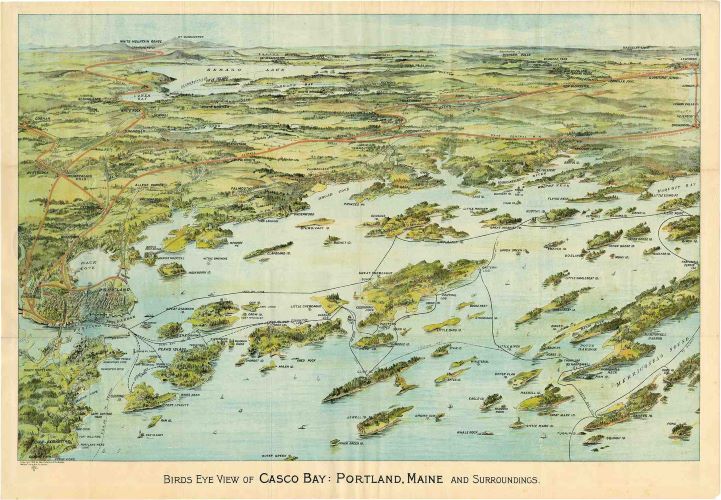
Illustration: Birds-eye view of Casco Bay, Portland, Maine, and surroundings. Geo. H. Walker & Co. Maine Central Railroad Company (1906)
Bibliography
Baxter, J. P. (1844) Documentary History of The State of Maine. Vol. III. Containing the Trelawny Papers. Hoyt, Fogg, and Donham: Portland.
Bourque, B. (undated) Richmond Island’s Pot of Gold: A fascinating tale of early Maine. MAINEBOATS.com. https://maineboats.com/print/issue-157/richmond-island’s-pot-gold
Churchill, E. A. (1984) A most ordinary lot of men: The fisherman at Richmond Island. Maine in the early Seventeenth century. The New England Quarterly 57: 184 – 204.
Fenlason, C. (2016) People who called Scarborough home: Indian Jane – Jane Hannup, Scarborough Historical Society. https://scarboroughhistoricalsociety.org/2016/10/uphannum-indian-jane/
 Turmoil in Dawnland