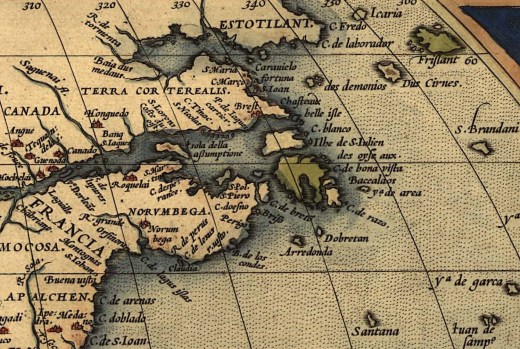
Two of the earliest patents awarded by the Council of New England were along the Saco River in Maine in 1630. One was given to John Oldham and Richard Vines, covering the area between Cape Elizabeth and Cape Porpoise on the south side of the river (now occupied by Biddeford), and the other to Thomas Lewis and Richard Bonython on the north side of the river (today represented by Saco).
The area covered by these grants was well-known to European explorers. Previous visitors were Samuel de Champlain, who had arrived at Saco Bay in 1605 and described a large community of agricultural people farming along the Saco River, and Richard Vines himself, who had spent the winter of 1616-1617 at a place he called Winter Harbor, a protected area at the mouth of the Saco River. He had been sent by Ferdinando Gorges to test the survivability of the Maine winter and had spent it in the wigwams of Wabanaki, who by that time were so sorely afflicted with a plague “that the country was in a manner left void of inhabitants (Baxter, 1885, p. 19).
Vines took possession of his patent on June 5, 1630, in a ceremony witnessed by several fellow travelers and explorers. Included in that group were Edward Hilton and Thomas Wiggen of Pascataqua (today Piscataqua), Isaac Allerton, a prominent member of the Plymouth colony, and Thomas Purchase, who would later establish a trading post at Pejepscot, now Brunswick.
Vines established his colony near the mouth of the river in the area that would become the village of Biddeford Pool, the same place he had spent the winter of 1616-1617 (Folsom, 1830). During the early years of his colony, about 40 people came to settle with him. Bonython, his son John, and two daughters emigrated to Biddeford in 1630 or 1631, and were joined by about 50 others.
The colonists found the land largely uninhabited, with vast stretches of abandoned agricultural fields. Vines was assigned as the area’s governor, while Bonython would serve as his assistant. Brighton, another early settler who had been a military officer in England, was made a magistrate. For the next century, the name Saco would be used to represent both settlements on the two sides of the river.
Most settlers engaged in farming, fishing, or both and traded for furs with a small group of local Wabanaki that had summer camps in the Saco area (Folsom, 1830). Most Europeans pursued all these activities and referred to themselves as husbandmen or planters. Most of the husbandmen took leases on 100 acres, which they rented for small fees from Vines.
The settlements along the Saco were small but soon had a vigorous economy. As described by Folsom (1830, pp. 36 – 37): “Fishing was the most common occupation, as it was both easy and profitable to barter the products of this business for corn from Virginia, and other stores from England. The trade with the planters of Massachusetts soon became considerable … The fishermen take yearly on the coast many hundred quintals of cod, hake, haddock, pollock, etc. and dry them at their stages, making three voyages in a year. They make merchantable and refuse fish, which they sell to Massachusetts merchants … The merchant sends the first to Lisbon, Bilboa, Marseilles, Bordeaux, Toulon, and other cities of France; to Canaries pipe staves and clapboards: the refuse fish to the W. Indies for the negroes …
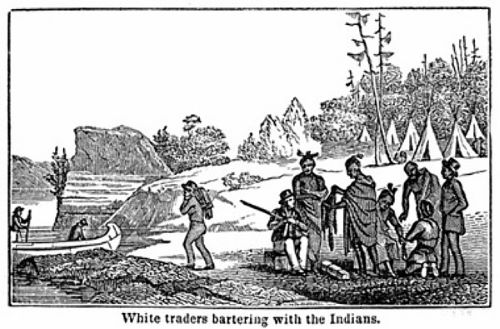
A considerable traffic was carried on with the natives by many of the planters, some of them visiting remote parts of the coast, or travelling into the interior for this purpose. English and French goods were bartered for valuable furs, particularly beaver … The furs obtained in the trade with the natives were disposed of to the European vessels that frequented the coast or at some of the few trading houses established in this quarter by the western colonies and English merchants. The greatest resort in our vicinity for these objects, at the period referred to, was Richmond’s island, now a part of the town of Cape Elizabeth.”
The colonist’s interactions with the local Wabanaki were uneasy at best. From the colony’s beginning, the settlers would be “strangers” and the Amerindians “savages”. The Wabanaki’s numbers were far lower than they had been when Champlain first visited, but the settler’s farms and fishing still encroached on native hunting and fishing grounds, interfering with the Wabanaki’s time-honored activities.
There was one particularly ugly incident between the traders and Wabanaki. Winthrop reported that a man named Jenkins, in I632, traveled from Cape Porpoise into the country, where he was killed, and his goods stolen while he was sleeping in a wigwam. The local chief recovered the goods and sent them back (Folsom, 1830).
Illustration: Woodcut, Unknown artist, White traders bartering with Indians circa 1820. Graphic Arts Collection, National Museum of American History, Smithsonian Institution, Nr: 2003-33644
Bibliography:
Baxter, J. P. (1885) George Cleeve of Casco Bay 1630-1669, with collateral documents. Gorges Society
Folson, G. (1830) History of Saco and Biddeford, with notices of other early settlements and of the proprietary governments, in Maine, including the provinces of New Somersetshire and Lygonia. Alex G. Putnam.
 Turmoil in Dawnland