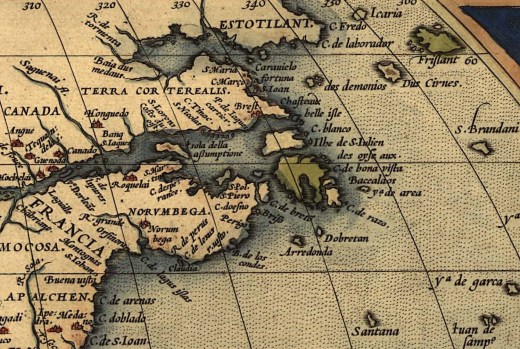
On December 1, 1631, the English merchants Robert Trelawny and Moses Goodyear were deeded from the Council of New England a tract of land between the Spurwink and Presumpscot Rivers along Casco Bay, “with liberty to erect and maintain stages and places for preserving fish in and upon and near the islands commonly called Richmond” (Burrage, 1914, pp. 213-214)
The next year, they sent an agent named John Winter to establish a settlement on Richmond Island, where the workers would be employed in several occupations, including lumbering, fishing, trading, and shipbuilding. The Trelaway papers, a compilation of letters, accounts, and documents sent by Winter to Trelaway over a ten-year period, detail this operation (Baxter, 1844).
In its prime, the station was large, with at least 60 fishermen on the island, a few artisans and servants, and several yeomen who farmed at nearby Spurwink. Very few women were on the island except for Winter’s wife. The workers were hired for three years and were paid annual wages, a share of the catch, or a combination of both.
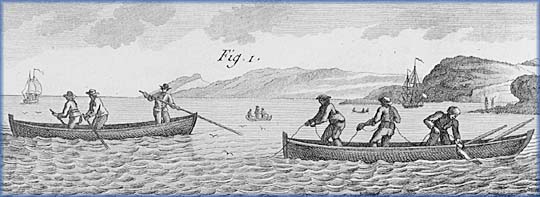
“The fishermen worked in crews of four, three of whom went to sea, while the fourth remained at the island, curing the fish previously brought in and preparing it for shipment to Europe. The sea-going men included a master, who steered the vessel and was in charge of the voyage, and a midshipman and fore-shipman responsible for handling the craft. They fished from shallops, double-ended vessels about twenty feet long and measuring three to five tons” (Churchill, 1984, p. 186)
The men generally made three or more day-long fishing trips each week during the winter; in the summer, when fishing was poor, they might extend their trips to two days. They could only stay out to sea for so long before the fish began to spoil. These trips could become quite dangerous if a sudden squall or a severe cold snap came up.
In the summer, the station yeoman managed about 20 acres of crops and a substantial herd of cattle, goats, and pigs. In the winter, they helped dress and dry fish.
Treleway sent several ships each year to England, Spain, or France, loaded with fish and whale oil. The ships returned with manufactured goods and provisions.
About the only leisure time the men got was to sleep and eat. The pattern for serving meals—light breakfasts and lunches and a major meal at suppertime—was set to correspond with the fishing schedule. Typical meals included breakfast of cornbread, flat cakes, and beer; for lunch, biscuits, pork or cod, and wine for the fishermen; and bread, perhaps a light gruel, and drink for the shoremen. Supper often consisted of a stew, pork, peas, bread, pudding, and beer or wine.
“Alcoholic drinks, for Winter’s men as for most people in the New World, England, and Europe, were staple beverages. Any man who had to drink water was felt to be truly deprived, and it was thought to be positively harmful to do so for any length of time. Beer, the basic drink, was brewed on the island from barley, wheat, and other grains, locally grown hops, and imported malts. Wines and brandies had to be imported, though, and apparently, each man was required to purchase his share of these more potent beverages.” (Churchill, 1984, pp. 192 -193).
The men at Richmond Island regularly attended religious services. In 1636, Trelaway sent the Reverend Richard Gibson, an Anglican clergyman, to the station on a three-year contract. In 1642, Mr. Robert Jordan, a clergyman of the Church of England, moved to the island and began regular services.
Most of the men Winter hired came from small towns in Cornwall and Devon Counties in the West Country of England. Most were in their 20s, and a little more than half were married and sent part of their wages home. Many stayed in Maine after their term of service. Out of 110 who finished their term, it is known that at least 33 remained in Maine, and 11 or 12 moved somewhere else in New England (Churchill, 1984). Among those that stayed, many became independent fishermen and farmers scattered along the coast.
Some of the men who remained in Maine after their service did very well financially. “Landman Jonas Bailey, for example, managed to save about half of the £5 he earned each year at Richmond Island and was able to move to nearby Blue Point. He settled down and soon married the widow of a local landowner, carpenter George Deering. And thereby acquired all of Deering’s holdings. Bailey operated the farm until he died in the winter of 1664. He left an estate valued at £290, including his farm, a herd of twenty cattle, seventeen hogs, a substantial stock of provisions, and an impressive list of household items.
Another enterprising laborer from the Island, Richard Martin, would also accumulate an estate of more than £200. In 1639, only two years after arriving at the Island and while still engaged by Winter as a fisherman, he had raised enough hogs independently to sell over 560 pounds of meat to his employer. He started a farm at Scarborough but moved to Presumpscot after marrying widow Atwell and acquiring her holdings. He developed and expanded his agricultural operation, bought and sold land, and even worked a second stint with Winter in the early 1640s. The inventory of his estate in 1672/3, like Bailey’s, mirrored his farming activities” (Churchill, 1984, pp. 201 – 202)
Illustration: Cod fishing shallop. Canadian Museum of History. https://www.historymuseum.ca/cmc/exhibitions/hist/lifelines/licog18e.html
Literature cited:
Baxter, J. P. (ed.) (1844) The Trelaway papers. Hoyt, Fogg and Donham, Portland.
Burrage, H. S. (1914). The beginnings of colonial Maine 1602-1658. Marks Printing House.
Churchill, E. A. (1984) A most ordinary lot of men: The fisherman at Richmond Island. Maine in the early Seventeenth century. The New England Quarterly 57: 184 – 204.
 Turmoil in Dawnland