The Pilgrims of Plymouth made the first significant purchases of Indian land in the Kennebec Valley. In 1648, sachem Monquine (or Natahanada) sold the land on both sides of the Kennebec from Cushnoc to Wesserunset (Skowhegan) to William Bradford, governor of Plymouth Colony. This land was north of the colony’s previous grant from the Council of New England.
In 1650, Plymouth abandoned its trading post at Kenibec in the lower reaches of the Kennebec River in favor of a location upriver at Cushnoc, where they expected less competition. However, the move was not without negative ramifications, as Baker (1986, p. 107) suggests: “While the move to Cushnoc to secure their trade may have seemed a good course of action at the time, Plymouth officials quickly recognized that they had made a tactical mistake. By taking Indian deeds, Plymouth colony had recognized the right of all Indians to sell their land. Plymouth’s action also suggested that the Indians themselves, and not the colony’s patent, were the source of clear titles to Kennebec lands. Finally, Plymouth’s acceptance of these deeds meant that the colony had to recognize the Indian deeds of its English competitors in the fur trade.”
In 1649, the most significant competitor of the Plymouth Colony would emerge: Thomas Lake. Lake was descended from a wealthy Lincolnshire family and was a wealthy Boston merchant who participated in the triangular trade of London, sending furs to England and boards, staves, fish, peas, and wheat to Barbados and the Wine Islands.
Lake, along with John Allen and Nicholas Shapleigh in 1641, obtained a massive patent encompassing thousands of acres of timber along the southern bank of the Piscataqua River and the north shore of Massachusetts. In 1649, as this area faced increasing deforestation, Lake sent his agent Christopher Lawson to the Kennebec to purchase more land; joining with two new partners, Roger Spencer, and John Allen, he purchased two large tracts on the Kennebec from the local Wabanake.
As Baker (1986, pp. 108-109) describes: “One deed ran from “Swan Allie” (Swan Island) in Richmond north about thirteen miles to the mouth of the Cobboseecontee Stream and extended ten miles into the woods on both sides of the Kennebec. A second tract, overlapping property purchased by Plymouth in 1648, centered around Taconic (or Teconnet, the falls in present-day Waterville), stretching four miles above the falls and six miles below. This second tract also extended ten miles into the woods on both sides of the river. By 1653 trading posts had been set up on both tracts, one at Taconic and another at Neumkeag (not to be confused with Neguamkeag) on the east bank of the river at what is now Agry’s Point in Pittston. The Plymouth station at Cushnoc fell between these two trading posts, meaning that Wabanaki going either upriver or downriver would trade their furs with Lake’s men before reaching Cushnoc. A struggle to buy up Indian lands would quickly ensue between Lake and the Plymouth colonists.”
While Lakes’s strategy to take over trade on the Kennebec was sound, it was hampered by the fact that the northern tract he had purchased overlapped with the property bought by the Plymouth Colony. As Baker (1989, p. 240) again outlines: ” Abagadusset (or Bagadusset), an Indian who lived many miles downriver (in present-day Richmond), sold much of this tract to Thomas Lake, Roger Spencer, and Christopher Lawson. Plymouth Colony authorities then proceeded to take depositions from several Indians to confirm Pilgrim ownership. Essemenoque (also spelled Assiminisqua and Quesememecke), “one of the right owners of Toconett,” signed one of the depositions, stating that he had been aware of the sale of land by Monquine to Bradford, consented to it, and received “part of the pay.” While Essemenoque acknowledged that he and all the other Indians freely approved of Monquine’s transaction, he claimed that Abagadusset had no right to sell Taconic, for the land belonged to him and Watchogoe’s wife.”
In 1654, the Plymouth Colony and Thomas Lake resolved their difficulties by agreeing to specific property boundaries and uniting their separate truck houses into one fur-trading partnership.
However, from this point on, the Plymouth Companies’ profits plummeted. Several factors reduced its profitability. Not only were they competing with Clarke and Lakes’s southern trading posts, but many other independent “coasters” and small resident traders competed with them for furs. The distant Plymouth colony simply did not have the manpower to protect its jurisdiction along the river. Supplies of furs were also reduced in 1659 when a raiding party of Mohawks killed and kidnapped several Wabanaki, and the Maine Indians shifted their focus from trading furs to fighting the Iroquois. Governor Bradford, who had directed the Plymouth fur trade, also died in 1657.
As described by Baker (1986, p. 115): “Unwilling to expend energy and money on a distant territory and unable to profit from the bountiful fur supply of the Kennebec, the Plymouth Colony began seeking a buyer for the Kennebec tract. In 1661, the colony sold the whole tract for £400 to four Boston merchants, John Winslow, Antipas Boyes, Edward Tyng, and Thomas Brattle.”
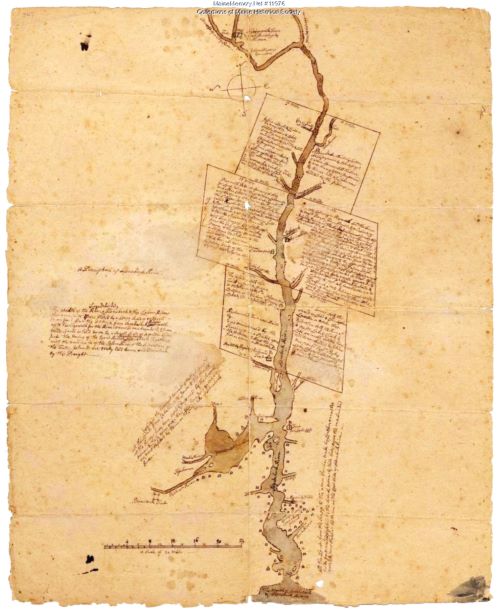
Illustration: Plan of the Kennebec River showing the Plymouth patent, ca. 1719. Maine Historical Society.
Bibliography:
Baker, E. W. (1986) Trouble to the eastward: the failure of Anglo-Indian relations in early Maine. Dissertations, Theses, and Masters Projects. William & Mary. Paper 1539623765. https://dx.doi.org/doi:10.21220/s2-mh0r-hx28
Baker, E. W. (1989) “A Scratch with a Bear’s Paw”: Anglo-Indian Land Deeds in Early Maine Ethnohistory 36 (3): 235-256
 Turmoil in Dawnland