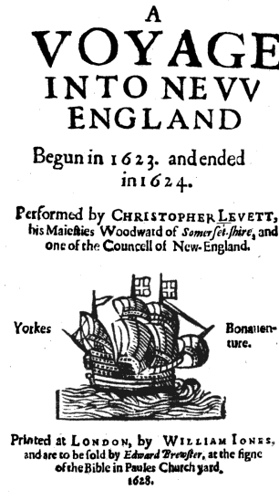
The first European to settle on the shore of Casco Bay was Christopher Levett, a merchant and friend of Sir Ferdinando Gorges. He left a detailed account of his adventure, “A Voyage into New England,” published in 1626 and reprinted by James Phinney Baxter in 1893.
Levett set sail for New England in 1623, reached the Isles of Shoals in the autumn, and then, after a visit to Piscataway, proceeded up the coast in two open boats with ten others to find a location for his colony. Levett first examined the area around today’s Portsmouth, or Aquamenticus, as he called it. Here, he found a good harbor and much land that was “already cleared, fit for planting corn and other fruits, having heretofore been planted by the savages, who are all dead. There is [also] good timber and likely to be good fishing, but as yet there hath beene no tryall made that I can heare of. (Baxter, 1893, p. 92).
He then proceeded to Cape Porpoise, and then ‘Sawco” (Saco), four leagues farther east. On the way, he had to battle a heavy fog; the boats became separated, and such a fierce storm assailed them that they were forced to strike sail and take to their oars, spending the night at sea. Finally united on land, the group spent five nights at Saco, huddled in a wigwam made of their boat sails, in weather “very unseasonable, having much raine and snow, and continuall foggse “… The greatest comfort they had, “next unto that which was spiritual, was this we had foule enough for killing, wood enough for felling, and good fresh water enough for drinking.” (Baxter, 1893, p. 95)
Making his way farther up the coast, Levett came to a place he called “Quack”, which he named York, after his hometown in England. Quack, he describes, as ” a bay or sound betwixt the main and certain islands which lyeth in the sea about one English mile and a half”. This would be Portland Harbor, the western part of Casco Bay. Continuing, Levett adds: ”There are four islands [Cushing’s, Peaks’, Diamond and House] which make one good harbor; there is very good fishing, much fowl and the main as good ground as any can desire”. (Baxter, 1893, p. 99)
While exploring the region, he met: “the Sagamore or King of who hath a house, where I was one day when there were two Sagamors more, their wives and children, in all about 50. and we were but 7. They bid me welcome and gaue me such victualls as they had, and I gaue them Tobacco and Aqua vitae … And the great Sagamore of the East country, whom the rest doe acknowledge to be chiefe amongst them, hee gave unto me a Bevers skin, which I thankfully received, and so in great loue we parted.”
Continuing his exploration eastward, Levett mentions Casco having “a good harbor, good fishing, good ground and good fowl, and a site for one of the twenty good towns well- seated to take the benefit both of the sea and fresh rivers”. He also suggests that the whole distance from Cape Elizabeth to the Sagadahoc, was exceedingly favorable for plantations. (Baxter, 1893, 100 – 101).
The next place Levett came to was Capemanwagan [Southport or perhaps Boothbay]. Here he lingered and met many important Wabanaki sagamores with their wives and children and was able to make a significant fur trade: “there I staid foure nights, in which time, there came many Savages with their wives and children, and some of good accompt amongst them, as Menawormet a Sagamore, Cogawesco the Sagamore of Casco and Quack, now called Yorke, Somerset, a Sagamore, one that hath ben found very faithfull to the English, and hath saved the lives of many of our Nation, some from starving, others from· killing. … hearing of my being there, they desired to see me, which I understood by one of the Masters of the, Ships, who likewise told me that they had some store of Beauer coats and skinnes, and was going to Pemaquid to truck … I then sent for the Sagamores, who came, and after some complements they told me I must be their cozen … whereupon I told them that I understood they had some coates and Beauers skins … Somerset swore that there should be none carryed out of the harbour, but his cozen Levett should haue all …”
When the Sagamores were ready to leave, they asked Levett where he was going to settle. He told them that he “intended to goe farther to the east before I could resolue … Cogawesco, the Sagamore of Casco and Quacke, told me if that I would sit downe at either of those two places, I should be very welcome, and that he and his wife would goe along with me in my boate to see them, which curtesey I had no reason to refuse, because, I had set up my resolution before to settle my plantation at Quacke, which I named Yorke, and was glad of this oppertunity
Levett built a fortified home there in the summer of 1624 and then took passage for England on a fishing boat to garner support for his colony. He left ten men behind, intending to return the following year, but never made it back. Nothing is known about the fate of these men.
Illustration: Frontispiece of Christopher Levett’s A Voyage into New-England, Begun in 1623, and Ended in 1624.
Bibliography:
Baxter, J. P. (1893) Christopher Levett of York: The pioneer colonist in Casco Bay. Gorges Society: Portland
 Turmoil in Dawnland