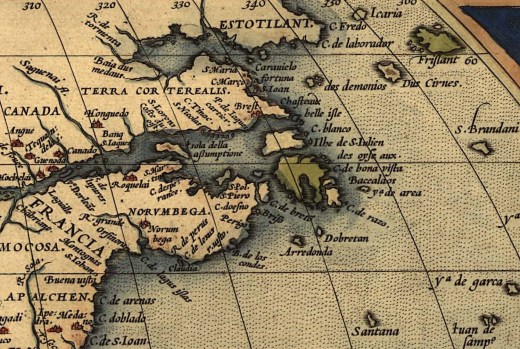
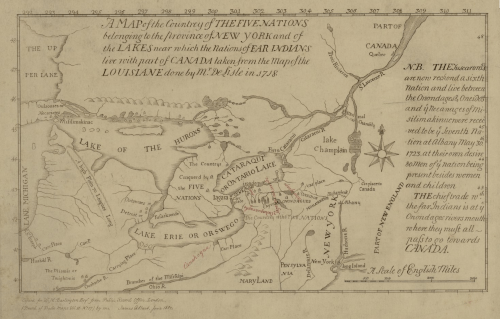
When the first Europeans began to explore the Gulf of Maine, the coast was inhabited by a well-established, populous society that had lived there for over 12,000 years. They recognized themselves as the Wabanaki and their land as Wôban-aki, which signifies the People of the Dawnland, the First Light, or simply of the East. Spanning the geography of Maine, the Wabanaki were composed of three distinct Algonquian nations, first recognized by Champlain in 1607: the Souriquois, Etchemins, and Armouchiquois.
The Souriquois were located in the northern corner of Maine, Nova Scotia, New Brunswick, Prince Edward Island, Newfoundland, and on the Gaspé Peninsula of Quebec. The Souriquois were hunter-gatherers who obtained most of their sustenance from the sea.
The Etchemin were located along the central coast of Maine in the woodlands between the Kennebec and St John Rivers. They were flanked on their northeast by the Souriquios and to their southwest by the Armouchiquois. The Etchemins can be further divided into two groups: the Eastern Etchemins, who allied with the Souriquois and were located east of the Narraguagus River, and the Western Etchemins, who allied with the Armouchiquois and ranged along the coast and into the forested hinterland from the Narraguagus to the Kennebec River (Hoffman, 1955). This separation is controversial (see Snow, 1968 and 1978).
The Western Etchemin were composed of corn-growing villagers who inhabited the Kennebec Valley and areas to the south. The Eastern Etchemin were comprised solely of migratory foraging bands that ranged the coastal waters and vast woodlands east of the Kennebec.
The Armouchiquois ranged from western Maine to Cape Cod and comprised several corn-growing groups, which came to be known as the Abenaki, Penacook, Massachusett, and Wampanoag. They called themselves “alnamback,” or “real people” (Haviland, 2017).
Champlain did not give the origins of the names he gave the Indigenous people, but conjectures have been made (Haviland, 2017). The word ‘Etchemin’ is believed to be either a French alteration of an Algonquian word for canoe or a translation of ‘skidijn’, the native word for people. ‘Souriquois’ was a French term meaning ‘saltwater men. ‘Armouchiquois ‘ was a French corruption of the Souriquois word ‘Alemousiski ‘, which meant ‘land of the little dog ‘. This term was intentionally derogatory, reflecting the power dynamics between the Souriquois and Armouchiquois. Their name for themselves was U’nu’k, meaning humans or people.
Maine’s evolving ethnicity
Over the 17th century, the way European’s recognized the Indigenous People of Maine would significantly evolve. The term “Armouchiquois” would quickly disappear, while the labels “Etchemin” and “Souriquois” would endure longer but also be replaced.
The English never used Champlain’s names for the Wabanaki nations. The Souriquois would become the Micmac or Mi’kmaq, and the Armouchiquois and Souriquois tribes would be identified by the village or watershed in which they lived.
Wabanaki groups along the Saco River were known as the Sokokis and Pequawket (Ridlon, 1895). Along the Androscoggin or Anasagunticook River lived the Pejepscot of Brunswick, the Rokomeko of Canton Point, the Passaconaway along the little Androscoggin, and the Caughnawaga, who moved about. None of these tribes survived the Wabanaki-Euro Wars of the 17th century. Survivors from these groups joined more eastern nations or moved to the Jesuit missions of Canada (Smith, 1949).
Several tribes were found along the Kennebec River. The Sagadahocs were located in an area spanning the Kennebec Valley to Merry Meeting Bay. The Midcoast region was named after this group. The Canabas or Kennebec were centered around Swan Island, across from present-day Richmond. The grand-chief Bashaba, known to many of the early English explorers, belonged to this group. At their village of Norridgewock, several Jesuit priests, including Gabriel Droillettes and Sebastian Rale, were sent to teach the Catholic religion. Rale would ultimately lead the Wabanaki in numerous bloody raids in one of the Euro-Wabanaki Wars.
The Cussenocks or Cushnocs ranged near Augusta, and would interact peacefully with the Pilgrims at an early trading post they established. The Tacconets lived in the Sebasticook watershed, and along the coast from the Kennebec to the St. John lived the Sheepscot, Damariscotta, St. George River and Pemaquid tribes, collectively known as the Walinakiak or Wawenocks. George Weymouth would abduct five Wawenocks in 1605 and take them to Sir Ferdinando Gorges and Lord Popham in England.
The Penobscot or Pentagoet lived in the Penobscot River Valley. Their great leader was Madockawando, who played a central role in two of the Euro-Wabanaki Wars. His daughter was married to the Frenchman Baron Saint-Castin, who became a powerful trader and led a series of Indian raids.
The Passamaquoddy or Pestumokayiks lived on the coast between the Penobscot and St. Croix Rivers. North of them were the Maliseet or Malecite people.
Today, only four small federally recognized tribes exist in Maine: the Houlton Band of Maliseet Indians, the Mi’kmaq Nation, the Penobscot Nation, and the Passamaquoddy Tribe. The Passamaquoddy include two tribes, one at Motahkomikuk and another at Sipavik.
Illustration: Marc Lescarbot’s map of New France, made in 1609. Originally published in his Histoire de la Nouvelle France (Paris). Note the locations along the coast of theSouriquois, Etchemins, and Armouchiquois.
Bibliography:
Obomsawin, M. & Smith, A. (2020). The Wabanaki of the Kennebec River. https://gradfoodstudies.org/wp-content/uploads/2024/06/39f1a-thewabanakiofthekennebecriver.pdf
Prins, H. E. L., & McBride, B. (2007). Asticou’s Island Domain: Wabanaki Peoples at Mount Desert Island 1500-2000. Acadia National Park. Ethnography Program. National Park Service.
Ridlon, G.T. (1895) Saco Valley settlements and families. historical, biogeographical, genealogical, traditional, and legendary. Author Published, Portland, Maine.
Smith, M. J. (1949) A history of Maine, from wilderness to statehood.Falmouth Publishing House: Portland, Maine.
Snow, D. R. (1968). Ethnohistoric baseline of the Eastern Abenaki. Ethnohistory 23(3): 291 – 306.
Snow, D. R. (1976). The ethnohistoric baseline of the Eastern Abenaki. Ethnohistory, 291-306.
 Turmoil in Dawnland