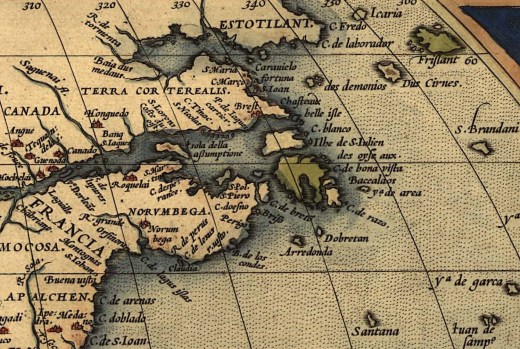
The Jesuit Relations are filled with references to the hardships incurred by the priests who accompanied Amerindians on their long winter hunts. However, winter was actually a welcome time for the Wabanaki of Maine. The interior hunting grounds were rich sources of wild sustenance, with moose being the most important and their favorite. Stable, deep snows facilitated successful moose hunting by family groups of eight to ten along routes that sometimes exceeded three hundred miles. The Wabanaki had great respect for the severity of the cold and the potential for hunger, but were also confident of their ability to survive in the worst conditions.
In late fall each year, the family bands would head upriver in their birchbark canoes, which could hold up to 10 people. When the rivers began to freeze, they left their canoes behind and moved ahead on foot, and when the snow got really deep, they used snowshoes to travel and pulled toboggans with their household goods. Their snowshoes were made of white ash or beech and held together with cords made of guts or hide.
They would camp at promising hunting sites near water, first building a fire, and then constructing a wigwam. As the Jesuit missionary Father Baird described:
The women would go to the woods and bring back some poles, which were stuck into the ground in a circle around the fire, and at the top were interlaced into a pyramid, so that they came together directly over the fire, for there is the chimney. Upon the poles, they throw some skins, matting, or bark. At the foot of the poles, under the skins, they put their baggage. All the space around the fire was strewn with leaves of the fir tree, so they would not feel the dampness of the ground; over these leaves were often thrown some mats, or sealskins as soft as velvet; upon this they stretch themselves around the fire with their heads resting upon their baggage; And, what no one would believe, they are very warm in there around that little fire, even in the greatest rigors. (Thwaites, 1898, p. 75)
Other Jesuits would describe these wigwams as filthy, crowded, and smoke-filled, but to the Wabanaki, they must have felt snug and welcoming. Certainly, a respite from the bitter cold.
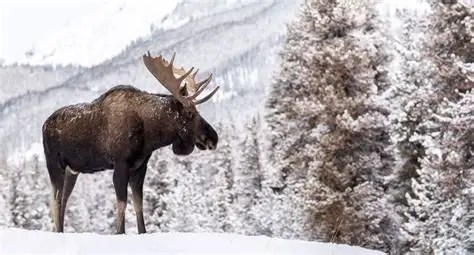
Hunting for moose became the Wabanaki’s primary focus. In the winter, the moose remained in the uplands where Wabanaki hunted, while the white-tailed deer moved to the lowlands where the English settlers lived. White tailed deer were hindered by twelve inches of snow and immobilized by twenty inches unless the surface was frozen and could hold their weight. Moose, with their much longer legs, could handle deep snow much better, although they were sufficiently slowed to be vulnerable to Wabanaki hunters on snowshoes.
With each step, a moose’s legs punched through the frozen surface of the snow, which slowed it down and sometimes lacerated its skin. Snowshoes kept Wabanaki hunters from sinking, and over the course of a long chase, they could outperform the fatigued, wounded, and harried animal. If the conditions were right, Native hunters caught up to a moose “sometimes in half a day, sometimes a whole day,” or, in other words, after many miles. For the “ardent Hunter who is following on snowshoes,” such hunts required both agility and endurance. As Josselyn noted, only “the young and lustie Indians” could keep pace with the moose. Dogs helped too, enjoying the same advantage atop a frozen snowpack. On dry ground, moose towered over humans, with the back of a bull often seven feet off the ground. But atop the surface of the snow, Wabanakis could sometimes be even taller and make the kill from above with their lances. (Wickman, 2015, p. 68).
A moose yielded a considerable amount of meat and much rawhide for clothing and moccasins. The Wabanaki cooked and ate all parts of the moose, including the heart, tongue, snout, kidney, liver, and intestines, and the cacamo, or moose butter. This was produced by pounding the bones to a powder after sucking out the marrow, then boiling it to recover the fat, which bubbled to the surface. They could get five to six pounds of grease per moose, which they ate directly or used as provisions on a hunt. Some of the meat was smoked and dried for long-term storage and shared with other family bands in need. It served as subsistence insurance for a wide network of hunting bands scattered across the forest (Whickham, 2015).
Some scholars have suggested that the long winter treks of the Wabanaki were due to the scarcity of game, forcing them to move continually in search of food. However, the long expeditions
actually signaled virtuosity in winter travel—not scarcity-induced wanderings—and registered the strong positive value they placed on the winter hunt … evidence from the early eighteenth century indicates that moose, bears, and beavers thrived throughout much of Dawnland, despite diminishing populations near the coast.
John Gyles, held captive by a Maliseet band after a 1689 raid on Pemaquid, Maine, witnessed firsthand Wabanakis’ persistence in pursuing moose. They continually moved “up the country after moose,” and concluded on the northern end of the Gaspé Peninsula, some four hundred miles away from the site of the raid. Gyles’s captors sought to comfort him by promising a rich hunt: he later recalled that his masters “would often encourage me, saying in broken English, ‘By-by, great deal moose. (Wickman, 2015, pp. 70 – 71)
Illustration: A Maine Moose in winter.
Bibliography:
Prins, H. E. L., & McBride, B. (2007). Asticou’s Island Domain: Wabanaki Peoples at Mount Desert Island 1500-2000. Acadia National Park. Ethnography Program. National Park Service.
Thwaites, R. G. (ed) (1898) The Jesuit Relations and Allied Documents, vol. 3. Acadia 1611 – 1616. Burrows Bros. Co., Cleveland
Wickman, T. (2015) “Winters Embittered with Hardships”: Severe Cold, Wabanaki Power, and English Adjustments, 1690–1710. The William and Mary Quarterly 72: 57–98.
 Turmoil in Dawnland