Throughout the French and Indian Wars, the English operated on a misconception. They were not fighting an organized hierarchical enemy, but rather numerous, independent groups who often did not cooperate.
The Wabanaki lived in dispersed bands of extended families for much of the year, coming together during the spring and summer at seasonal encampments along rivers or the seacoast. They foraged in small extended families of a larger tribal community that numbered 300 to 500 people. The kin groups lived independently for most of the year, foraging in their familiar areas, but in the spring, they rejoined larger kin groups at food-rich sites. Many hundreds of tribal members and visitors from distant regions would then encamp together.
“Each kin group within the small communities had its own vested interests in certain tracts of forest, stretches of rivers and lakes, peninsulas, seashores, and coastal islands sustaining them … Successive generations of Indian hunters, fishers, and gatherers periodically returned to these familiar places where they could hunt, fish, and gather for some time, before moving on to another place to set up camp. With kinship ties, including intermarriage, between neighboring families, they would have operated in close association, and their foraging territories probably overlapped” (Prins & McBride, 2007, pp. 17-18).
The Wabanaki leaders were usually chosen from a small group of men belonging to families believed to possess supernatural powers. The ”sokom” (sagamore or chieftain) kept his position until he died, or the people lost confidence in him. A new tribal leader was elected from among the leading family heads, but most were selected from the same respected family as the deceased chief. The sokom mediated disputes and decided on foraging territories, but all decisions were subject to the consensus of family heads and elders of his community. Most major decisions were made during the springtime gatherings.
“While each tribal group had recognized leaders, or sakoms (“sagamores”), their political organization was largely a democracy. Heads of larger kin-groups sharing a foraging domain participated in important political discourse concerning internal and external affairs, and decisions concerning the common wealth were based largely on consensus among members. Within the tribal community, one family head would be recognized as a first among equals and acknowledged as the region’s headman or district chief “ (Prins and McBride, 2007, p. 34). Some powerful super chiefs, like Bashaba or Makawando, came to the forefront and led many groups to war, but only through persuasion and admiration. There was no formal leadership structure.
While Squando and a group of allies were the first to rage and start King Philips War in 1675, many other groups were reluctant to abandon peace. There was by no means a consensus on how to react to the uptick in hostilities. Bilodeau (2013, p. 13) suggests, “Those in favor fought for at least four reasons. Many allied with the sachem Squando were bent on revenge for the death of his infant son. Others were incensed at English demands for Indian disarmament. Yet others harbored resentment over decades-old problems related to the fur trade. Finally, some listened attentively to envoys from King Philip and wanted to engage the English in what might be understood as a pan-Indian war on New England. And, of course, many Indians were motivated by a combination of these issues. But other Indians remained unconvinced. They pushed for peace, hoping to maintain trade for necessities and skirt the inevitable problems that come from warfare – death, disease, and migration from harm’s way.”
Even though many Wabanaki groups remained peaceful during phases of the French and Indian Wars, the English largely overlooked these nuances and viewed the Wabanakis as a single, monolithic entity. Violence from any group meant all Wabanaki were at war. This confusion would have a profound impact on the war’s course.
The English would retaliate against the Wabanaki as if they all operated under a central authority. No matter how small, any affront warranted retaliation against all Wabanaki encountered. In their holistic attempts to crush the Wabanaki in Maine, the English ultimately catalyzed even the most peaceful tribes to join the war. Because the Wabanakis had no centralized army and conducted the war through small, sporadic raids, the English had no single, identifiable target to wage war against.
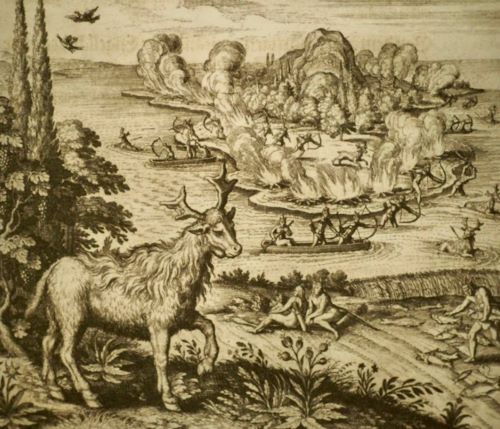
Illustration: Engraving of Mattheüs Merian (1593-1650) depicting Wabanaki hunting on Mount Desert Island from Sir Ferdinando Gorges 1622 “Brief Relation of the Discover and Plantation of New England”
Bibliography:
Bilodeau, C. J. (2013). Creating an Indian Enemy in the Borderlands: King Philip’s War in Maine, 1675-1678. Maine History 47(1): 10-41.
Hancock, J. F. (2025). John Cabot to Henry Hudson: Early European Arrivals in Mid-Atlantic and Northeastern North America. McFarland and Company.
Prins, H. E. L., & McBride, B. (2007). Asticou’s Island Domain: Wabanaki Peoples at Mount Desert Island 1500-2000. Acadia National Park. Ethnography Program. National Park Service.
 Turmoil in Dawnland