The Wabanaki concept of land ownership differed significantly from that of Europeans. The Indigenous people of Dawnland did not believe that people could own land, whereas 16th- and 17th-century European colonists considered owning land to be a God-given right. According to Genesis 1:28:
“God blessed them and said to them, Be fruitful and multiply; fill the earth and subdue it. Rule over the fish in the sea and the birds in the sky and over every creature that moves on the ground.”
To the Wabanaki, the land was a sentient being. It was their mother, a close relation to be cared for and respected. As Ian Saxon (2019) describes:
“In conferences with English leaders, Wabanaki speakers said they “belonged” to rivers or stretches of land. In contrast, early modern English people “belonged” to towns or other human communities rather than the land itself … The Wabanaki} worldview, which recognized they shared the land with animals and other people. As a result, the Wabanaki managed available resources in cooperation with animals and otherworldly beings rather than wielding domination over them, as European Christians believed their God had directed them to do in the book of Genesis. Instead, the Wabanaki lived in what scholars call an “animate” world, in which people, animals, and even some nonliving things had a spirit or force, and they were conscious of sharing a network of relations with humans and others.”
The Wabanaki would find the Europeans’ concept of land confusing. Lisa Brooks(2019) suggests:
“When English people arrived in Wabanaki territory, including the land now known as Maine, Wabanaki leaders worked to incorporate settlers into their social and ecological networks, to create responsible relationships, and to “make kin” and alliances with their guests. English guests all too often misinterpreted such hospitality, misunderstanding the obligations that accompanied the privilege of sharing space. The written language of the English, as compared with wampum protocols and verbal agreements of the Wabanaki, led to confusion and to deliberate dispossession. Even as the Wabanaki people strove to incorporate settlers into their Indigenous cultural and economic systems, the settlers sought their signatures and consent for land ownership on finite political documents.”
Traditional ecological knowledge
Because of their long and intimate association with nature, Wabanaki possessed what has been called “traditional ecological knowledge” (TEK). Their society had acquired a cumulative body of knowledge, practice, and belief that reflected the tight interrelationships among all living beings (including humans) and with their environment. TEK evolved as the Wabanaki adapted to their environs, and the knowledge gained was handed down through generations.
The Wabanaki learned which cultural practices would sustain their communities over the long term. The seasonal cycles of scarcity and abundance that they regularly faced had taught them that overexploitation of the habitat they were part of would result in dire consequences for their own survival.
Brooks and Brooks (2010) describe how the “Wabanaki people developed a matrix of stories, ceremonies, and subsistence practices that enabled long-term survival in the places to which they belonged … [They learned] individual action can have tremendous ramifications for the whole, and therefore individual responsibility to the community, including one’s human and non-human relations, is held in utmost.”
One of the most important roles of the Sagamore was to ensure that resources were distributed equally among the group. “The sachems, generally the most successful providers, acted as redistributive agents. They not only created a surplus but assured its fair division”. The most successful planters, hunters, and fishers were valued for their ability to contribute to the whole; their “skills and hard work were rewarded, not with greater wealth, but with greater responsibility, and respect within one’s family network”.
Sagamores were also responsible for distributing resources between villages through trade. During times of scarcity, warfare could arise if this system failed. Regular ceremonial council meetings helped avoid such instances, “cementing familial relationships and ensuring that resource rights and responsibilities were clearly defined”.
When the English moved into Wabanaki lands, the Wabanaki tried to incorporate them into their reciprocal networks, but the English were rarely cognizant of how they fit into this system. They viewed agreements as giving exclusive title, not sharing relationships. “[English] settlers and fishermen sought to take advantage of the abundant resources of the region, amassing as much fish and wood as possible to ship overseas to transatlantic markets. Conflicts arose when European traders and settlers failed to participate in the local system of distribution, conservation, and “ritualized reciprocal exchange.” Wabanaki people were not interested in capital formation for its own sake. Rather, they recognized economic success in terms of the security it achieved for the community as a whole.” However, this economic value system came into direct conflict with a European system that emphasized accumulation of goods, protection of property and wealth, and the rights of the sovereign, corporation, or individual to amass as much resources as possible for their own use and for distribution overseas …”
The ever-increasing English assertion of sovereignty over the region and its resources would ultimately lead to open warfare in the late seventeenth century,
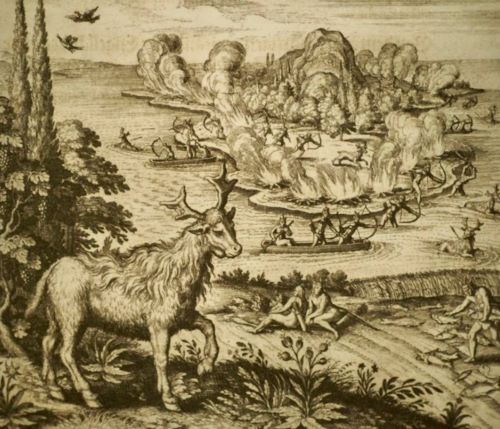
Illustration: Wabanaki Hunting on Mount Desert Island, 1622. Author: Matthäus Merian (1592-1650). Source: Public domain, via Wikimedia Commons.
Bibliography:
Berkes, F. (1999) Sacred ecology: Traditional ecological knowledge and resource management. Taylor & Francis: Philadephia
Brooks, L. (2019-2020). Holding Up the Sky: Wabanaki People, Culture, History, and Art. Maine Memory Network.
Brooks, L. T. and Brooks, C. M. (2010) The Reciprocity Principle and Traditional Ecological Knowledge: Understanding the Significance of Indigenous Protest on the Presumpscot River. International Journal of Critical Indigenous Studies. 3(2):11-28. p. 13.
Saxon, I. (2019). Properties of Empire: Indians, Colonists, and Land Speculators on the New England Frontier. New York University Press, p. 13.
 Turmoil in Dawnland