When the Europeans first arrived in the Gulf of Maine, there were two Wabanaki super chiefs living across the Gulf from each other – the western Etchemin Bashaba, who resided on the Penobscot near Bangor, Maine, and the Souriquois (Mi’kmaq) Membertou, who lived in western Nova Scotia near Port Royal. Bashaba led the Mawooshan Confederacy encompassing a 120-mile stretch of Maine from the Narraguagus River in the northeast to the Mousam River (at Kennebunk). Membertou was the head of the rival Tarentines, an amalgamation of the Souriquois of Nova Scotia and their neighboring eastern Etchemin (Today’s Passamaquoddy and Maliseet) across the Bay of Fundy.
Bashaba
Many early European reports of encounters with Bashaba confirm his eminence over other Wabanaki leaders. Near Bangor, Maine, in 1605, Champaign met with him, another local sagamore named Cabhis, and 30 of their followers. The meeting went smoothly, and strong interests were expressed for cooperation and alliance.
A marvelously detailed description of Mawooshen was written in England in 1605 or 1606 by Ferdinando Gorges, who, with George Popham, hosted five Etchemin that had been abducted from the coast of Maine by George Waymouth. The original document does not exist, but a version entitled “Description of the Country of Mawooshen” was published unattributed in 1623 by Samuel Purchas. In it, Mawooshen is described as covering a series of nine river drainages extending from Mount Desert Island on the east to the Saco River on the west. Along each river are outlined the major villages, the number of men in each, and the most critical sagamores. Overall, 21 villages and 23 sagamores fell under Bashaba’s jurisdiction.
This document was carried to Maine by the settlers of the Popham Colony at Sagadahoc in 1607 to serve as a travel guide. The settlers of this ill-fated colony avoided direct contact with Bashaba, but they had extensive interactions with his son Tahánedo, one of the original abductees of Waymouth. Tahánedo had gotten back to Maine in 1606, serving as a guide for Thomas Hanhan, who explored the rivers and harbors of the Gulf of Maine.
Jesuit missionary Father Pierre Biard met Bashaba near Castine, ME, in November 1611 at a gathering of about 300 Etchemin. In his History of New France, he reported, “The most prominent Sagamore was called Betsabes, a man of great discretion and Prudence.”
Captain John Smith also interacted with Bashaba in 1614 through Tahánedo. In his Voyages to New England, Smith “clearly laid out the bounds of Bashaba’s lands and powers. He described the region from the Penobscot to the Sagadahoc as the land of Bashaba.” (Baker, 2004, p 80).
Membertou
Very soon after the first fur traders arrived in the St. Lawrence River Valley in the 16th century, Membertou was recognized as a powerful representative of the Mi’kmaq. In addition to being sagamore, Membertou was also the autmoin, or spiritual leader. He “was an agent of transition: a leader with the vision and strength of character that enabled him to influence changes. He led by example, accumulating prestige, power, and influence. The Mi’kmaq became a real trading and naval force at sea.”(Sayer, 2024).
Membertou and his followers were among the first to regularly use Basque-style shallops in long-distance travel for trade. In the 1570s, he spent time in France, hosted by the major of Bayonne. When the first French expedition of the Sieur de Monts arrived in Nova Scotia in 1604, Membertou was among the first Indigenous people to greet the settlers, and he played a key role in their survival.
Membertou head of the Tarentines, became embroiled in a bloody dispute with the Mawoosen Confederation of Basaba. In the fall of 1606, a group of Etchemin plundered and killed Panoniac, a Mi’kmaq chief who had served as a guide to Champlain. In revenge, Membertou gathered 400 warriors, attacked the village of Chouacoet, near Saco, Maine, in July 1607, killing twenty people and two sagamos. The crafty Membertou was unarmed when he appeared before the Armouchiquois, feigned the wish to negotiate, and then, as the lawyer, adventurer Lescarbot describes in La Defaite des sauvages, “suddenly he and his men seized the weapons he had set out” and attacked. Many Abenaki chiefs died, whereas Membertou’s party incurred not a single loss. (Béreau, 2020). Bashaba was not part of this battle and survived until 1615 when a group of Tarentines ambushed him.
In 1610, Membertou entered a formal alliance with the French and was the first Indigenous leader to be baptized as a Catholic. Twenty-one members of his family joined in the ceremony. Membertou was given the baptismal name of Henri, after the late king of France.
Membertou died of dysentery later in 1610, supposedly at over one hundred years old, in one of the great epidemics that raced through the Indigenous people of the Northeast.
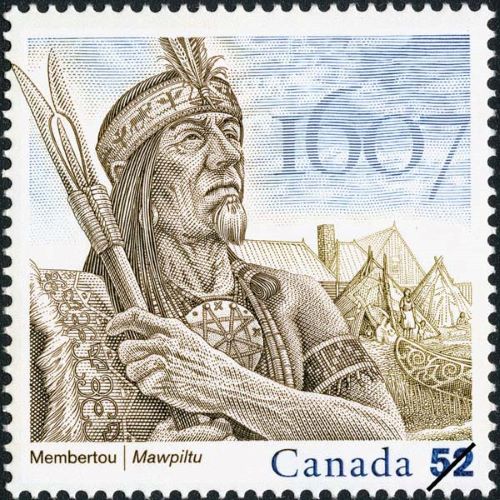
Illustration: Canadian postage stamp of Membertou
Bibliography:
Baker, E. W. (2004) Finding the Almouchiquois: Native American Families, Territories, and Land Sales in Southern Maine. Ethnohistory, 51 (1): 73 – 100.
Béreau, S. (2020). Membertou (baptized Henri). Dictionary of Canadian Biography, Vol. 1, University of Toronto/Universite Laval. http://www.biographi.ca/en/bio/membertou_1E.html.
Grant, W. L. (Ed.) (1907). Voyages of Samuel de Champlain 1604 – 1618. Charles Scribner’s Sons.
Prins, H. E. L., & McBride, B. (2007). Asticou’s Island Domain: Wabanaki Peoples at Mount Desert Island 1500-2000. Acadia National Park. Ethnography Program. National Park Service.
Purchas, S. (Ed.) (1907) The Description of the Country of Mawooshan Discovered by the English in the Yeere 1602. In: Hakluytus, Posthumus, or Purchase his Pilgrims (Glasgow: J. Maclehose 8c Sons), vol. 19, pp. 400-05
Sayer, B. (2024) Messamouet. Historic Nova Scotia. https://historicnovascotia.ca/items/show/189.
 Turmoil in Dawnland