Long before the Europeans appeared on Maine’s shores, the Wabanaki had lived and prospered on its rivers, lakes, and woods for many thousands of years. From generation to generation, their long and rich history was passed down through oral tradition.
The Wabanaki’s worldview was shaped by the many creation stories featuring their mythological ancestor, Gluskap. In these stories, Gluskap taught the Wabanaki how to live in harmony with and respect the land, water, and all living things.
As described by Frank Speck, 1935, p. 10): “Penobscot mythology credits Gluskap with some twenty major achievements for the benefit of man, to wit: distributing over the world the game animals, food, fish, hares and tobacco; renewing the warmth of summer; protecting the eagle above who regulates daylight and darkness; moderating the destructive force of the wind; tempering the winter; bringing he summer north; reducing giant animals to a harmless size; domesticating the dog; clearing obstructions from the portages along the routes of hunting and travel; smoothing out the most dangerous waterfalls; creating the whole Penobscot river system; moderating the power of fire; making burns curable; creating sweetgrass; and serving as a source of power for those who come to his distant dwelling with their troubles. His benefits to mankind reach a climax in the mission he allocates to himself: to watch over his people and return to the land at some unknown date. Against this time, he is preparing food and armaments to save them in a crisis. By inference the Penobscot are also inclined to attribute to him the origin of their arts and inventions.
In these stories, the Wabanaki were reminded of their place in the natural environment and their relationships with the land.
The story of Gluskap’s origin as Klose-kur-beh, “The Man from Nothing,” is beautifully told in Joseph Nicolar’s book, The Life and Traditions of the Red Man. Nicolor was a Penobscot tribal governor and a direct descendant of the great Wabanaki leader Madockawando, who lived in the 1600s, in a time when the Penobscot were still numerous and powerful.
Nicolar (1993, pp. 7- 8) offered this detailed telling of Gluskap’s own mythic beginnings:
“KLOSE-KUR-BEH, “The Man from Nothing,” first called the minds of the “Red Children” to his coming into the world when the world contained no other man, in flesh, but himself. When he opened his eyes lying on his back in the dust, his head toward the rising of the sun and his feet toward the setting of the sun, his right hand pointing to the north and his left hand to the south. Having no strength to move any part of his body, yet the brightness of the day revealed to him all the glories of the whole world; the sun was at its highest, standing still, and beside it was the moon without motion, and the stars were in their fixed places, while the firmament was in its beautiful blue.
While yet his eyes were held fast in their sockets, he saw all that the world contained. Besides what the region of the air revealed to him, he saw the land, the sea, mountains, lakes, rivers, and the motion of the waters, and in it he saw the fishes. On the land were the animals and beasts, and in the air the birds. In the direction of the rising sun, he saw the night approaching. While the body clung to the dust, he was without mind, and the flesh without feeling. At that moment the heavens were lit up, with all kinds of bright colors most beautiful, each color stood by itself, and in another moment every color shot a streak into the other, and soon all the colors intermingled, forming a beautiful brightness in the center of the heavens over the front of his face. Nearer and nearer came the brightness toward his body until it got almost to a touching distance, and a feeling came into his flesh; he felt the warmth of the approaching brightness, and he fell into a deep sleep. The wind of the heavens fanned his brow, and the sense of seeing returned unto him, but he saw not the brightness he beheld before, but instead of the brightness, a person like unto himself, standing at his right hand, and the person’s face was toward the rising of the sun …
Immediately after the passing of the lightning over his body, a sense of thought came unto him. The first thought that came unto him was, that he believed the person was able to bring strength unto him, and the “Great Being” answered his thought saying these words: “Thou doest well believing in me, I am the head of all that thou beholdest, and as thou believest, arise from thy bed of dust, and stand on thy feet, let the dust be under thy feet, and as thou believest, thou shalt have strength to walk.” Immediately strength came unto him, and he arose to his feet, and stood beside the “Great Being”…
Then, by command of the “Great being, Klose-kur-beh began a journey to search out companions and make the world right and good, traveling with the knowledge that: the world was all spiritual, that there was a living spirit in all things, and the spirit of all things has power overall, and as the spirit of all things center in Him, he was the Great Spirit, by His will, all things move, all power comes from Him; and he – “Klose-kur-beh” must teach the people that there is but one great spirit” (Nicolar, 1893, p. 14).
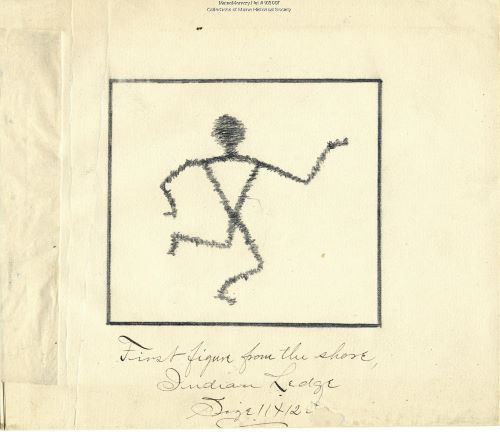
Illustration: A 900- to 1200-year-old drawing of Gluskap, found on the banks of the Kennebec River near Embden, Maine. E.W. Moore made the drawing in 1894, one of five in a bound sketchbook>
Bibliography:
Nicolar, J. (1893) The Life and Traditions of the Red Man. C. H. Glass & Co., Printers, Bangor Maine.,
Prins, H. E. L. (1994). “Children of Gluskap: Wabanaki Indians on the Eve of the European Invasion.” In American Beginnings: Exploration, Culture and Cartography in the Land of Norumbega, pp.165- 211. E.Baker, et al, eds. Lincoln: U. Nebraska Press.
Speck, F. (1935) Penobscot Tales and Religious Beliefs. The Journal of American Folklore 48(187): 1-107.
 Turmoil in Dawnland