Gluskap was the mythical creator and teacher of the Wabanaki people. A number of his legends were recorded in books by Charles G. Leland (1884) and Louis Spence (1927). Below are a few samples.
How Gluskap Made Elves, Fairies, Man, and Beasts (Leland, 1884).
Gluskap came first of all into this country, into Nova Scotia, Maine, Canada, into the land of the Wabanaki, next to sunrise. There were no Indians here then (only wild Indians very far to the west) …
And in this way, he made Man: He took his bow and arrows and shot at trees, the basket-trees, the Ash. Then the Indians came out of the bark of the Ash trees…
Gluskap made all the animals. He made them at first very large. Then he said to Moose, the great Moose who was as tall as Ketawkqu’s, [a giant] “What would you do should you see an Indian coming?” Moose replied, “I would tear down the trees on him.” Then Gluskap saw that the Moose was too strong, and made him smaller, so that Indians could kill him.
Then he said to the Squirrel, who was of the size of a Wolf, “What would you do if you should meet an Indian?” And the Squirrel answered, “I would scratch down trees on him.” Then Gluskap said, “You also are too strong,’ and he made him little.
Then he asked the great White Bear what he would do if he met an Indian; and the Bear said, “Eat him.” And the Master bade him go and live among rocks and ice, where he would see no Indians.
So he questioned all the beasts, changing their size or allotting their lives according to their answers…
Gluskap’s Great Deeds: How He Named the Animals & His Family (Leland, 1884).
Before men were instructed by him, they lived in darkness; it was so dark that they could not even see to slay their enemies. Gluskap taught them how to hunt, and to build huts and canoes and weirs for fish. Before he came, they knew not how to make weapons or nets. He the Great Master showed them the hidden virtues of plants, roots, and barks, and pointed out to them such vegetables as might be used for food, as well as what kinds of animals, birds, and fish were to be eaten. And when this was done, he taught them the names of all the stars. He loved mankind, and wherever he might be in the wilderness he was never very far from any of the Indians. He dwelt in a lonely land, but whenever they sought him, they found him. He traveled far and wide: there is no place in all the land of the Wabanaki where he left not his name; hills, rocks and rivers, lakes and islands, bear witness to him …
Gluskap’s Gifts (Spence, 1927).
Four Indians who went to Gluskap’s abode found it a place of magical delights; a land fairer than the mind could conceive. Asked by the god what had brought them thither, one replied that his heart was evil and that anger had made him its slave, but that he wished to be meek and pious. The second, a poor man, desired to be rich, and the third, who was of low estate and despised by the folk of his tribe, wished to be universally honored and respected. The fourth was a vain man, conscious of his good looks, whose appearance was eloquent of conceit. Although he was tall, he had stuffed fur into his moccasins to make him appear still taller, and his wish was that he might become bigger than any man in his tribe and that he might live for ages.
Gluskap drew four small boxes from his medicine bag and gave one to each, instructing them not to open them until they reached home. When the first three arrived at their respective lodges, each opened his box, and found therein an unguent of great fragrance and richness, with which he rubbed himself.
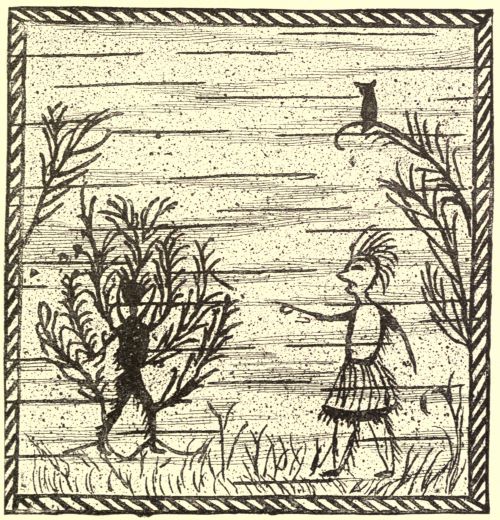
The wicked man became meek and patient, the poor man speedily grew wealthy,and the despised man became stately and respected. But the conceited man had stopped on his way home in a clearing in the woods and, taking out his box, had anointed himself with the ointment it contained. His wish was also granted, but not exactly in the manner he expected, for he was changed into a pine tree, the first of the species, and the tallest tree of the forest at that.
Gluskap and the Baby (Spence, 1927).
Gluskap, having conquered the Kewawkqu, a race of giants and magicians, and the Medecolin, who were cunning sorcerers, and Pamola, a wicked spirit of the night, besides hosts of fiends, goblins, cannibals, and witches, felt himself great. Indeed, and boasted to a certain woman that there was nothing left for him to subdue.
But the woman laughed and said: “Are you quite sure, Master? There is still one who remains unconquered, and nothing can overcome him.” In some surprise, Gluskap inquired the name this mighty individual. “He is called Wasis,” replied the woman, “but I strongly advise you to have no dealings with him.”
Wasis was only the baby, who sat on the floor sucking a piece of maple sugar and crooning a little song to himself. Now, Gluskap had never married and was quite ignorant of how children are managed, but with perfect confidence, he smiled to the baby and asked it to come to him. The baby smiled back to him, but never moved, whereupon Gluskap imitated the beautiful song of a certain bird. Wasis, however, paid no heed to him, but went on sucking his maple sugar. Gluskap, unaccustomed to such treatment, lashed himself into a furious rage and, in terrible and threatening accents, ordered Wasis to come crawling to him at once.
But Wasis burst into dreadful howling, which quite drowned out the god’s thunderous accents and, for all the threatenings of the deity, he would not budge. Gluskap, now thoroughly aroused, brought all his magical resources to his aid. He recited the most terrible spells, the most dreadful incantations. He sang the songs which raise the dead, and which sent the devil scurrying to the nethermost depths of the pit.
But Wasis evidently seemed to think this was all some sort of a game, for he merely smiled wearily and looked a trifle bored. At last, Gluskap, in despair, rushed from the hut, while Wasis, sitting on the floor … crowed triumphantly.
Illustration. Gluskap turns a man into a cedar tree. Scraping on birchbark by Tomah Joseph (1884).
Bibliography.
Leland, C. G. (1884) The Algonquin legends of England or myths and folklore of the Micmac, Passamaquoddy, and Penobscot Tribes. Sampson Low, Marston, Searle & Rivington.
Spense, L. (1927). Myths of the North American Indians. George G. Harrap.
 Turmoil in Dawnland